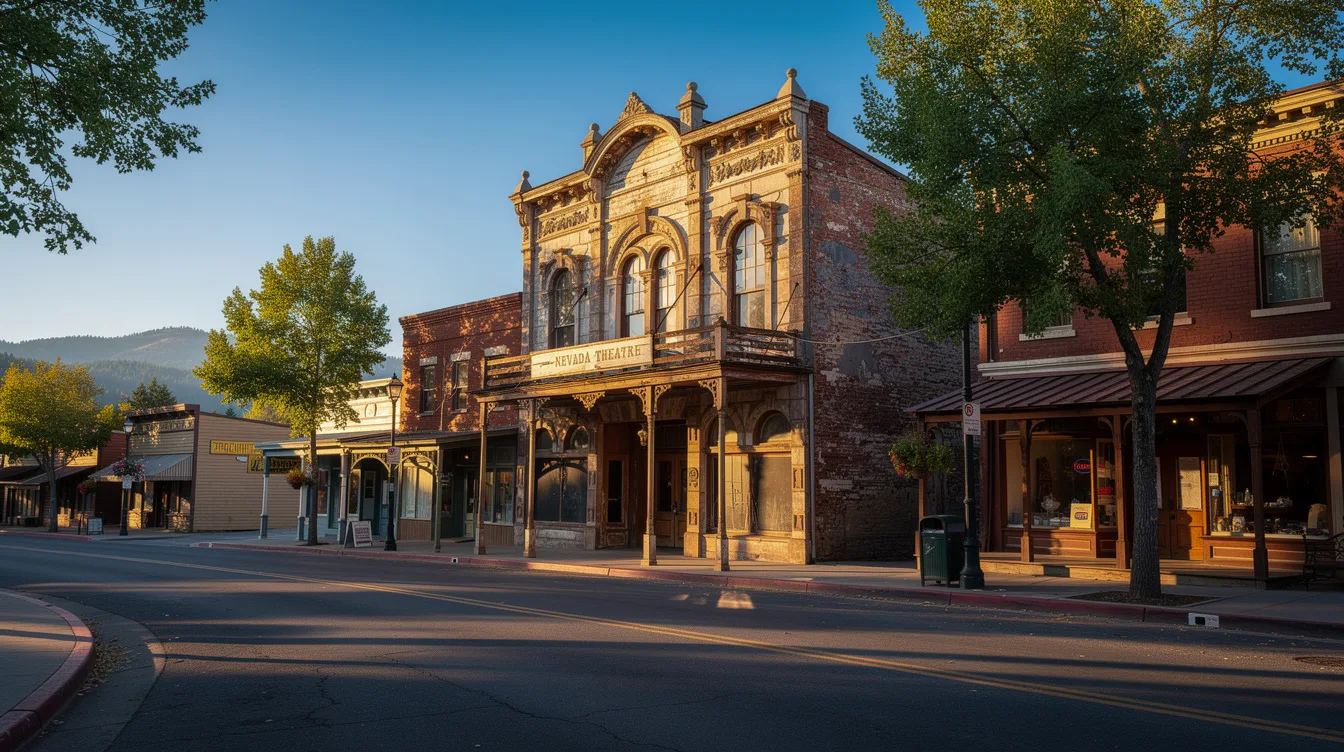
Nevada City has California’s oldest operating theater, and the date is unexpectedly early. The Nevada Theatre was built in 1865, when the town was still shaped by the Gold Rush. It’s presented as the oldest theater in California that remains in operation.
And that fact gives this small Sierra Nevada town more weight than its size suggests. At roughly 3,172 residents, Nevada City feels intimate, but its history reaches well beyond its quiet streets.
The theater arrived soon after the Gold Rush
Nevada City began as a mining camp in 1849, during California’s Gold Rush. Sixteen years later, the Nevada Theatre appeared in a town whose identity was already tied to movement, money, and hard-earned entertainment.
But the theater isn’t the only reason to come. The preserved downtown has Victorian façades, independent shops, restaurants, galleries, and historic hotels, so you can spend an afternoon walking without needing a packed itinerary.
And I’d take that unhurried pace seriously. The National Historic Landmark district feels more convincing when you slow down and let the old storefronts do the talking.
A small town with two easy directions
Nevada City sits about 60.3 miles northeast of Sacramento and 83.9 miles southwest of Reno. That makes it a practical detour from two larger western cities, though the town itself feels far removed from urban momentum.
But California State Route 49 runs through town, keeping the approach straightforward. You’ll reach Nevada County by road, then trade highway pace for wooded streets and a compact center where the Gold Country history stays visible.
And the town’s elevation, about 2,477 feet, helps explain the change in atmosphere. The air feels cooler than the valley below.
Spring is when the gardens change the mood
Spring is the strongest season for a visit, especially if you add Crystal Hermitage Gardens to your plans. The gardens are known for spring blooms, including thousands of tulips, which bring color to a town better known for stone and Gold Rush history.
And that contrast is the appeal. You can spend the morning among old buildings, then find yourself surrounded by flowers and open air, with the town’s artistic side coming forward.
But spring doesn’t turn Nevada City into a polished resort. It remains a small place with a local rhythm, so you should expect a slower visit and plan your stops around what genuinely interests you.
Stay for the river, not just the theater
The South Yuba River gives the area a second reason to stay. It’s associated with swimming, hiking, fishing, kayaking, and wild river scenery, bringing a physical edge to a town that could otherwise become a purely architectural stop.
And you can use Nevada City as a base for one to three nights. From there, the wider region points toward Grass Valley, Auburn, the Tahoe National Forest, and the former mining territory around the Sierra foothills.
But the river comes with a practical limit: the notes describe activities, not conditions on any particular day. Check local access information before entering the water, and don’t treat a scenic setting as a guarantee of easy swimming.
Why Nevada City works for a short stay
Nevada City suits travelers who want history without a major-city schedule. Music, local theater, film festivals, markets, vineyards, hiking, and cycling all appear in the town’s tourism mix, but none of them overwhelms the compact center.
And the best day here probably has some empty space in it. Walk downtown, visit the Nevada County Narrow Gauge Railroad Museum, then follow your curiosity toward the river or a nearby garden.
But housing costs and wildfire risk are part of the town’s present reality. The median home value was estimated at $677,400 in 2024, and recent fires in the area have caused destruction and evacuations.
That tension makes Nevada City more interesting, not less. It’s historic, artistic, and close to nature, but it’s also a living California town with real pressures beyond its preserved façades.
By evening, the old downtown settles into a quieter register. The theater’s 1865 date stays with you, while the last light rests on Victorian windows above the wooded streets.