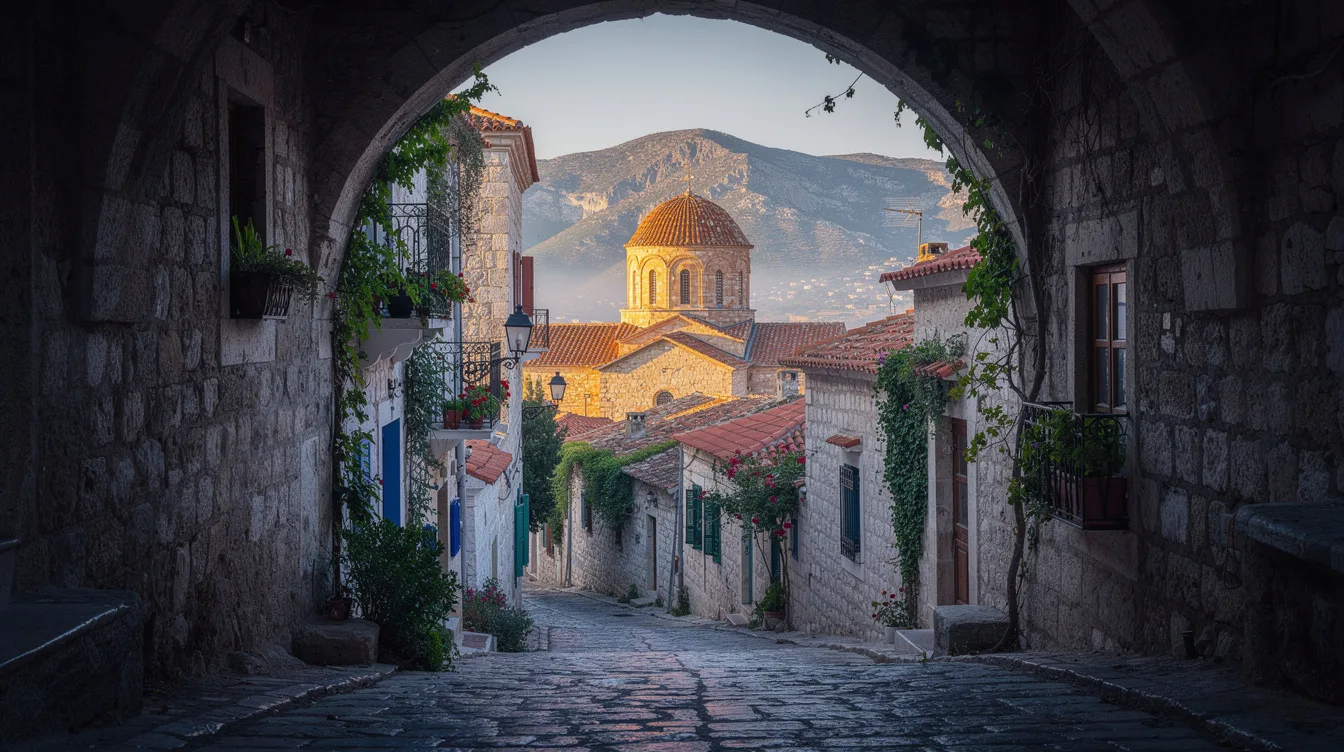
Mesta is a medieval fortress village on Chios where narrow lanes stay covered, even under the sharp afternoon sun. It sits 21.7 miles from Chios Town, about 35 minutes by car, so you can reach its stone passages before dinner and still return to Chios the same day.
And this is the kind of place that changes your pace immediately. The village’s houses form a defensive outer wall, while the interior opens into a dense maze of shadowed walkways. But Mesta feels lived-in rather than staged, with a central square where you can stop for coffee and watch the day settle.
Why Mesta feels different from the rest of Chios
And Mesta was built as a fortress people could live inside, not as a postcard village arranged around a view. Its stone façades sit tightly together, creating an almost continuous enclosure that once made entry difficult.
But the protection comes with a practical pleasure today: the center is largely pedestrian. Park at the entrance, then let the lanes lead you past low arches, rough stone walls, and corners that seem to narrow just as you reach them.
The village belongs to the Mastichochoria, the southern Chios communities shaped by mastic production. This aromatic resin from the island’s lentisk trees remains central to local food and commerce, and the tradition is listed on UNESCO’s intangible cultural heritage register.
Covered lanes, old churches, and one useful wrong turn
And the best way to see Mesta is to resist a strict route. Start at Porta tou Kapetanio, one of the historic entrances, then walk without trying to decode every turn.
But don’t expect broad streets or open sightlines. The passages are tight and often covered, which keeps the experience cool in the late afternoon while making the village feel more secretive than spacious. You’ll hear your own footsteps before you notice the next square.
At the center, look for Megalos Taxiarchis, the large church built on the site of the former central tower. Palaios Taxiarchis is also worth seeking out for its carved iconostasis, a detail that rewards a slower look.
Can you explore Mesta without a car?
And you can explore the village itself entirely on foot once you arrive. The bus exists, but frequencies may be limited, so a rental car is the practical choice if you want to connect Mesta with other southern villages.
But you don’t need a packed schedule here. Give yourself time to wander, pause in the square, and follow the stone lanes until they return you to a familiar entrance. The village is compact, though its layout makes a short visit feel longer.
How to plan the visit from Chios Town
And the drive from Chios Town takes about 35 minutes under normal conditions. Mesta is inland in southwestern Chios, while the port of Limenas Mesta makes it easy to pair the village with time beside the water.
Visit in the late afternoon, when the heat drops and the light softens across the stone. But don’t arrive expecting a full day of attractions. Mesta works best as an evening excursion, or as one night in a traditional stone room.
After walking the fortress village, continue toward Limenas Mesta for fish tavernas and the sea. You can also combine the stop with Pyrgi, another mastic village known for geometric patterns on its façades.
Where should you stay?
And staying inside Mesta makes sense if you want the lanes before breakfast or after the day visitors leave. Traditional stone accommodations offer a quieter experience, with rooms and apartments spread through the historic center.
But this isn’t the right base if your priority is constant beach time or nightlife. Mesta gives you architecture, food, and atmosphere instead. The trade-off is exactly its appeal: evenings are calm, and the village doesn’t try to entertain you every minute.
The mastic story is part of the visit
And you’ll notice mastic beyond the fields and local history. Shops sell mastic liqueur, chewing gum, pastries, cosmetics, and other products built around the resin.
But the village’s strongest impression comes from the way that tradition fits the setting. Stone walls hold the shade, narrow lanes turn the breeze into a soft current, and the scent of dinner eventually pulls you toward the square.
Mesta isn’t a beach destination, and it won’t fill a week by itself. It is a superb evening stop or a one-night stay, especially if you want southern Chios to feel older, quieter, and more solid underfoot.
By the time you leave, the covered lanes have cooled and the square has emptied. The last light rests on the stone near the village entrance, while Limenas Mesta waits a short drive away.