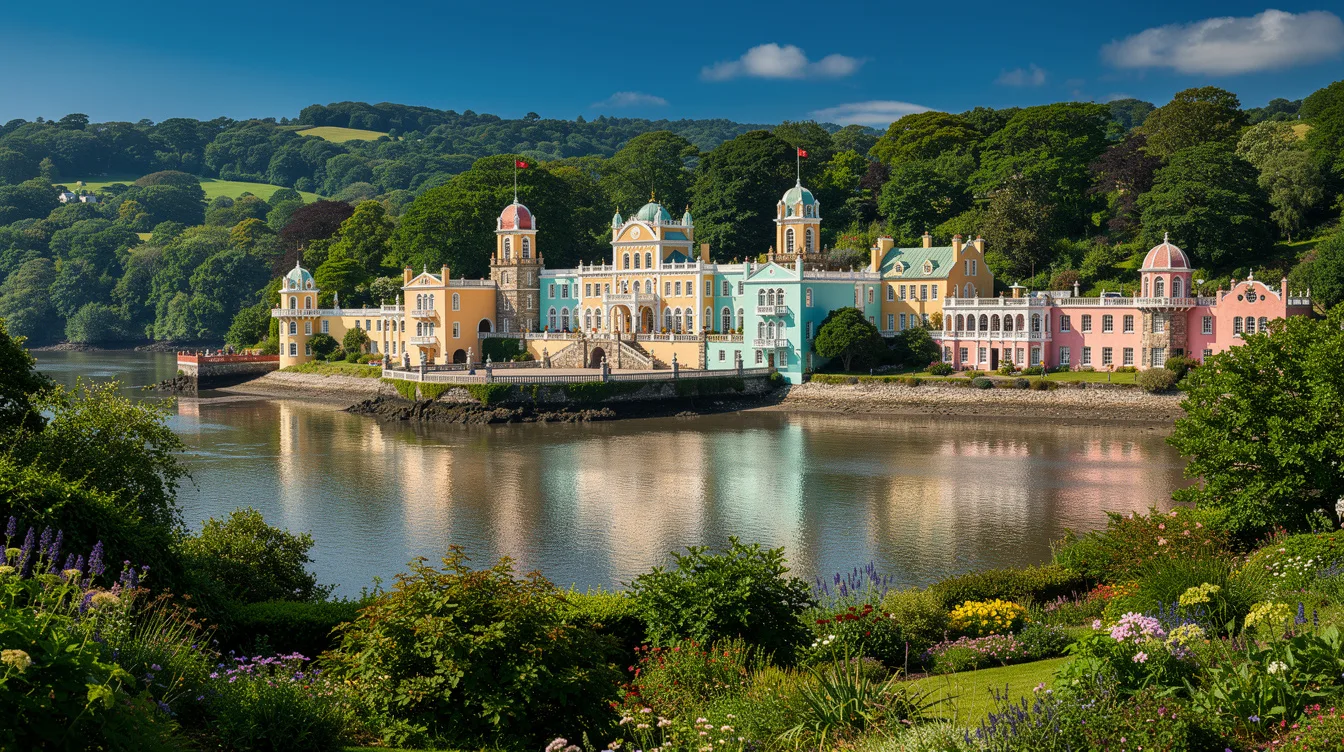
Overlooked by Wales crowds, Portmeirion is an Italian-inspired tourist village where The Prisoner filmed “The Village” in 1966-1967. It sits on the River Dwyryd estuary in Gwynedd, 2 miles from Porthmadog. If you know the cult series, the colorful facades look less like decoration than a trap.
But the setting is real, and that contrast gives Portmeirion its strange pull. The village feels playful in daylight, while the water and wooded grounds add a quieter edge. And because many filming locations remain virtually unchanged after more than 50 years, you can still recognize the place without needing a guide.
Fans continue to visit for the series, which became a cult classic after its television run. And the village hosts annual Prisoner fan conventions, so the connection isn’t a faded footnote. My opinion is simple: the show makes Portmeirion more interesting, but the architecture keeps you there.
The Prisoner turned architecture into a character
The production used Portmeirion’s exteriors as “The Village,” where a retired intelligence agent was held and questioned in pleasant surroundings. But the location stayed unidentified on screen until the final episode’s credits, at the architect’s request. That secrecy made the cheerful setting feel even more unsettling.
And the details still reward close attention. The building used as the lead character’s home is now a Prisoner-themed souvenir shop, while a large outdoor chessboard was installed in 2016 as a tribute. If you have watched the series, you’ll notice how little the place needs to change to feel theatrical again.
That is why I wouldn’t rush through the village for photographs alone. Walk slowly, look above the doorways, and listen to the wind moving in from the estuary. But remember the trade-off: Portmeirion is a working visitor attraction, not a preserved television set open only to fans.
1925-1975: an Italian idea built in Wales
Portmeirion was designed and built between 1925-1975 in a Baroque style. The architect wanted to evoke the atmosphere of the Mediterranean, although he denied that the village simply copied Portofino. And that distinction matters, because the result feels more like an imaginative stage than a faithful Italian replica.
The design also draws on fragments from demolished buildings and work by other architects. Many structures are listed for their architectural and historical importance, including Portmeirion Town Hall. You can see the deliberate mix most clearly where formal details meet bright paint and unexpectedly theatrical shapes.
Beyond the buildings, Y Gwyllt forms the village’s wild garden. It reaches toward the coast and the Dwyryd estuary, with rhododendrons, camellias, and other exotic plants. And its seaside position keeps the grounds frost-free, which helps explain why the gardens feel surprisingly lush beside the Welsh water.
The gardens hold a Grade II* designation on the Welsh register of parks and gardens of special historic interest. But you don’t need to know the listing system to appreciate the change in mood. I prefer this quieter side of Portmeirion, where paths replace painted facades and the air smells of wet leaves.
Getting there is simple, but the map matters
Portmeirion lies 2 miles from Porthmadog and one mile from Minffordd railway station. If you arrive by train, a footpath follows the driveway toward the village. And because the distance is short, Portmeirion is remote in feeling without being difficult to reach.
From Minffordd, the route passes Castell Deudraeth and continues along the field called Cae Mawr below the castell. You should check the approach before setting out, since a short distance can still feel different on foot than it does on a map. But the walk gives you a gradual arrival rather than an abrupt entrance.
Day visits are available with an admission charge, and the site also operates as a hotel and resort. Rooms, self-catering cottages, shops, a cafe, a tea-room, and a restaurant make the village feel active beyond filming history. That said, it isn’t a free public street, so plan for a proper visit rather than a quick detour.
Look beyond the painted facades
Portmeirion can be read through four areas: the village, the gardens, the estuary, and Amis Reunis. You can spend your time among the domes and arcades, then turn toward open water when the architecture starts to feel almost too arranged. And that change is the real reason to stay longer.
The hotel and cottages occupy much of the village, while the shops and dining rooms keep the place from becoming a silent museum. But its charm depends on accepting the artifice. Nothing here pretends to be an ordinary Welsh town, and that is exactly why the setting works so well on camera.
If you visit only for The Prisoner, you’ll leave with the central image intact: a bright village that never feels entirely welcoming. If you explore the grounds, you’ll find a broader idea, part garden, part resort, part architectural experiment. By the estuary, painted walls give way to water, wind, and the last sound of footsteps.