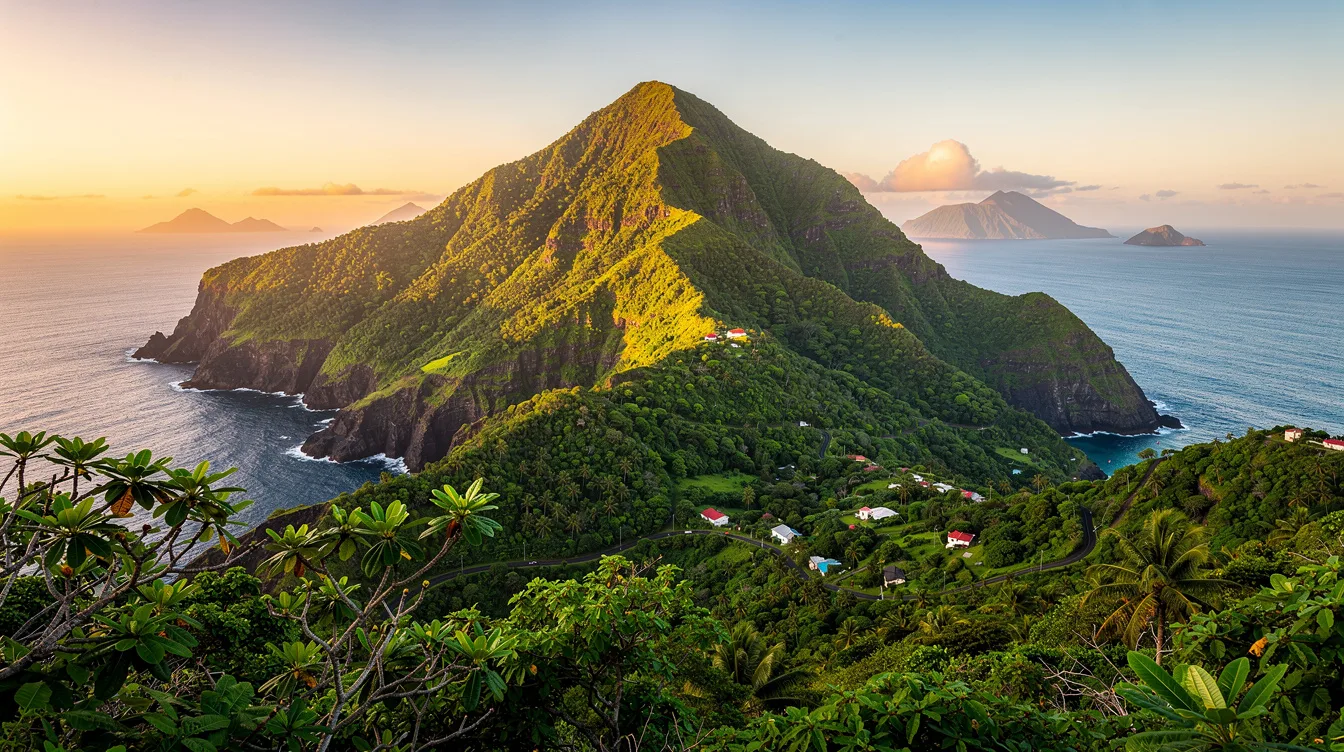
On Saba, a small island in the Caribbean Netherlands, the summit reaches 2,910 feet. That makes Mount Scenery the highest point anywhere in the Kingdom of the Netherlands, a surprising distinction for an island covering about 5 square miles.
And the mountain isn’t a distant backdrop. It rises above a compact, volcanic island where steep slopes shape almost every arrival, walk, and view. You come for the summit, but you’ll quickly notice the larger appeal: Saba feels quiet because its geography leaves little room for mass tourism.
Mount Scenery changes what a Caribbean island feels like
But Saba doesn’t fit the usual beach-island script. There are no broad sandy beaches or mega-resorts, so the day naturally turns toward walking, diving, and looking out across the sea.
And the climb to Mount Scenery gives the island its central challenge. The route leads toward the summit through steep, green terrain, with the air changing as you gain height. The climb is the point, though it isn’t a casual stroll for every traveler.
The island’s main villages include The Bottom, Windwardside, St. John’s, and Zion’s Hill, also known as Hell’s Gate. From there, roads and paths connect a small community of about 2,000 residents, where English is widely used and the US dollar is the local currency.
Getting there takes planning, but not a major expedition
And most visitors begin in Sint Maarten or Saint-Martin. A regional plane reaches Saba in about 12 minutes, while the ferry usually takes around 90 minutes, depending on the operator and sea conditions.
Can you reach Saba without flying?
Yes, you can take the ferry, but the crossing gives weather and water a larger say in your plans. The small aircraft is faster, while the boat lets you approach the island at sea level before the cliffs rise ahead.
But Saba doesn’t have a conventional international connection for large commercial aircraft. Juancho E. Yrausquin Airport has an extremely short runway designed for small turboprop planes, so the arrival feels more specialized than routine.
On a practical note, build flexibility into your schedule. The island is easy to reach from Sint Maarten in distance, but its connections are limited enough that a missed departure can reshape the day.
The best reason to stay is the water below the cliffs
And the island’s appeal doesn’t end at the summit. The Saba Marine Park surrounds underwater volcanic terrain that attracts divers and snorkelers, giving visitors another way to read the island’s steep geography.
You won’t find a long strip of loungers waiting at the shore. Instead, the coast drops toward clear Caribbean water, and the experience feels more active than a standard resort afternoon. That’s a fair trade if you prefer fins and a mask to a crowded beach.
But the small scale matters. Saba has few large hotels, no mega-resorts, and a quieter visitor rhythm than Saint-Martin or Curaçao. You can spend the morning in the water, then hear the island settle into its slower pace by evening.
What Saba is, and what it isn’t
And legally, Saba is part of the Netherlands, though it isn’t one of the kingdom’s autonomous Caribbean countries. It is a special public entity, grouped with Bonaire and Saint Eustatius outside any Dutch province.
That distinction matters because the island’s identity is easy to misread from a map. Saba is Dutch in administration, Caribbean in setting, and English-speaking in much of daily life. The result feels unusual, but never confusing once you arrive.
There is a limit to its appeal. If your ideal trip means a wide beach, nonstop flights, and a resort that handles every detail, Saba will ask too much of you. If you want a mountain climb and a marine park within a very small island, it makes a strong case.
Plan for a place that rewards a slower arrival
And you should treat Saba as a nature and diving escape from Saint Martin rather than a conventional beach holiday. Start with the summit, leave room for the water, and accept that transport follows island conditions.
But that’s precisely why the island stays memorable. The runway disappears behind you, the ferry wake fades below the cliffs, and Mount Scenery rises to 2,910 feet above the Caribbean.