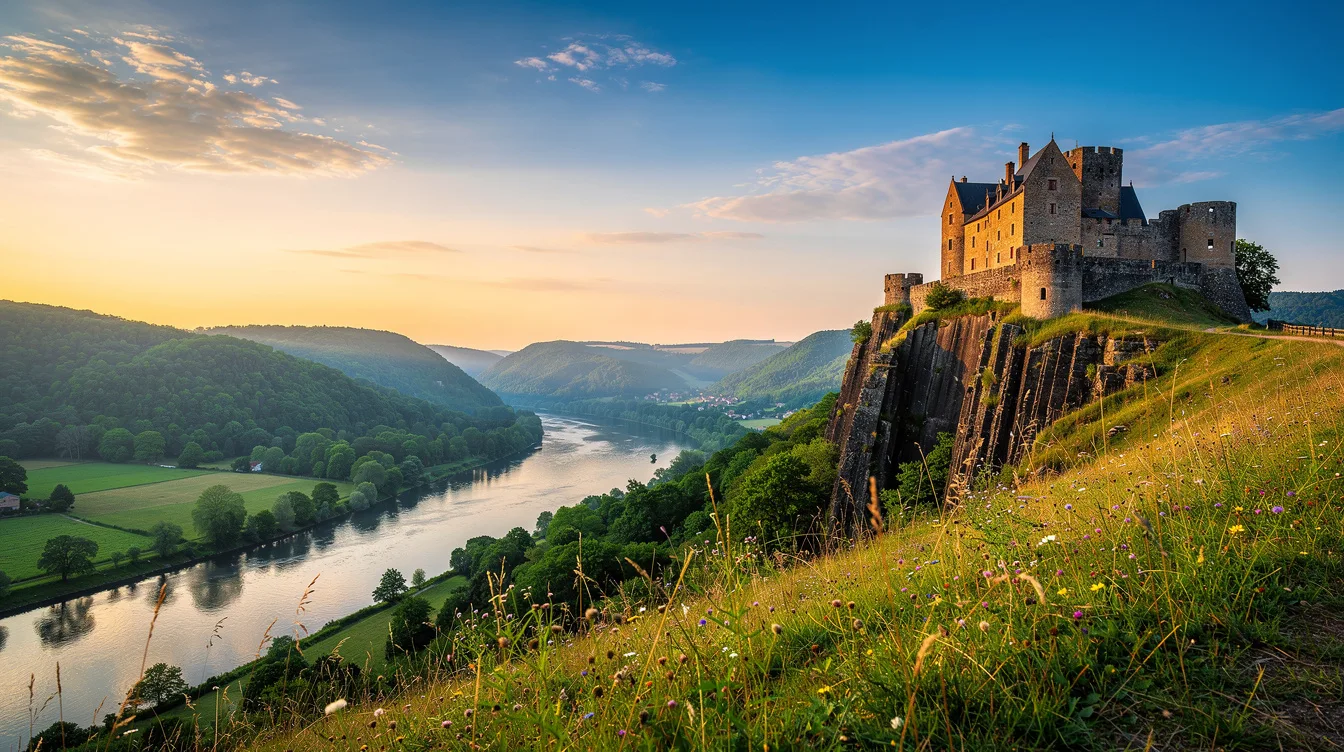
Arlempdes first appears in written records in 1267, perched above a volcanic crag in southern Haute-Loire. The ruins sit on a basaltic spur over a bend in the young Loire, which is why the site is often called the first castle of the Loire.
And that claim feels believable once you reach the old village. The rock does much of the defensive work, while the river curves below like a silver thread. You come for the date, but the view is what keeps you there.
1267 explains why this ruined castle matters
The first written mention dates to 1267, but the site feels older than its paperwork. Remparts, towers, ruined living quarters, and the Saint-Jacques chapel still follow the shape of the volcanic rock.
But Arlempdes was more than a dramatic lookout. It once controlled a strategic passage between the Velay and Vivarais, so its position mattered as much as its walls. I prefer this kind of ruin because the geography explains the history before any sign does.
And the castle is often presented as the first castle of the Loire. You can test that description from the viewpoint, where the young river bends through the high volcanic plateaus below.
A chapel and a village fill in the missing centuries
The oldest parts of Saint-Jacques chapel reach back to the 12th century. Its presence gives the ruins a human scale, especially after the fortress walls begin to feel stark and exposed.
But the chapel isn’t the only older structure worth your time. Saint-Pierre church is a Romanesque building with a single nave, and the village also keeps an old postern and a carved cross from the 15th century.
And the village itself deserves a slow turn before you enter the castle. Dark stone houses, local roofs, and narrow lanes make the former fortified settlement easy to read. You won’t need a packed schedule here, which is part of its appeal.
The volcanic crag does most of the storytelling
From the castle, the Loire appears close to its sources, looping beneath the promontory. The rock rises from the surrounding high plateaus, so the view has a severe edge rather than a soft pastoral one.
But don’t expect a polished palace or a fully restored interior. You get broken walls, open sky, and the sound of wind moving across the stone. That limitation is honest, and it makes the setting more convincing.
And if you like places where terrain and history lock together, this is the strongest reason to visit. The crag became part of the fortress, while the river below explains the choice of location. My advice is to pause before photographing anything.
Can you visit Arlempdes in 2026?
Yes. The castle is announced open from March 21 through mid-October 2026, except Mondays. Tickets are available at Le Manoir, the bar-restaurant in the village, so you can sort out entry before walking toward the ruins.
But check the day before you go, especially if Monday is your only available morning. The address is Le Bourg, 43490 Arlempdes, in southern Haute-Loire near Le Puy-en-Velay.
And you should plan for about 1 to 1.5 hours for the village, church, and castle. You can stay longer to walk around the river bend and watch the light change on the promontory.
Make it a measured stop, not a rushed photo break
Arlempdes works well on an itinerary through Le Puy-en-Velay, the Loire gorges, Pradelles, and the Ardèche plateau. The village is remote in feeling, but the visit itself is straightforward once you arrive.
But there is a trade-off: the site won’t fill an entire day unless you linger over the river views and surrounding lanes. That suits travelers who’d rather have one powerful hour than a crowded list of attractions.
And by late afternoon, the stone takes on a warmer tone above the dark curve of the Loire. You leave with wind in your ears and the volcanic crag still hanging over the river.