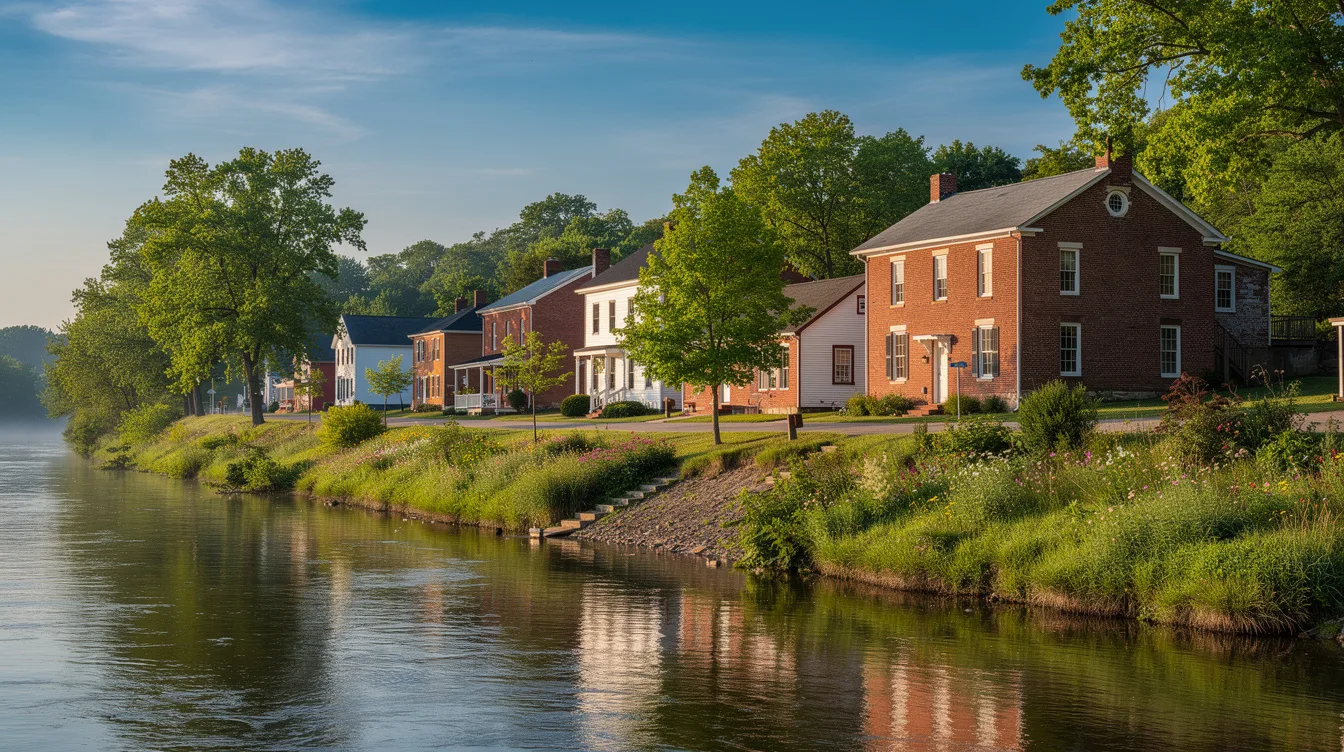
In Indiana, New Harmony brought utopian living back in 1825, after an earlier experiment had already shaped the town. The result wasn’t a neat success story. It was a short, ambitious attempt to rethink work, education, religion, and community on the Wabash River.
And that’s why this small southwestern Indiana town still feels unusual. At the 2020 census, only 690 residents lived here, yet its history reaches far beyond its size. You come for the quiet streets, but you stay with questions about how people might live together.
Two experiments changed one Indiana town
New Harmony’s first community began in 1814, when a German religious group established Harmony. Its members organized daily life around shared work, strict religious principles, and celibacy. The community became prosperous, which makes the next chapter even more striking.
And in 1825, a Welsh industrialist and social reformer bought the town and renamed it New Harmony. He wanted a more equal cooperative society built around education, science, and collective work. The experiment soon failed as an economic and political project, but its ideas traveled much farther than its residents did.
That tension gives New Harmony’s history its edge. One community relied on religious discipline, while the next tried to test social reform. Both believed daily life could be deliberately redesigned.
Why the 1825 experiment still matters
The second community’s influence survived its short lifespan. It supported broader access to education for girls and boys, along with early schooling for young children. And its free public library reflected a belief that learning shouldn’t stay inside private homes or elite institutions.
New Harmony also became associated with natural science and geology in the United States. That legacy feels larger than the town itself, which is exactly the point. A place can fail as a practical experiment and still succeed as an intellectual provocation.
But don’t expect a preserved utopia waiting behind one gate. The town is better understood as a collection of surviving buildings, ideas, and carefully maintained spaces. You won’t find a single grand answer here, only evidence of people trying to build one.
The Wabash setting keeps the visit grounded
New Harmony sits on the Wabash River in southwestern Indiana, near the Illinois border. It’s about 28 miles northwest of Evansville, close enough for a focused outing but distant enough to feel removed from city routines.
And the river gives the town a slower rhythm. Water, old buildings, and quiet streets make the history easier to imagine, even when the original plans have disappeared. The setting is calm, but the ideas attached to it were anything but modest.
Because the town is small, you can take in its historic district without rushing between distant attractions. On a practical note, don’t arrive expecting a large urban destination. New Harmony rewards a patient walk and a willingness to read the place in fragments.
What should you see first?
Can you start with the Atheneum?
Yes. The Atheneum/Visitors Center is the logical starting point, with exhibits, a model, and a film about the two founding communities. Its modern design creates a useful contrast with the restored buildings beyond it.
And that contrast helps you understand the town quickly. The visitor center frames the story, while the streets make it physical. You can move from an explanation of communal life to the quieter evidence left in homes and public spaces.
The historic district is listed on the National Register of Historic Places. But its value isn’t only architectural. The buildings connect the religious community of 1814 with the reform-minded experiment that arrived in 1825.
Can you still find the utopian impulse?
Look for the Labyrinth, a historic garden associated with the earlier community, then continue toward restored homes from both periods. And make time for the town’s educational and scientific legacy, because that is where New Harmony becomes more than a collection of old structures.
The town also includes a park connected to a theologian who is buried there. That detail adds another layer to a place already shaped by belief, reform, and public thought. New Harmony is quiet, but it has never been intellectually empty.
That said, the limits are part of the appeal. You won’t find a packed itinerary or a polished spectacle. You’ll find a small Indiana town where the river runs past old ambitions, and where the last light settles over the Wabash after the arguments are long finished.