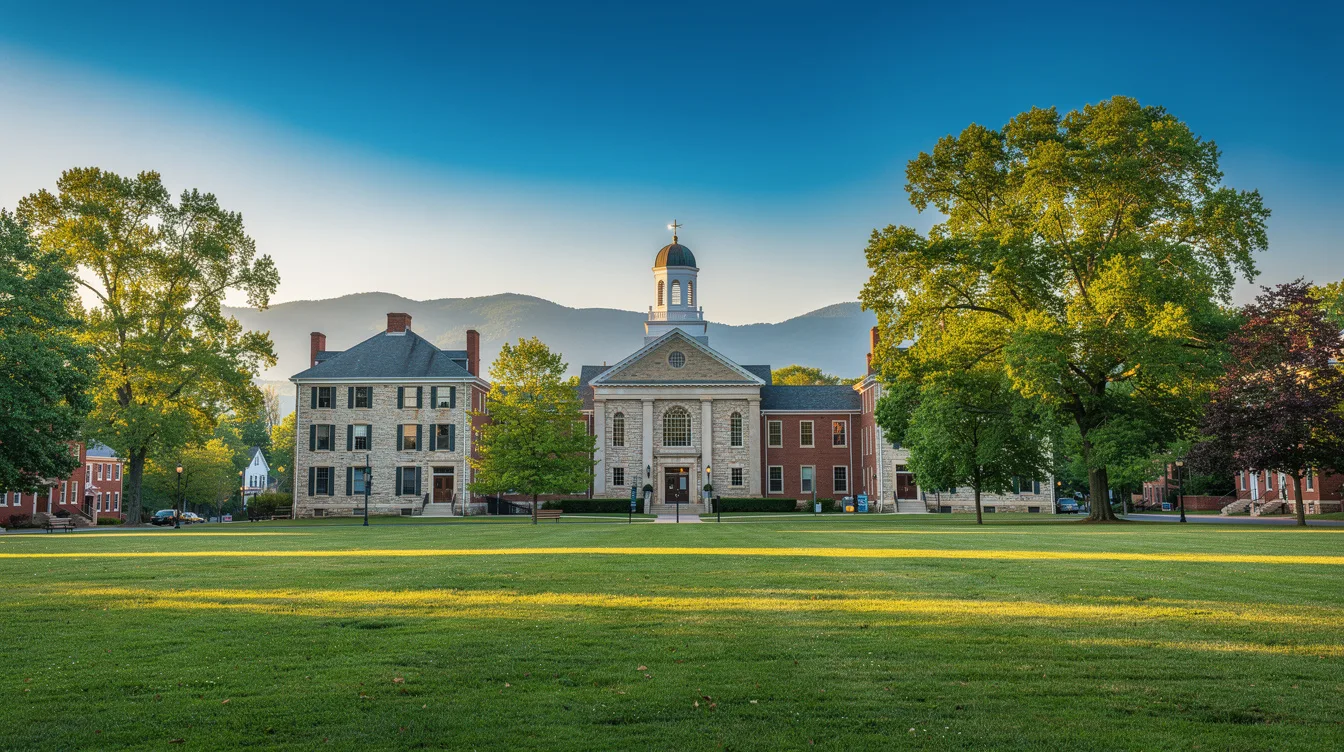
Lexington is where Lee is buried, but the town’s larger surprise is the Virginia Military Institute, founded in 1839. That pairing gives this Shenandoah Valley city a particular charge. Military tradition, university life, and Civil War memory sit within an easy walk of one another.
And Lexington remains small enough to understand on foot. The 2020 census counted 7,320 people, so you won’t spend your visit crossing endless commercial strips. Brick buildings, independent restaurants, galleries, and character-filled hotels keep the center compact and quietly absorbing.
Two institutions shape the town’s identity
At the Virginia Military Institute, the architecture and museum make the school’s history visible from the street. You can feel the place’s discipline in its formal spaces, but Lexington itself is relaxed. That contrast is the town’s strongest quality: serious history without a museum-only atmosphere.
And the nearby university campus brings another rhythm, with students and visitors moving through the same streets. Visit Lee Chapel & Museum to see where Lee is buried, then give yourself time to consider the complicated Confederate memory attached to the site. My view is simple: the history deserves attention, but never a polished gloss.
The center rewards a slow morning
Lexington’s downtown is made for wandering before lunch, when the streets feel open and the brick facades catch the changing light. You don’t need a packed itinerary here. Choose a cafe, browse a gallery, and let the town’s small scale do the work.
But don’t mistake quiet for dull. The local restaurants and hotels give the center a lived-in feel, while the university population keeps it from becoming only a preserved historic district. You can cover the main area quickly, though I think Lexington is better when you leave room for an unplanned turn.
Natural Bridge is close enough for an afternoon
Natural Bridge State Park is about 20 minutes by car, making it the easiest outdoor addition to a Lexington stay. The short drive changes the mood quickly. Streets and courtyards give way to wooded paths and the scale of the Shenandoah Valley.
And you can treat the park as a half-day escape rather than a separate destination. That makes Lexington useful for travelers who want history in the morning and open space later. The trade-off is that you’ll need a car, and the town’s appeal is strongest when you resist trying to see everything at once.
Getting there takes less effort than it sounds
Lexington sits 49.7 miles north of Roanoke and 93.2 miles west of Charlottesville. Those distances put it within reach of a Virginia road trip, while the valley setting gives the arrival a sense of separation from larger cities.
But the most practical airport is Roanoke-Blacksburg, roughly 50 minutes away by car. Lynchburg and Charlottesville are also usable, each a little more than an hour away. You should plan the driving before booking, because Lexington is remote enough to feel different but connected enough for a comfortable stop.
Stay one night, or make the town your pause
Lexington works especially well for one to two nights on a Virginia trip linking the Shenandoah Valley and Blue Ridge Parkway. You can visit the VMI Museum, walk through the university area, and see Lee Chapel without turning the day into a race.
And the Virginia Horse Center adds a rural, equestrian side to the visit when events are taking place. That schedule matters, so check it before you go. Otherwise, come for the compact history and stay for the slower pace, when footsteps replace traffic along the brick streets.
By late afternoon, Lexington feels neither crowded nor frozen in the past. It is a working college town with difficult history underfoot, and the last quiet stretch downtown is often the one you’ll remember.