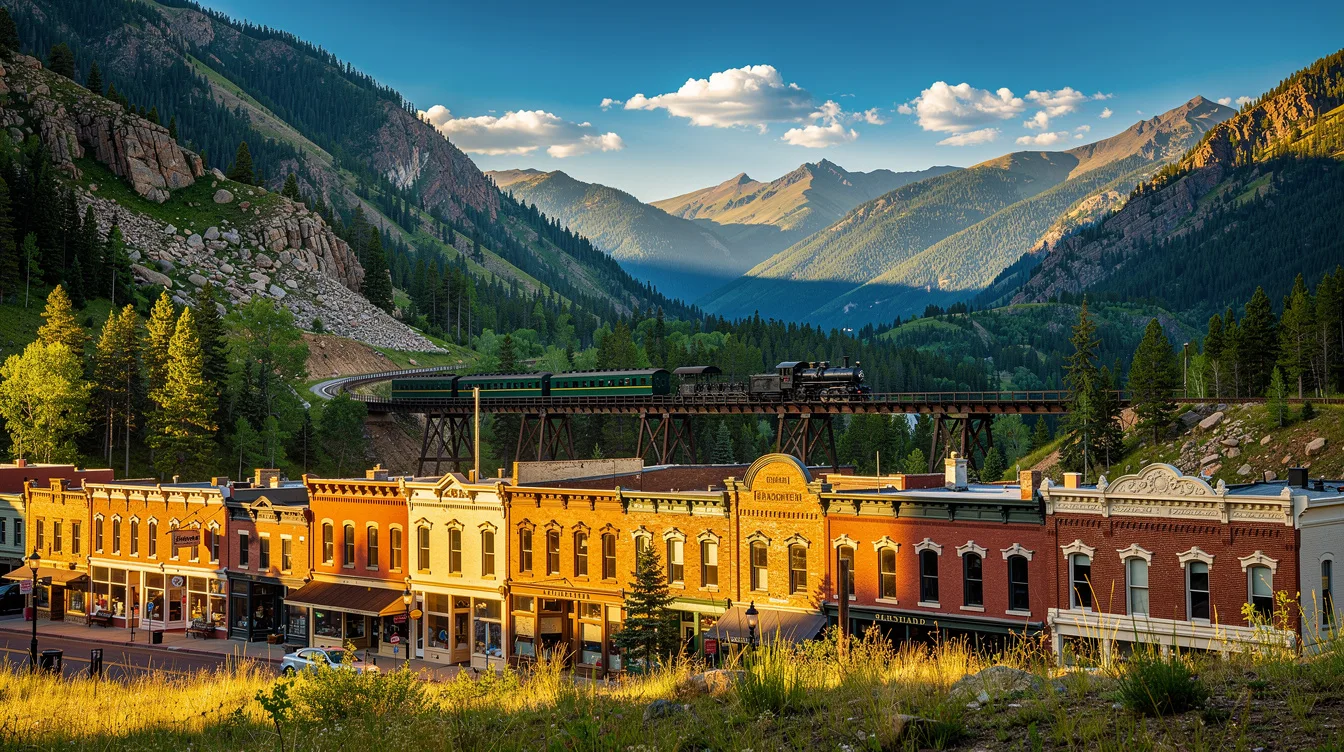
Georgetown sits about 45 miles west of Denver on Interstate 70, yet plenty of travelers keep driving toward the ski towns. That is their loss. This compact Colorado stop has a railroad line completed in 1884, plus the kind of main street that makes you slow down before the mountains do.
It’s called the “Silver Queen of the Rockies,” a big nickname for a small town. But the preserved Victorian blocks and steep peaks give it enough presence to carry it.
The 1884 railroad is the reason to stop
The Georgetown Loop Railroad runs between Georgetown and Silver Plume on a historic narrow-gauge route. Its original line was completed in 1884, and the train crosses a high trestle over a mountain valley, which is the moment most passengers stop talking.
You don’t come here for speed. You come for the measured clatter of the cars and the view through open air, with mountains close enough to make the valley feel narrow.
And that’s why the railroad works better than a quick roadside photo. It gives you time to see how difficult this terrain is, while keeping the day pleasantly simple.
Is the train enough for a day trip?
Yes, especially if you’re coming from Denver. Georgetown is roughly 45 miles away, so it can fit a half-day or full-day outing, depending on how long you linger downtown and whether you continue toward Guanella Pass.
But check seasonal operations before you go. High elevation changes the calendar here, and closures are possible when conditions turn.
A silver town that still feels compact
Georgetown is in Clear Creek County, where it is also the county seat. The Georgetown-Silver Plume area is a National Historic Landmark District, and its preserved 19th-century buildings make the mining-era story easy to read from the sidewalk.
Ornate brick storefronts face Victorian houses, while the mountains rise immediately beyond them. It is historic, but it doesn’t feel sealed behind glass.
You can visit the Hotel de Paris Museum, an 1875 former hotel, French restaurant, and salesmen’s showroom tied to the town’s mining prosperity. The Hamill House is another Victorian-era stop, dating to 1879.
And Georgetown has an advantage over a larger resort town: you can actually take it in. There are no sprawling districts to conquer, so an unhurried walk feels like the right pace.
At 8,530 feet, take the first hour slowly
Georgetown sits at about 8,530 feet in Colorado’s Front Range. That altitude keeps the air cooler than Denver, but it can catch out visitors arriving from sea level or even from the city.
Drink water, use sun protection, and don’t schedule your hardest activity the minute you arrive. You’ll enjoy the town more if you give your body a little time to adjust.
But this isn’t a polished resort bubble like Vail or Breckenridge. Georgetown is smaller and quieter, which is precisely why an afternoon here feels less programmed.
Its population is roughly 1,100 to 1,200 residents, and the scale matters. You hear passing traffic from I-70, then turn a block and find old facades against dark slopes.
Guanella Pass adds the mountain part
Guanella Pass begins at Georgetown and adds hiking, alpine scenery, and access toward Mount Bierstadt. Summer and fall are the strongest seasons for pairing the pass with the railroad, particularly when the higher country is open.
If leaf color is your goal, this is the more scenic extension. If you prefer history, stay in town and take your time with the district instead.
And be realistic about the road. Seasonal closures can affect higher elevations, so Guanella Pass is not something to assume into an itinerary.
Georgetown Lake is visible from I-70 and offers fishing and outdoor recreation. It’s a useful pause, though the town itself is the better reason to exit.
The practical choice is a slower Colorado stop
I-70 can bring winter weather, mountain driving conditions, and heavy traffic. That makes Georgetown easy to reach on paper, but not always effortless on the day you travel.
Still, it has a rare payoff for such a short detour. You get a real historic district, a mountain railroad, and a high-country setting without committing to a major resort stay.
By the time the train’s sound fades into the valley, Georgetown’s brick storefronts sit quietly beneath the peaks.