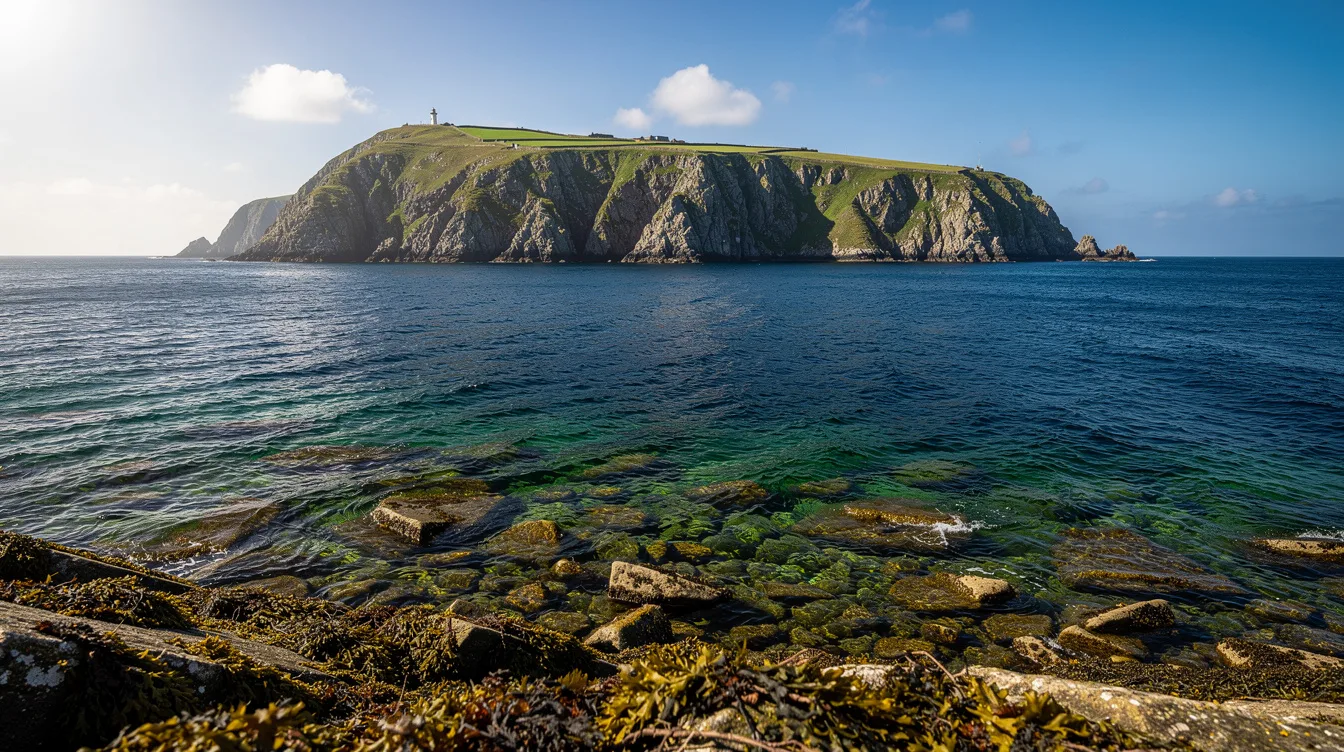
In 2010, Lundy became Britain’s first Marine Conservation Zone. That fact changes how you should see this rough Devon outpost: not as a quick sightseeing stop, but as a small island where the water matters as much as the cliff paths.
It sits in the Bristol Channel. The crossing is short enough to feel practical, yet the open water and stripped-back routine make the mainland seem much farther away.
Britain’s first conservation zone is still a wild place
Lundy is small, so you can grasp its scale quickly. But its compact size doesn’t make it tame. Granite cliffs face the Atlantic on the west, while Landing Bay on the east is relatively sheltered.
You come here for a place with real edges. The wind can be sharp, fog can settle over the rock, and the paths near the cliffs ask for attention. That exposure is part of the point, but it’s not a casual beach day.
The island’s marine protection reflects waters known for reefs, wrecks, seaweeds, sponges, corals, and cold-water diving. If you dive or snorkel, the designation gives the trip its focus. If you don’t, it still explains why Lundy feels less like a coastal attraction and more like a living boundary.
And the island’s long relationship with the sea has never been gentle. Shipwrecks, piracy, smuggling, trade, and old lighthouse sites all belong to its story. More than 1,300 archaeological sites have been mapped here, which is an astonishing concentration for such a small place.
Puffins give April through July their urgency
The name Lundy comes from Old Norse for “puffin island,” and that’s no marketing invention. April to July is the period to prioritize if puffins are why you’re crossing, when breeding seabirds bring movement and noise to the island’s exposed edges.
You may also see Manx shearwaters, other seabirds, and grey seals. But wildlife doesn’t run on a visitor schedule. Bring patience, keep your distance, and let the island set the tempo instead of chasing a guaranteed encounter.
Spring is the stronger choice for birds and flowers. May and June also offer longer daylight and generally better walking conditions. September can feel quieter than peak summer, with atmospheric light and better chances of finding a place to stay.
And winter has a different appeal: severe weather, tighter logistics, and very little insulation from the elements. You’ll want it for solitude, not convenience. The sound of wind around the buildings can make the island feel wonderfully remote, then plainly demanding.
Can you see puffins on a day trip?
Yes, if you travel from April through July and give yourself several hours ashore. But an overnight stay is the better call for wildlife, walking, and photography, because a rushed visit leaves too little room for weather or simply sitting still.
The boat crossing is part of the decision
The usual seasonal route is the MS Oldenburg, with departures from Bideford or Ilfracombe in North Devon. Crossings are typically around two hours, which gives the journey a satisfying sense of departure before you even reach the island.
But sailing dates, departure ports, weather, and availability can change. Check the official Lundy and Landmark Trust timetable before making plans. This is one of those trips where flexibility isn’t optional, especially when the Bristol Channel decides otherwise.
Winter access is generally by helicopter from near Hartland Point, usually linked to pre-booked stays and subject to the operator’s schedule. That sounds dramatic because it is. It also reinforces that Lundy is not built around spontaneous arrivals.
You’ll find an island that is car-free, lightly populated, and limited in services. There are places to stay through the Landmark Trust, plus camping, but popular dates can fill well ahead. Plan food, water, waterproof layers, and sturdy footwear before you leave Devon.
Go for the separation, not mainland convenience
The National Trust owns Lundy, and the Landmark Trust has managed it since 1969. Most residents live around the settlement at the south of the island. There were 28 residents recorded in 2007, a figure that helps explain the scale of daily life here.
That low-service reality is its strength, but it comes with limits. Don’t count on strong mobile coverage. Don’t expect mainland ease.
And don’t treat exposed paths as an afterthought just because the island itself is small.
For a day trip, Lundy works best when you choose one aim: seabirds, a long walk, diving, or a slow look at its maritime history. Trying to do everything turns a rare crossing into a checklist. I’d take fewer stops and more time near the water.
By the time the boat heads back toward Devon, the cliffs fade into the Bristol Channel haze, and the island keeps its distance.