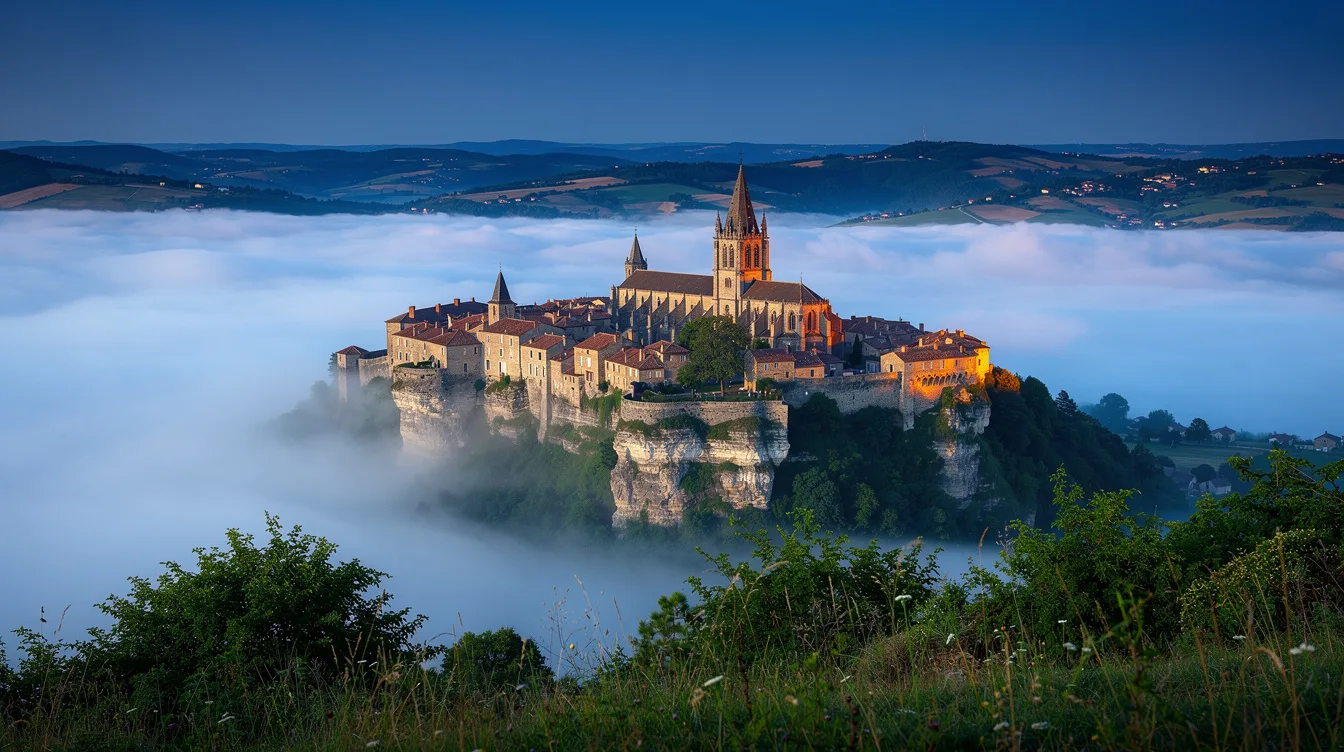
Cordes-sur-Ciel earned its unusual name because clouds often gather in the Cérou Valley below it. The medieval town was founded in 1222, then renamed in 1993 for those damp-morning moments when its stone streets appear to float above a white layer of mist.
It’s a strong claim for a town name, but Cordes makes it believable. You arrive to a steep silhouette on a ridge, then find narrow lanes, fortified gates, and carved Gothic facades once the climb begins.
The clouds are real, but they don’t keep a schedule
The best chance comes early on a humid morning, especially after a cool night. Because the village rises above the valley, low cloud can settle beneath it while the upper streets catch the first pale light.
And that is when the 1993 renaming clicks. You may see the famous cloud layer, or you may find a clear valley and distant hills instead. Don’t plan an entire trip around the mist, but do give yourself an early start if it matters.
Spring and September offer the best balance of calmer streets and agreeable weather. Summer feels lively, but it also draws bigger crowds and turns the uphill walk into more of a commitment.
A steep town built for looking outward
Cordes is a bastide, one of the planned towns established in southwest France during the medieval period. Its historic core rises over the Cérou Valley, so even a casual wander keeps pulling your attention toward an opening between the buildings.
You’ll want sturdy shoes. The town is steep and partly cobbled, with elevations described between 160 and 1,050 feet, and the grade can surprise travelers who expected a gentle old-town stroll.
But the effort gives the place its character. The streets feel compressed and cool in the shade, then suddenly open onto small squares where pale stone catches the sun and the valley appears below.
Start on Grand-Rue Raimond VII, the historic route climbing toward the top. Let yourself drift into the side lanes too, where fortified entrances and sculpted facades make the town feel less arranged for visitors than discovered one turn at a time.
Gothic houses make the climb worth it
The finest buildings date mainly from the late 13th and 14th centuries, when textile and leather trade brought money into Cordes. Their details reward a slower pace: carved stone, tall façades, and doorways that ask you to stop rather than rush uphill.
Look for the houses known as the Maison du Grand Écuyer, Maison du Grand Veneur, and Maison du Grand Fauconnier. Their names sound theatrical, yet the real pleasure is in the masonry, worn edges, and odd shadows across the street.
At the same time, Cordes isn’t frozen in medieval display mode. Art galleries, craftspeople, and small shops give the center a working rhythm, though it can feel more commercial during the busiest summer hours.
If you want one indoor stop, the Museum of Modern and Contemporary Art occupies the former Maison des Ormeaux. It’s a useful change of pace after all that stone, especially if afternoon heat has made the upper lanes feel hard work.
Give yourself longer than a photo stop
Plan 3 to 5 hours for the town if you want to walk, eat, and see one or two interiors. You can move through quickly, but Cordes punishes rushed visits because nearly every worthwhile view involves another slope.
And save some attention for the approach roads. Exterior views show why the hilltop setting matters, with the town’s ridge line above the Cérou Valley and the Gaillac vineyards beyond.
The population was 879 residents in 2023, while the town reached 2,925 residents in 1851. That contrast explains the scale: the streets and houses recall a busier past, but the present-day place remains small enough to quiet down when day visitors leave.
Getting there from Albi is the easy part
Cordes sits in the Tarn, about 25-30 minutes by car from Albi. That makes it an easy half-day outing, though a full day feels better if you want lunch and time for the upper streets without watching the clock.
By train, Cordes-Vindrac station is on the Toulouse-Rodez line, but it lies about 3.1 miles from the town. You’ll need to arrange a liO bus, taxi, or walk, so driving is simpler for most travelers.
Parking is available at the foot of the promontory, then the town takes over on foot. By late afternoon, the stone cools, the lanes soften into shadow, and the valley below begins to look like it’s holding its breath.