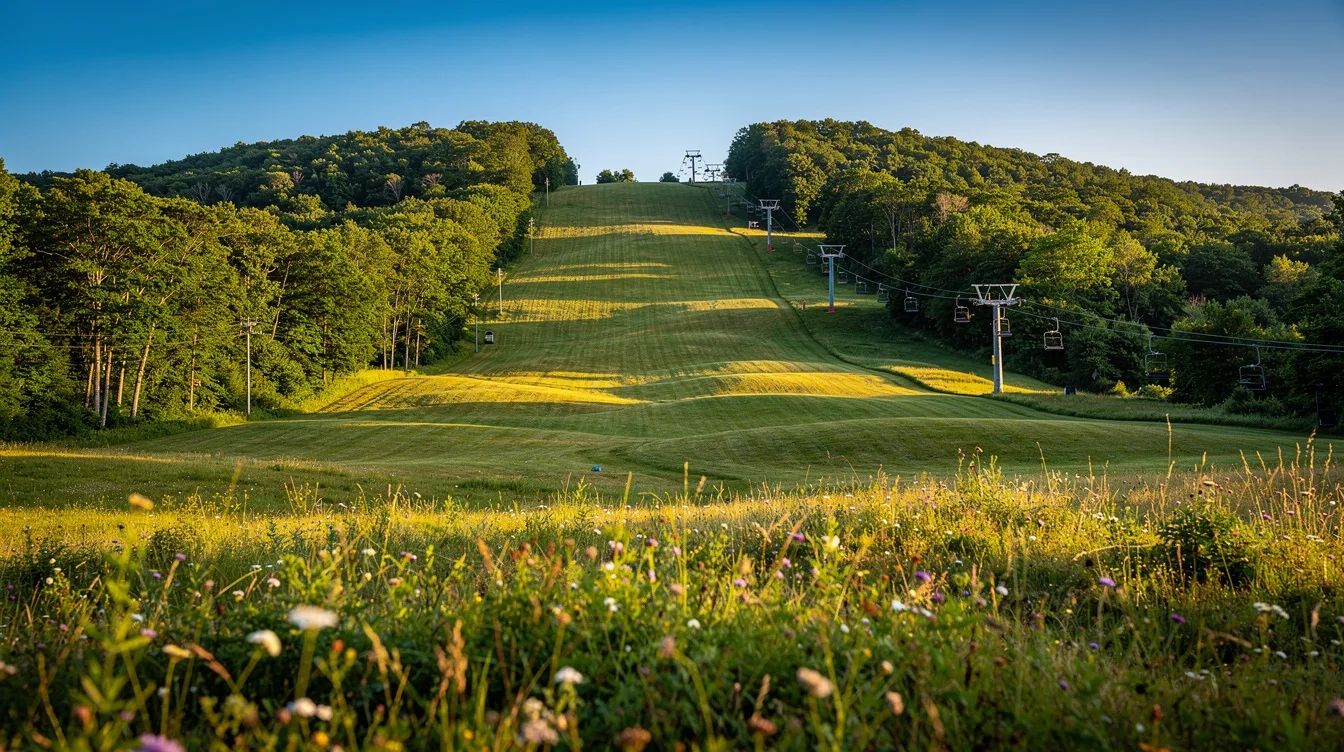
Saskadena Six, near Woodstock, introduced America’s first ski lift in 1934. That’s the reason this Vermont slope matters, even if you arrive without skis and with autumn leaves under your shoes.
Woodstock is in Windsor County on the Ottauquechee River, and it makes an easy New England escape because it’s about 3 hours from Boston by car. From New York, plan on roughly five hours, traffic and weather willing.
A 1934 first, then a slower Vermont day
The first lift gives Saskadena Six a real claim on American ski history. But the appeal isn’t museum-like. You can come for the story, then spend the rest of your day in a small town built for walking.
And in summer, Saskadena Six also offers mountain biking. That shift matters if you don’t travel with skis, because the same historic stop can fit into a June-through-September outdoor trip.
You won’t find a big-city rush here. Woodstock has a compact center around The Green, where independent shops, galleries, restaurants, and inns keep the day moving at a human pace.
The Green is the town’s best starting point
Start at The Green and let the village pull you outward. Federal and Georgian-style houses line tree-filled streets, so even a short walk feels considered rather than accidental.
But Woodstock is polished, and that polish comes with a trade-off. It’s a high-end destination in peak season, so you should expect crowds and higher prices when the foliage is at its best.
The town had 3,005 residents in the 2020 census. That small scale is part of the point. You can cross the center on foot, pause for a meal, and still have time for the river and covered bridge.
Middle Covered Bridge earns the detour
Middle Covered Bridge sits in town over a branch of the Ottauquechee River. Its wooden interior changes the sound of your steps, and the river below gives the village a little edge of cool air.
And this is where Woodstock’s postcard reputation feels earned. The bridge, the old houses, and the surrounding hills make a convincing scene, yet the place works best when you treat it as a town rather than a backdrop.
For more context, go to Billings Farm & Museum, a working farm and museum focused on agriculture and rural life. It gives the area more weight than a quick drive-through ever could.
Marsh-Billings-Rockefeller adds woods to the weekend
Marsh-Billings-Rockefeller National Historical Park is Vermont’s only national historical park. Its forests and trails make a useful counterpoint to the tidy village center, especially when you need a few quieter hours outdoors.
But don’t overpack the schedule. Woodstock is better across two or three nights, with one day for town and another for the park, farms, or the surrounding roads.
You can also head toward Quechee Gorge, described as Vermont’s “Little Grand Canyon.” The name is bold, but the draw is simple: a glacial gorge close enough to fit into a flexible day beyond town.
Autumn is the obvious choice, and the busiest one
Late September through October brings the signature fall color. It’s also the period when Woodstock can feel crowded, with an average of about 23,800 autumn visitors a month reported for a town of roughly 3,000 people.
And that contrast is worth knowing before you book. Fall has the color and the atmosphere, but June through September offers outdoor activity with less pressure from the foliage rush.
Winter suits travelers who want skiing and inns with fireplaces. Spring is quieter and can cost less, though the weather is more changeable. Either way, a car is the practical choice, particularly once snow enters the picture.
By late afternoon, the river moves under Middle Covered Bridge, the shops begin to thin out, and the old 1934 slope waits above town for the next season.