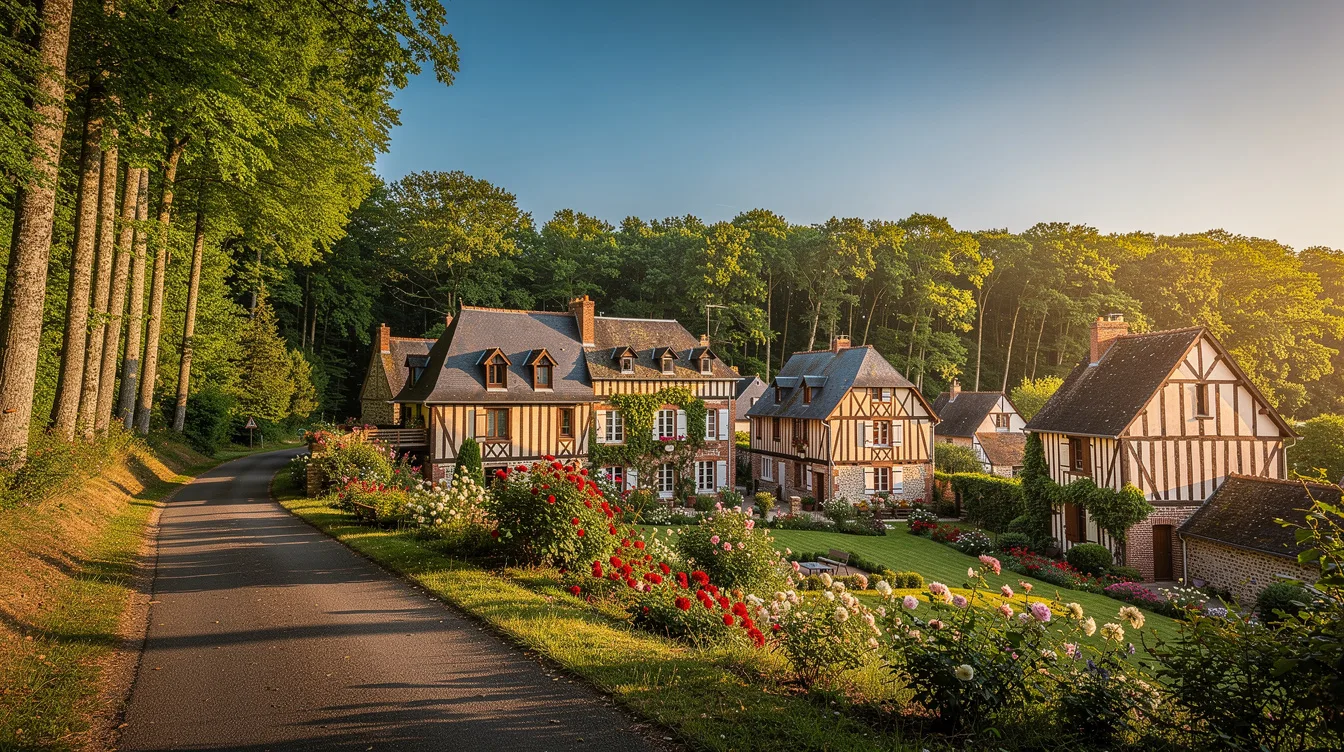
Lyons-la-Forêt became a Madame Bovary film set in 1933, and its timbered streets still make the choice feel obvious. The village in Normandy’s Eure department has the covered market hall, brick facades, and quiet corners a period story needs, without feeling staged for visitors.
And the second adaptation, filmed here in 1991, confirmed that the setting had not lost its pull. You come for the movie connection, but the surrounding beech forest is what can keep you longer than planned.
The 1933 film set still feels lived in
Walk toward the old market hall and the film logic clicks into place. Half-timbered homes sit beside pink brick buildings, while the streets bend around a compact center that feels residential rather than preserved behind ropes.
But don’t expect a museum with scene markers at every turn. Madame Bovary is the historical hook, not a themed attraction, which makes the village more convincing and a little less convenient for travelers who want everything explained.
The 1933 production used Lyons-la-Forêt as its setting, then another adaptation returned in 1991. That continuity matters because you’re seeing a place chosen twice for its actual architecture, not a recent film-location reconstruction.
Can you see the village in a few hours?
Yes, if your goal is the hall and the streets around it. But give yourself room to wander, because the best moments arrive after you stop trying to identify a specific façade and notice the weathered wood, pale plaster, and muted brick.
The forest is the bigger reason to stay
Forest of Lyons wraps around the village and changes the scale of the trip. It is the largest state forest in Normandy and one of Europe’s largest beech forests, so Lyons-la-Forêt feels less like an isolated historic stop than an opening into the woods.
The forest covers about 26,400 acres, based on the cited 10,700 hectares. Its tall, straight beech trunks have a cathedral-like effect, while clearings and small settlements break up the shade.
And that forest setting explains the town’s stillness. The Lieure runs through the commune, and the roads beyond the center lead into woodland rather than toward a coast packed with day-trippers.
You can walk or cycle here, then return to the hall for lunch. It’s calm, but it isn’t remote in the romantic sense, since Rouen sits only 21.1 miles away.
Spring and fall give Lyons-la-Forêt its best mood
Spring and fall are the seasons that suit this village best. Fresh leaves sharpen the lines of the timber framing in spring, while autumn turns a simple walk beneath the beeches into the main event.
But summer has its trade-off. Weekends can bring more visitors, even if Lyons-la-Forêt remains quieter than Normandy’s better-known coastal stops.
Start in the morning if you want the center at its most peaceful. You’ll hear ordinary village sounds around the hall, then the softer hush of the forest once the houses give way to trees.
A small village with a long, strange past
The film story is only one layer. 1135 is the date tied to the supposed death here of England’s Henry I.
The castle is private property, so this isn’t a grand palace visit. Still, the fact adds an odd historical charge to a village that otherwise reads as gentle and domestic, with an 18th-century covered market and houses from the 17th and 18th centuries.
And Lyons-la-Forêt belongs to Les Plus Beaux Villages de France. That label can attract expectations, but the place earns it through coherence rather than spectacle.
Make the detour from Rouen, then slow down
From Rouen, Lyons-la-Forêt works as a day trip or a deliberately slow weekend stop. The old market hall gives you a natural starting point, and the forest gives the visit a second act.
You’ll need to enjoy quiet streets and unhurried walking. There is no beach, no big-city rush, and no reason to race through the center before moving on.
By late afternoon, the timbered façades soften in the forest light, and the road beyond the hall disappears beneath the beeches.