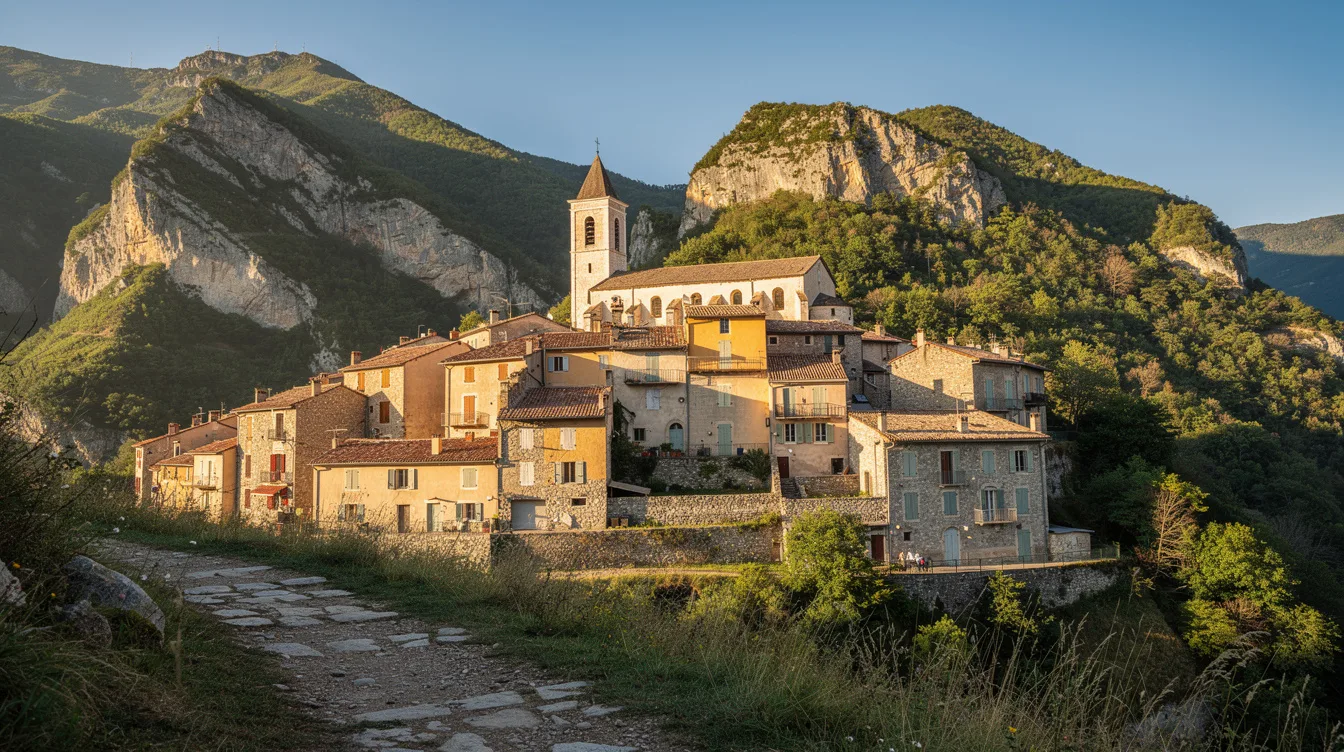
Saorge is a medieval village in southeastern France whose place in national history was decided under fire. In June 1793, Sardinian forces defeated the First French Republic here. The following April, French troops took Saorge back.
You can still feel why this mountain settlement mattered.
Its houses climb the slope above the Roya Gorge in tight tiers of stone and plaster. The lanes are steep, so a visit happens at walking speed, with stairways, vaulted passages, and sudden small squares breaking up the climb.
The 1793 battle was about control, not ceremony
Saorge belonged to Sardinia-Piedmont from 1388, and its position made it a strategic stronghold on an Alpine passage. In 1793, the first Battle of Saorgio ended with a Sardinian victory over French revolutionary forces. That result put the village at the center of a larger fight over the old County of Nice.
And this wasn’t a distant border skirmish for the people living here. Saorge and nearby Fontan supplied militia to oppose the invading French troops, while authorities from Nice had already fled to Saorge after news of the French advance caused panic.
French troops attacked through the Massif de l’Authion and the Cayros Valley during June and July 1793. They were inexperienced and lost 3,200 men. The terrain explains part of the story: valleys narrow movement, and mountain routes turn every approach into a decision.
In 1794, France took Saorge back
But the balance changed in April 1794. In the Second Battle of Saorgio, French forces wrested the town from the Piedmontese. That reversal is the promise of Saorge’s history in plain terms: one village, two battles, and a border whose ownership kept changing.
The town later returned to Sardinia-Piedmont after Napoleon Bonaparte’s overthrow. It was finally ceded to France in 1860, which is why Saorge’s French identity carries a distinctly Italian and Piedmontese edge rather than a simple national story.
You don’t need a battlefield museum to understand the tension. Look down toward the Roya, then up at the fortified-looking stack of homes. Saorge controlled a historic Alpine route, and its geography made that control worth fighting over.
The village rewards slow feet
Today, Saorge belongs to Les Plus Beaux Villages de France. That designation fits, though the real appeal is less polished than the label suggests. The village is handsome because it is compressed, practical, and built for a mountainside rather than for easy sightseeing.
And the baroque monuments give the lanes a different rhythm. The Franciscan monastery rises above the village, while Saint-Sauveur Church and the penitents’ chapels connect Saorge to the Roya Valley’s baroque tradition and its historic organ route.
The climb is worth it, but only if stairs don’t spoil your day. Cobblestones and uneven ground make Saorge difficult with a stroller or limited mobility. Good shoes matter more here than a tightly planned itinerary.
Can you reach Saorge without driving?
Yes. The Nice-Cuneo rail line passes through Saorge, and the route from Menton toward the Col de Tende also runs through the village. That makes it remote in mood, but not isolated if you build your day around the train.
Drivers can follow the Menton-to-Italian-border axis, and parking is reported free year-round near the village’s west entrance. But leave the car there. Saorge’s old center makes much more sense on foot, where every turn reveals another staircase or a strip of mountain light.
Make Saorge part of the Roya Valley
Saorge sits between Breil-sur-Roya, Fontan, and Tende, so it works best as one stop in a longer valley route. Add La Brigue if you have time. The train connection helps, and the sequence keeps the journey from becoming a rushed out-and-back.
You can also use Saorge as a base for the Roya Valley and Mercantour area. Hiking, cycling, climbing, horseback riding, and paragliding are available in the wider area, while winter brings snowshoeing and ski touring at higher elevations. Activities vary with conditions, so don’t assume every option is running.
Saorge has only about 442 residents, which helps explain its scale. It feels lived-in, but never built around crowds. By the time you head back toward the station, the stone lanes are quiet again, with the gorge far below and the village holding tight to its slope.