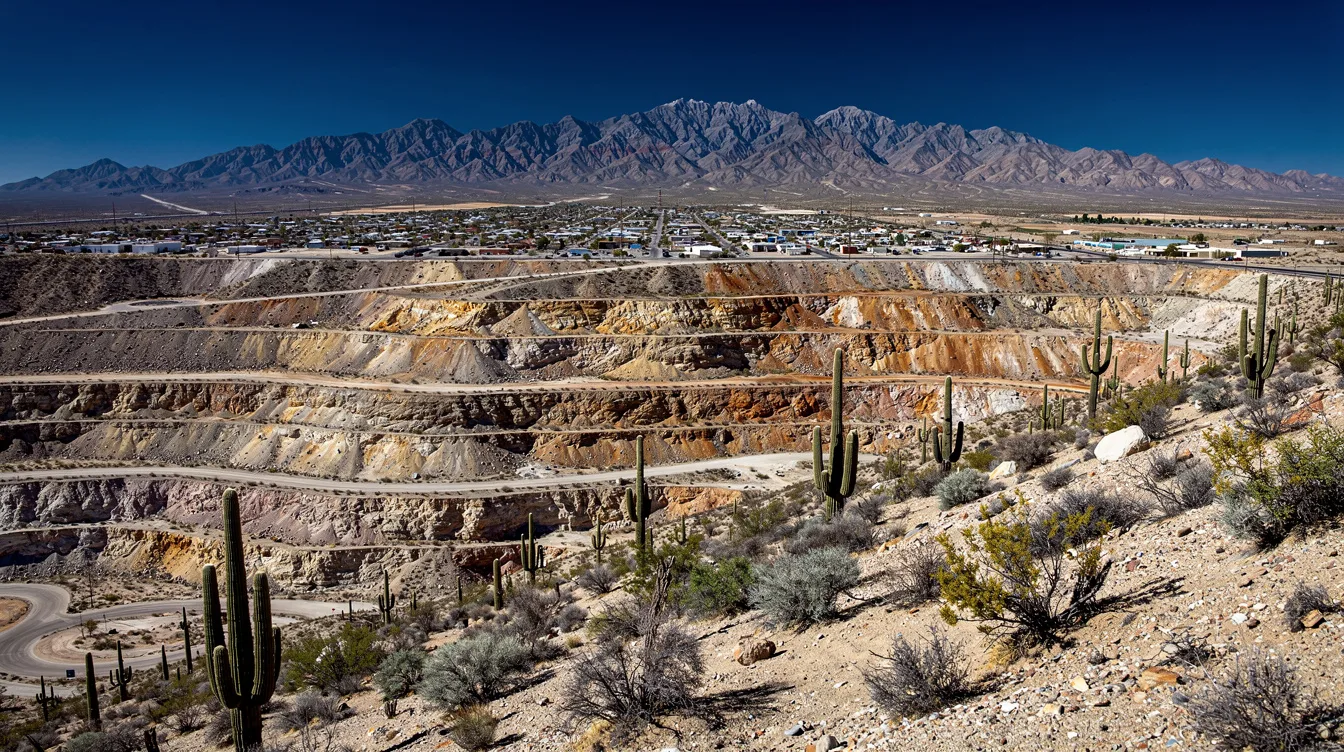
Ajo, pronounced “Ah-ho,” is a small Arizona community where the old mine still sets the mood. The former New Cornelia open-pit copper mine stopped producing in the 1980s, but its scale explains why this desert town looks and feels different from a typical highway stop.
You can see the town’s story in its layout before you reach a museum or order coffee. Copper brought the development, then the closure changed the local rhythm, so Ajo now feels quiet in a way that’s deliberate rather than empty.
The New Cornelia mine is still the point of view
The New Cornelia mine is the reason to come with your eyes open. Its former open pit shaped Ajo’s growth, and the Cornelia Mine Overlook gives you a direct look at the industrial mark that remains after production ended.
And that view is more affecting than a polished attraction would be. You’re looking at the physical reason for the town’s streets, homes, and long pauses between traffic, with dry Sonoran air and open ground stretching beyond it.
But don’t expect a theme-park version of mining history. Ajo’s appeal is its honesty: the mine is a former workplace, not a neat backdrop, and the town doesn’t try to disguise what happened when copper production stopped.
The mine also keeps the article’s promise grounded. This is not a town that merely remembers copper. Its former open pit still defines the visual frame, and it makes the modest shops and white buildings downtown feel tied to a much bigger enterprise.
About 100 historic homes make the center worth slowing down for
Ajo’s central Plaza has palms, white buildings, modest businesses, and the old railroad depot. The style is Spanish Colonial Revival, which gives the center a composed look even when the desert light feels sharp and unforgiving.
About 100 homes in the historic center are listed on the National Register of Historic Places. That designation matters because you can read the mining era in ordinary residential streets, not only from an overlook or a plaque.
And you should spend time around the Plaza instead of treating it as a quick photo stop. The town works best at a slower pace, when the pale facades, shade from the palms, and small-scale storefronts have room to register.
But Ajo isn’t built for travelers who need constant choices. There are fewer hotels, restaurants, and nightlife options than in larger Arizona destinations, which is exactly why the plaza can feel calm without feeling staged.
Is Ajo a destination or a useful stop?
It’s both, although the second answer is more practical. Ajo is a quiet base for the Sonoran Desert and Organ Pipe Cactus National Monument, so you can make the town part of the trip instead of simply passing through it.
The town sits in Pima County on Arizona State Route 85, roughly 42.9 miles from the Mexican border. That border proximity gives the route a frontier feel, though you should check border, insurance, and safety conditions before planning any cross-border drive.
Organ Pipe is close, but Ajo is where you reset
Organ Pipe Cactus National Monument lies about 15 miles south of Ajo. The short distance makes the town a sensible place to return after desert time, particularly if you prefer a plaza and a meal to another long stretch of road.
And the setting is expansive without being effortless. Ajo is surrounded by the Sonoran Desert, public lands, tribal lands, and protected areas including Cabeza Prieta National Wildlife Refuge to the west, so the sense of space arrives quickly.
You’ll notice the town’s elevation too. At about 1,759 feet, Ajo sits above sea level but remains firmly in desert country, where sun, distance, and limited services should shape the pace of your day.
But don’t confuse quiet with isolation you can ignore. Bring what you need before heading out, keep your plans simple, and let the desert be the main event rather than trying to pack every hour.
Come when the heat gives you a chance
Ajo has a desert climate, with mild winters and very hot summers. Average summer temperatures reach the high 90s Fahrenheit, so autumn, winter, and early spring are the better windows for walking around town and visiting Organ Pipe.
Fall through early spring lets you enjoy Ajo’s strongest trait: unhurried outdoor time. The dry air and wide sky make the Plaza, overlook, and nearby desert feel connected, while summer heat can turn even a short outing into a chore.
And there’s a useful contrast in Ajo’s small size. Its 3,039 residents, counted in 2020, mean you won’t find the momentum of a major resort town, but you may find the room to pay attention.
By late afternoon, the old mine sits beyond the town’s white buildings, the palms hold their shadows, and Ajo feels most convincing when you stop trying to rush through it.