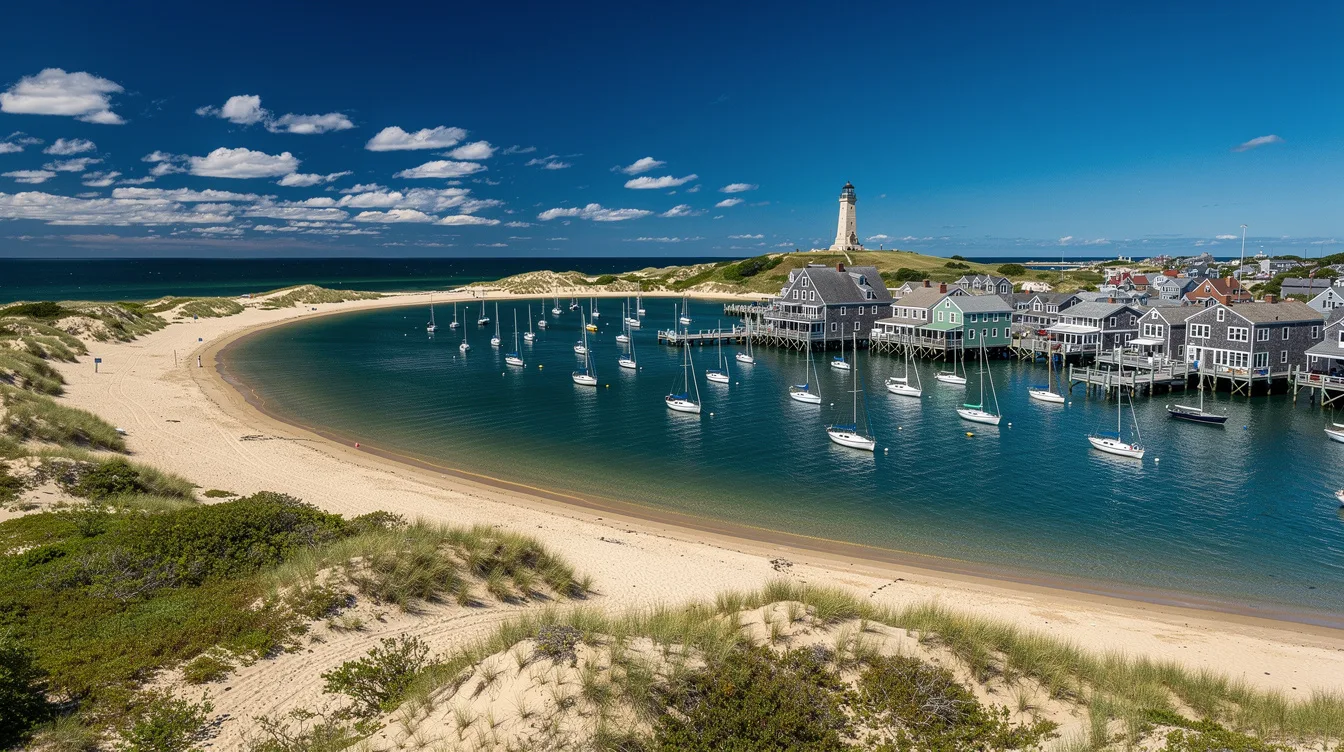
Provincetown has 3,664 year-round residents, then summer pushes its population toward 60,000 people. That shift is the point. At Cape Cod’s far tip, this small Massachusetts town turns into a full-volume beach escape from late May through September.
And it can feel crowded. But the harbor, dunes, galleries, and openly LGBTQ+ social life give those crowds somewhere to go besides standing in one another’s way.
A small town with a very big summer
You’ll find Provincetown at the end of Cape Cod, where arriving by boat can feel more sensible than staring at summer traffic.
Commercial Street is where the town shows its personality: independent shops, restaurants, bars, galleries, and historic houses packed along the waterfront. It’s lively, but it isn’t a generic resort strip. You can hear bike tires on pavement, gulls over the harbor, and music leaking from an open doorway.
And yes, July and August are the peak. You’ll need reservations, and lodging costs more when the town fills up. If you want the energy without quite as much friction, May, June, September, and October are the smarter months.
The harbor still explains everything
Provincetown is surrounded by water on nearly every side, so the sea never feels like a distant attraction. It’s right there at the end of Commercial Street, beyond the docks and the last row of weathered buildings.
The Mayflower anchored here in November 1620 before continuing to Plymouth. The Mayflower Compact was drawn up and signed aboard the ship in Provincetown Harbor, a historical fact that lands differently when you’re looking at the protected water that drew the vessel in.
But this is not a colonial-history museum town. The past sits beside drag shows, cabaret, theater, music, and the seasonal nightlife that has made Provincetown a major destination for LGBTQ+ travelers and allies.
Commercial Street rewards slow wandering
If you’re only here for a day, give Commercial Street more time than your schedule suggests. The galleries matter because Provincetown calls itself the country’s oldest continuously operating artists’ colony, and art is woven into the town rather than tucked into one formal district.
And you don’t need an agenda to enjoy it. Step into a gallery, then follow the smell of dinner toward the harbor. The street can be busy in high season, yet its narrow scale keeps it personal.
Can you find quieter water nearby?
Yes. Race Point Beach and Herring Cove Beach offer the sand-and-dunes side of Provincetown, away from the center’s restaurant tables and storefronts. Cape Cod National Seashore surrounds much of the experience, so the town can feel social one hour and windswept the next.
You can also rent a bike and ride through dune country and park spaces. The terrain and exposed setting are part of the appeal, though you should expect a more elemental outing than a polished boardwalk stroll.
Whales, dunes, and a town that stays awake
Provincetown is a known departure point for whale-watching trips, including opportunities to see humpback whales in season. That’s the sort of outing that changes the pace of a weekend, especially after a morning spent in galleries and shops.
But don’t treat the town as merely a launch point. Its harbor, beaches, cultural calendar, and queer community are why people return. The contrast is unusually good: a serious art history, a playful night scene, and open water just beyond town.
From late May through September, restaurants stay open later and the calendar thickens. That convenience comes with crowds. By winter, many seasonal businesses close, and Provincetown becomes much quieter for travelers who prefer an isolated, contemplative Cape Cod stay.
Choose your arrival carefully
A fast ferry from Boston brings you directly into Provincetown Harbor and is likely the most enjoyable route. You arrive at the waterfront instead of spending the day navigating Cape Cod traffic and searching for parking.
Driving is possible, of course, but summer traffic can be heavy and parking can be difficult. Provincetown Municipal Airport, PVC, also has air service depending on the season and operator.
And that final approach matters. By the time you reach the harbor, the town’s houses, boats, and sandy edge come into view at once. The last ferry leaves, the waterfront softens, and Provincetown briefly sounds like a town of 3,664 again.