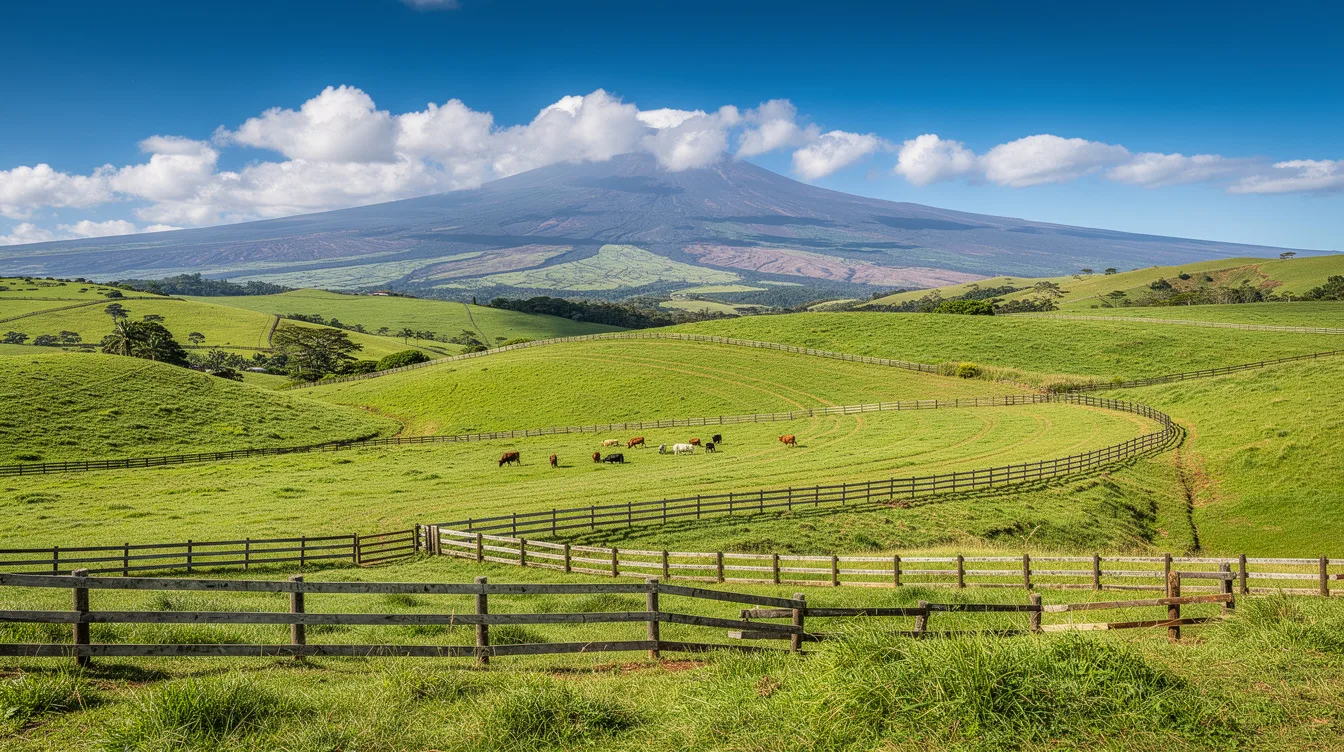
Waimea, also known as Kamuela, keeps the Big Island’s cowboy story in plain sight. At roughly 2,625 feet, this inland town feels cooler and greener than the coast, which is why the drive from Kailua-Kona can feel like entering a different Hawaii.
But this isn’t a beach stop. You come for pasture country, horses, and the working memory of the paniolo, Hawaii’s cowboys, whose culture is tied to cattle ranching and the long presence of Parker Ranch.
A cowboy history that still shapes Waimea
Parker Ranch, founded around 1815, is central to the town’s identity. That history gives Waimea a firmer sense of place than many resort areas, where the island can feel arranged around the next ocean view.
And you don’t need to pretend it’s the Old West. This is Hawaii, with green slopes, damp air, and mountain clouds moving low across the fields. The point is the contrast: ranch country on an island many visitors imagine only as sand and surf.
You’ll see Waimea called Kamuela in postal use, a practical distinction from Waimea on Kauaʻi. On the ground, the town and its signs commonly use Waimea, so don’t let two names make the route seem more complicated than it is.
The higher elevation changes the whole mood
Waimea sits in South Kohala between the Kohala mountains and Mauna Kea. Because the town is high above the coast, its weather is described as cooler, wetter, and greener than Kailua-Kona, Waikoloa, or the west-side beaches.
But pack for that difference if you’re arriving from the shore. The air can feel softer after coastal heat, and the pasture views make you want to slow down, yet this is still a rural town rather than a polished resort village.
South Kohala works best for travelers who want a pause between coastal days. You can trade beach crowds for ranch roads and local food, then head back toward the water later without making Waimea pretend to be something it isn’t.
Why the Kona drive earns your time
From Kailua-Kona, Waimea is about 1 hour 10 minutes away. That makes it an easy shift in atmosphere, though you should treat the trip as part of the day rather than a quick detour between hotel pool hours.
And the town is a useful base for the Kohala Coast, Hāwī, Waipiʻo Valley, Mauna Kea, or the route connecting Kona and Hilo. You get choices from here, but you’ll want a car because Waimea’s appeal spreads beyond a compact walkable center.
Highway 250, the Kohala Mountain Road, heads toward Hāwī through pastureland and low clouds. It’s the sort of drive that rewards an unhurried afternoon, when the green hills and open road do more work than a packed itinerary ever could.
What to do when ranch culture is the point
The Paniolo Heritage Center and Parker Ranch give the story structure, especially if you want more than a roadside glimpse of cattle country. You’ll understand why the cowboy tradition belongs in a Hawaii trip, not as a novelty but as a local inheritance.
But don’t expect nonstop activity. Waimea is better at calm pleasures: farmers markets, cafés, ranch views, and Hawaii Island cooking that draws on local producers. Lively, but never built around nightlife.
You can also use the town as a food stop before or after a longer island drive. The practical advantage is simple: a meal here comes with cooler air and a view of a Hawaii that feels agricultural rather than coastal.
Stay long enough to notice the difference
One to two nights is the right scale for most visitors. That gives you time to see the ranching side of the Big Island and take the Kohala road, while accepting that Waimea isn’t where you stay for steps-to-the-beach convenience.
And that trade-off is exactly why the town works. You can have beaches elsewhere, but here the island opens into fields and mountain weather. If your Hawaii plans need only sun and sand, Waimea may feel too quiet.
But if you want the islands’ cowboy history to feel real, start here. By late day, the clouds settle over the pastures, the road turns silver with light, and Waimea feels far from the coast without ever leaving the Big Island.