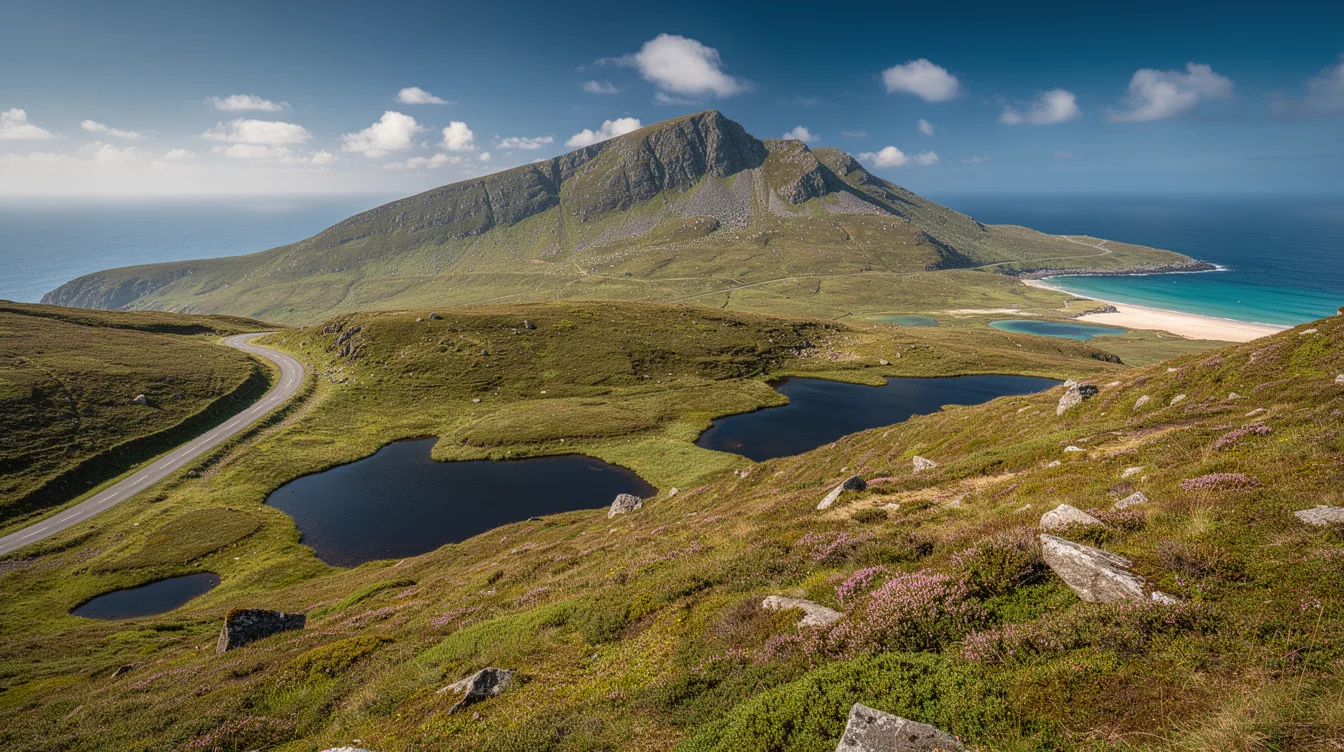
Clisham rises to 2,621 feet, the highest point in Scotland’s Outer Hebrides, and that fact changes how Harris feels. These aren’t merely white-sand beach islands. Above the lochs and coastal roads, the mountain gives the southern half of Lewis and Harris a hard, high backbone.
Harris is often called an island, but it shares one landmass with Lewis to the north. Come for the sea if you like, but look inland too. The abrupt hills make even a short drive feel more remote, and you’ll understand why this corner of northwest Scotland rewards unhurried plans.
Clisham puts Harris above the usual island escape
At 799 m, Clisham is the Outer Hebrides’ high point. That’s the promise here: an island region with a real mountain at its center, where lochs sit below steep slopes and the coast keeps appearing at the edge of the view.
And Harris doesn’t make you choose mountains over beaches. The same trip can hold high ground, pale sand, and turquoise water. It’s a rare pairing, but the weather and the exposed setting mean you should leave room in your schedule for a slower day.
For travelers who dislike busy resort islands, that’s the appeal. Harris is very lightly urbanized, so the roads feel spare rather than polished. But that also means services and schedules can be limited, especially in high season.
Two beaches make the summer case
Luskentyre Beach is the Harris image that stays with you: a broad, light-colored beach facing the island hills. You’ll want time to simply stand there. The contrast between sand and rising ground is more compelling than any rushed photo stop.
At Scarista Beach, summer brings flowering machair, the coastal grassland that borders the west-coast sand. The air can carry salt while the ground near the beach turns greener and brighter. It is touristy in summer, but the scale keeps it from feeling crowded in spirit.
And you should treat the beaches as part of a wider drive, not as a checklist. Harris works best when you let a loch, a changing patch of light, or an empty pull-off interrupt the plan. That flexibility is why a car is the most useful choice here.
Tarbert is the practical start, not the whole story
Tarbert is Harris’s main village and port, set on the isthmus between East and West Loch Tarbert. It’s where an arrival begins to make sense. From there, you can fan out toward the beaches, Rodel, or the eastern coast without constantly backtracking.
The Isle of Harris Distillery is in Tarbert, where Harris Gin uses Atlantic sugar kelp. Harris Tweed is another local thread worth following through workshops, weavers’ shops, and galleries. But don’t treat either as a substitute for getting outside.
The roads are the point.
Take the Golden Road along eastern South Harris for coves, lochs, and small settlements. Then head south to Rodel, known for medieval St. Clement’s Church.
The route is scenic, but it isn’t fast, which is exactly why it suits Harris.
How much time should you give Harris?
Two nights can cover Tarbert, Luskentyre or Scarista, and either Rodel or the Golden Road. You’ll get the shape of the place, though not much spare time. For a first visit, three or four nights is the more satisfying call.
That extra time lets you add North Harris, Huisinis, walks, tweed studios, or a boat outing. Huisinis, at the more remote northwest end, is for travelers who enjoy the road as much as the destination. But buses alone make these far-flung stops harder to manage.
The ferry is part of the filter
From Skye, the Uig-to-Tarbert ferry takes about 2 hours. It’s the most direct arrival for Harris, and it puts you at the island’s working port rather than at an airport gate. Because crossings shape the day, book ferry space early in the busy season.
From the mainland, Ullapool to Stornoway takes about 2 hours 30 minutes, followed by a drive south into Harris. You can also reach Stornoway by air from Glasgow or Edinburgh, but Harris itself has no airport.
And that slight inconvenience is useful. It keeps the trip deliberate. By the time you reach Scarista’s flowering machair or see Clisham above the lochs, the ferry’s low engine hum has given way to wind and water.