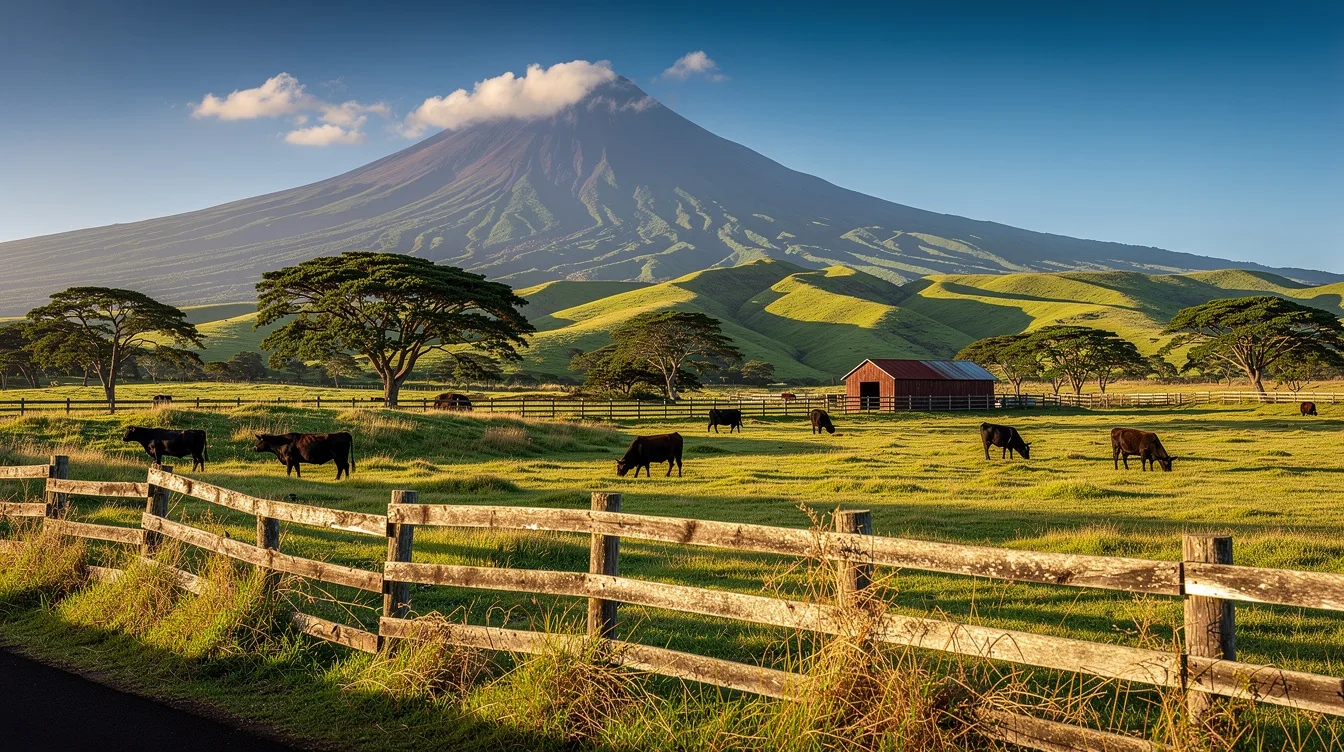
Waimea sits high in the Big Island’s northern interior, and it changes the Hawaii picture fast. At 2,671 feet, this ranch town feels cooler, greener, and far removed from Kona’s resort rhythm.
But Waimea, also called Kamuela for postal addresses, isn’t a detour for scenery alone. It’s where paniolo culture, Hawaii’s cowboy tradition, still gives the town its character through its long connection to Parker Ranch.
Hawaii’s ranch country starts above the coast
Drive inland from Kona for about 1 hour 10 minutes, and the air shifts before the view does. The road reaches pasture country, where low cloud can soften the hills and ranch fences replace the coastal hotel corridor.
And that contrast is Waimea’s real appeal. You’re still on the Big Island, but the beach-town version of Hawaii falls away. The town’s ranch history gives even an ordinary coffee stop a different backdrop: open fields, cooler air, and Mauna Kea beyond town.
Paniolo culture isn’t a costume here. Waimea is the historic center of Hawaiian ranching, historically tied to Parker Ranch, so the cowboy story belongs to the place rather than being added for visitors.
Parker Ranch explains the town’s point of view
Parker Ranch is the reason Waimea reads differently from most Hawaii stops. Its history is tied directly to the town’s cattle-ranching identity, and that identity remains visible in the surrounding pastureland and the local preference for an unhurried pace.
But don’t arrive expecting a frontier theme park. Waimea is a working inland town, and that’s better. The appeal lies in seeing Hawaii through agriculture, ranch land, and food rather than through a pool bar or a shoreline reservation.
You’ll notice the difference in the weather, too. Waimea’s elevation makes it cooler than the resort areas around Kona, which is why a light layer can feel more useful here than another beach cover-up.
Is Waimea the same as Kamuela?
Yes. Kamuela is Waimea’s postal name, used to distinguish this Big Island town from Waimea on Kauaʻi and Waimea Bay on Oʻahu. If you’re mapping a trip, make sure the destination says Big Island or Hawaiʻi County.
That distinction matters. Waimea on Kauaʻi points toward Waimea Canyon, while Waimea Bay means Oʻahu’s North Shore. This Waimea is the inland ranch town between the Kohala Mountains and Mauna Kea.
Take the Kohala Mountain Road slowly
Waimea is a practical starting point for the Kohala Mountain Road, also known as Highway 250. It leads toward Hāwī and the Pololū Valley viewpoint, trading coastal bustle for rolling green country and long, quiet stretches of road.
And this is the drive to leave room for. The route is scenic because the terrain opens up, not because every mile is designed as an attraction. If you like stopping when the cloud cover breaks, Waimea gives you that freedom.
The Pololū Valley viewpoint adds a sharper edge to the day. Beyond Waimea’s softer pastureland, the north end of the island feels more exposed and dramatic. It’s a strong contrast, though you’ll want to plan the return drive before daylight fades.
Make it a pause between Kona and Hilo
From Hilo, Waimea is about 1 hour 20 minutes by road. That makes it an easy inland stop if you’re crossing the island, especially if Kona’s dry coast or Hilo’s wetter feel has left you wanting a change of temperature and tempo.
But it works best when you don’t rush it. Waimea has local agriculture, restaurants focused on fresh ingredients, and farmers’ markets, so a meal here can be part of the reason to stop rather than something squeezed between drives.
You won’t come to Waimea for a classic resort week. You come because Hawaii has more than one rhythm, and this is the one shaped by pasture, mist, and ranch gates.
By the time you head back toward the coast, the hills are often still under cloud, and Waimea’s cooler air lingers longer than you expect.