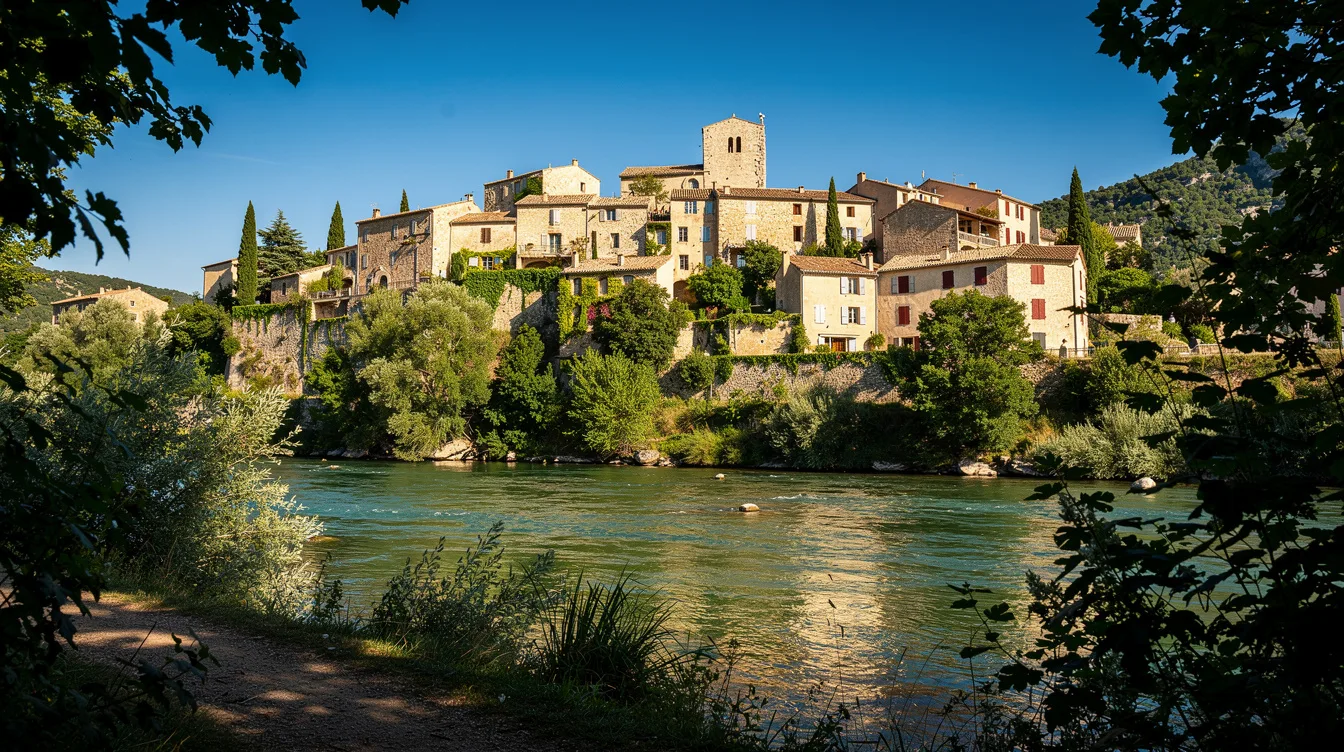
Montclus is a medieval village beside the Cèze in northeastern Gard, near the Ardèche border. It belongs to Les Plus Beaux Villages de France, but its real appeal is quieter: pale stone lanes, river air, and no need to rush anywhere.
This is the kind of place that makes a long lunch feel like a sensible plan. Because the old center is mostly pedestrian, you can leave the car at the entrance and let the steep, paved passages set the pace.
A small village that rewards taking your time
Montclus is easy to walk in one to two hours, though that estimate misses the point. You’ll stop beneath vaulted passages, look up at old stone houses, then turn a corner and find another stairway catching the afternoon light.
And the village has avoided the visual clutter that can make historic places feel staged. There’s little modern development in view, so the stonework, narrow lanes, and worn thresholds do most of the talking.
The streets are uneven and sometimes sloped. But good shoes change the experience completely, letting you wander without watching every step or wishing you had stayed by the parking area.
The Cèze keeps the mood cool
The Cèze runs at the foot of the village, and that river setting is why Montclus feels made for slow afternoons rather than a quick photo stop. In season, visitors come to walk its banks or swim, while the surrounding garrigue keeps the scene dry and fragrant.
Beyond the lanes, there are wooded hills, vines, and lavender in the wider countryside. It feels rural, but not empty, especially when summer visitors drift between the river and the old center.
And this is where you should resist overplanning. Spend time near the water after your walk, then return uphill when the stone walls begin to hold the softer late-day light.
The donjon gives the village its edge
Above the roofs, the medieval castle’s donjon gives Montclus a vertical counterpoint to the river below. The village also retains elements connected to an old Benedictine and troglodytic complex, which adds weight to streets that might otherwise feel simply charming.
See the Château de Montclus and its donjon, then make time for the Notre-Dame-de-l’Assomption church. The Pont du Moulin is another useful marker when you’re moving between the historic center and the river.
But Montclus isn’t a place for racing through a checklist. Its best moments come in the pauses: a cool archway, a rough stone stair, the faint sound of water beyond the houses.
Can you combine Montclus with a river day?
Yes. The Cèze is part of the reason to come, with walking and seasonal swimming close to the village. If you’re exploring the Cèze gorges, Montclus makes a strong half-day stop because you can pair the river with a compact old center.
You can also add Aven d’Orgnac, a nearby prehistoric site and developed cave. Barjac, the Ardèche gorges, and Uzès are other logical additions, though Montclus deserves enough time to feel its slower rhythm.
Go between April and October, with one summer caveat
The most comfortable window runs from April through October. Summer brings a traditional Tuesday-morning market and an early-August fête votive, which can add local energy without changing the village’s small scale.
But July and August are busy. The lanes are narrow, the village is small, and parking fills, so arrive in the morning if you want room to walk before the heat and crowds gather.
There’s a practical limit here: this isn’t a destination built around constant activity. That’s the point. Come for the river, the old passages, and an afternoon with no better agenda than following the Cèze’s sound back through the stone streets.