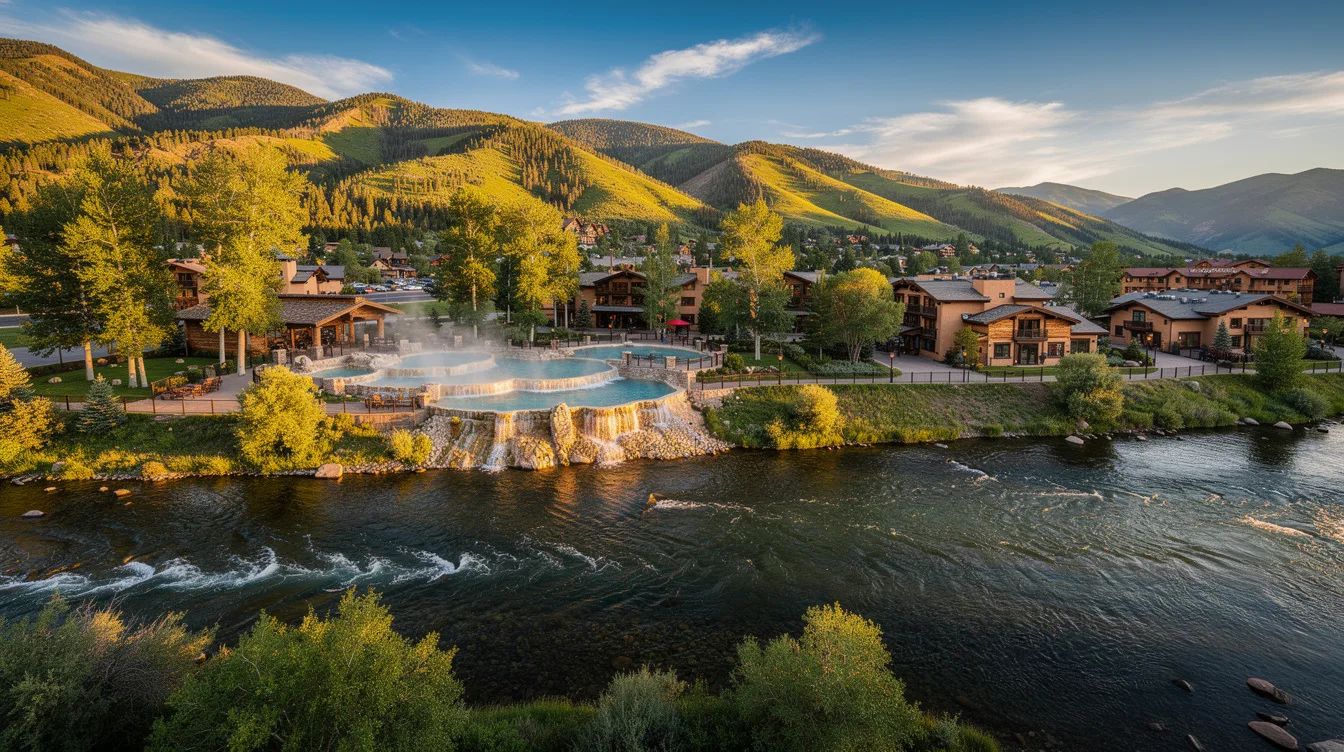
Pagosa Springs has a claim that changes how you see the town: its Mother Spring reaches more than 1,002 feet deep. The water rises beneath this Colorado mountain town, then feeds pools along the San Juan River.
That depth is the point, not a trivia fact. You come here to soak with the river moving through town and the San Juan Mountains close by. But the Mother Spring itself is far too hot for bathing.
A spring deeper than the town feels
The Mother Spring belongs to the geothermal system identified as the world’s deepest geothermal hot-spring aquifer. Its water is about 144°F at the source, so developed pools are the sensible place to spend an afternoon.
And that arrangement gives Pagosa Springs a particular rhythm. The river runs through the middle of town, while hot mineral water feeds soaking options on its upper banks. You can watch moving water from a warm pool, which is a hard afternoon plan to improve.
The Springs Resort, Healing Waters Resort, and Overlook Spa are the three privately owned places named in the research. Each draws from the same larger story, though the town’s appeal is less about spectacle than settling in.
But don’t treat the riverbank as a free-for-all soak. The primitive springs are publicly accessible, yet they are generally not for entering because of the extreme water temperature. That’s a useful distinction before you arrive in flip-flops.
At 7,126 feet, take the first day slowly
7,126 feet above sea level changes the practical math of a visit. Pagosa Springs sits on the Western Slope of the Continental Divide, and the altitude can catch up with travelers who charge straight into a hike.
Drink water, use sunscreen, and ease into strenuous activity for the first day or two. You’ll enjoy the pools more if you don’t mistake dry mountain air for a minor detail.
And summer has a real advantage here. Average highs are near 80°F, while winter daytime highs average near 40°F. The town has four distinct seasons, so hot springs work year-round even when your other plans shift.
Summer brings hiking, rafting, tubing, fishing, mountain biking, horseback riding, golf, and disc golf. Winter turns attention toward Wolf Creek Ski Area and the surrounding national forest. Lively outdoors, but not a high-energy resort-town routine.
Durango is 47 miles west, but Pagosa keeps its own pace
Pagosa Springs sits 47 miles east of Durango in Archuleta County, near the New Mexico border. It is the county seat and its only incorporated municipality, with a 2020 population of 1,571.
That small scale matters once you’re there. This is more relaxed mountain-community territory than an all-day resort circuit. And because the San Juan River passes through town, the outdoors never feels pushed to a distant edge.
The town is surrounded by about 2.5 to 3 million acres of national forest and wilderness. The San Juan National Forest, Weminuche Wilderness, and South San Juan Wilderness give the place its wide-open frame.
But wide-open doesn’t mean you should overfill the schedule. The better choice is usually one outing, then a soak. Let the warm water be the plan that holds the day together.
Beyond the pools, the San Juan country is close
For a bigger outing, the research notes point to Chimney Rock National Monument, Mesa Verde National Park, Great Sand Dunes National Park and Préservé, and scenic drives through the San Juan Mountains.
Those are viable excursions, not obligations. Pagosa Springs works best when you leave room for the town itself, especially after hiking or rafting. The contrast is simple: exertion outside, quiet warmth afterward.
And the river gives the place a softer soundtrack than its elevation suggests. You may hear water moving past town while steam hangs over a pool, with the mountain air cooling whatever isn’t under the surface.
Can you visit Pagosa Springs in winter?
Yes. The hot springs operate as a year-round reason to come, while skiing is a central winter activity nearby. You’ll want to plan around changing conditions, but cold weather makes a warm soak feel even more direct.
There’s history in the water, too. Indigenous people used these springs for centuries, and the area was considered sacred ground. A bathhouse first opened for paying customers in 1881, long before today’s developed soaking choices.
The best reason to stay is the water after everything else
Pagosa Springs doesn’t need a complicated pitch. You can hike or raft in summer, ski in winter, then return to a place whose defining water came from more than a thousand feet below ground.
But keep the scale of the town in mind. It rewards a slower visit, one where you hydrate, take the altitude seriously, and leave time to sit still.
By evening, the San Juan River keeps moving through Pagosa Springs, and warm mineral water keeps rising from somewhere far below it.