
Midnight blue bathroom ideas work best when you treat the room like an evening space, not a tiny white box that needs rescuing. I’ve watched dark paint make a cramped bath feel more intentional, but only when the light, metal, and mirror are planned first. Start there. Your bathroom doesn’t need to feel heavy.
Before you start, measure the hard edges
Measure your vanity, shower, toilet clearance, and window before you buy one navy sample or brass sconce. You’ll want a vanity between 32 and 36 in high, at least 21 in clear in front of the toilet, and a shower that reaches 36×36 in if you’re changing the layout. Those numbers keep your dark blue bathroom from becoming a dramatic room you can’t comfortably use.
I’d tape those dimensions on the floor with painter’s tape first. It looks silly for ten minutes, then saves you from a vanity that steals your knee room. Farrow & Ball Hague Blue No.30 can wait until you know where your body will move.
- Start with a blue that holds up at night
- Anchor the color-drench blue bathroom with one pale surface
- Build the Three-Height Light Stack
- Hang a mirror that interrupts the blue
- Mix brushed brass with blue before adding black
- Layer jewel tone bathrooms with a restrained shower tile
- Frame the tub using the Quiet Hotel Rule
- Float a warm vanity against dark blue bathrooms
- Use navy blue bathroom inspiration to edit your textiles
- Add storage with the Closed-Door Calm Method
- Paint the ceiling only after you test the Shadow Canopy
- Finish with one personal object over more decor
1Start with a blue that holds up at night
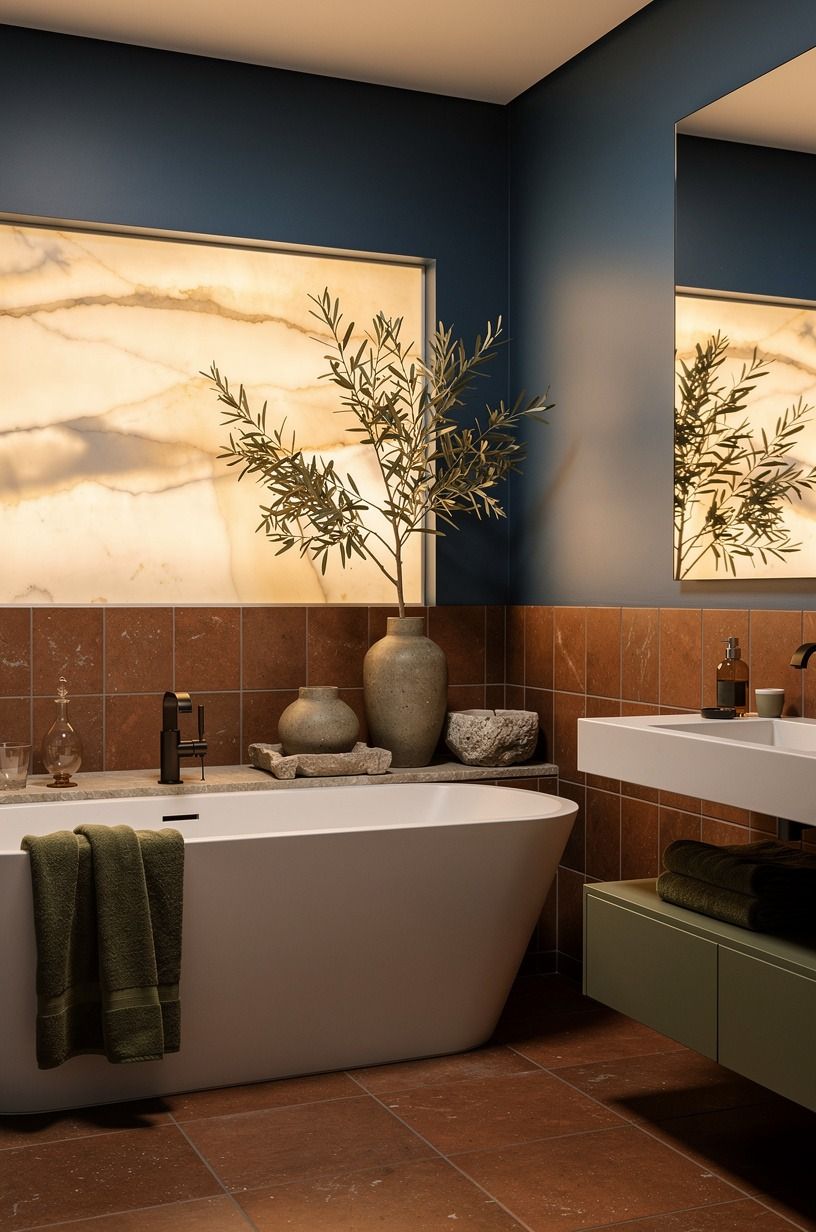
Choose a deep blue with gray or green underneath, because a flat primary navy can look harsh once daylight leaves. Farrow & Ball Hague Blue No.30 gives you a moody, refined wall that still has life under a warm bulb. It’s the better call over a bright cobalt, which can turn your bathroom into a sports-bar color story.
Let terracotta, stone, and olive notes soften the blue, especially through a backlit translucent onyx detail. You’ll see the difference by evening. And don’t judge it at noon only, because midnight blue earns its keep after dinner, when the room should feel intimate rather than merely dark.
For another approach to depth without visual weight, see dark blue bathroom ideas that feel rich, not heavy. Your ceiling color matters too, especially if you’re working with a low one.
2Anchor the color-drench blue bathroom with one pale surface
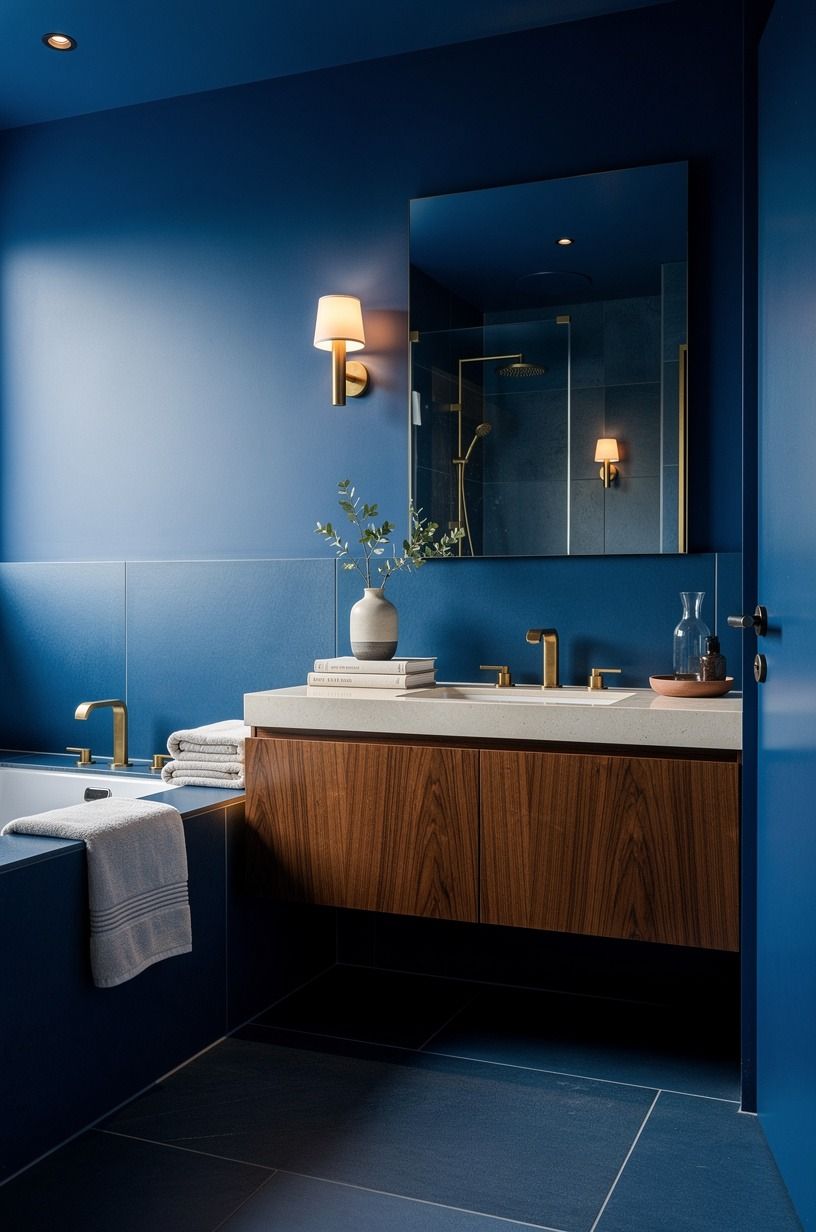
Let the blue surround one pale anchor: a vanity top, floor, tub, or large mirror. Clay, linen, and aged brass keep the contrast warm, while book-matched walnut brings enough structure that the room still feels settled.
3Build the Three-Height Light Stack
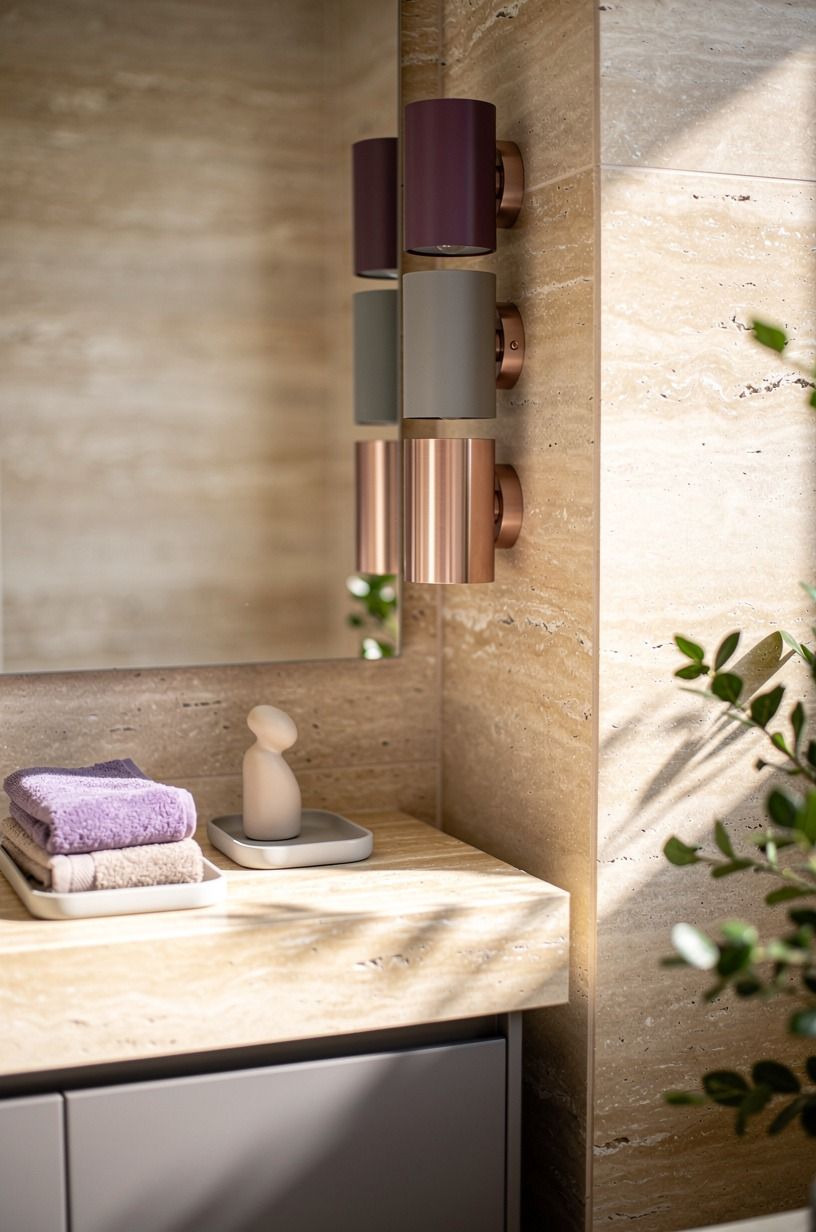
Use three heights of light: ceiling, face-level, and low glow. Your overhead fixture handles cleaning, aged-bronze sconces beside the mirror handle makeup, and a small shaded lamp or under-vanity strip gives the room its soft evening pool. One ceiling light alone is the losing option because it throws shadows under your eyes and makes blue paint look colder.
A pair of sconces placed near face level will feel far more flattering than a row of bare vanity bulbs. You’ll want warm bulbs, not blue-white ones. I learned this after installing a very sleek fixture that made everyone look vaguely unwell.
– A Schoolhouse Ray 2-Light Sconce beside the mirror – A linen shade near the tub – A concealed low strip under the vanity
Warm travertine works especially well with plum, grey, and rose-gold notes. That layered glow is calming. And yes, it changes the whole room!
4Hang a mirror that interrupts the blue
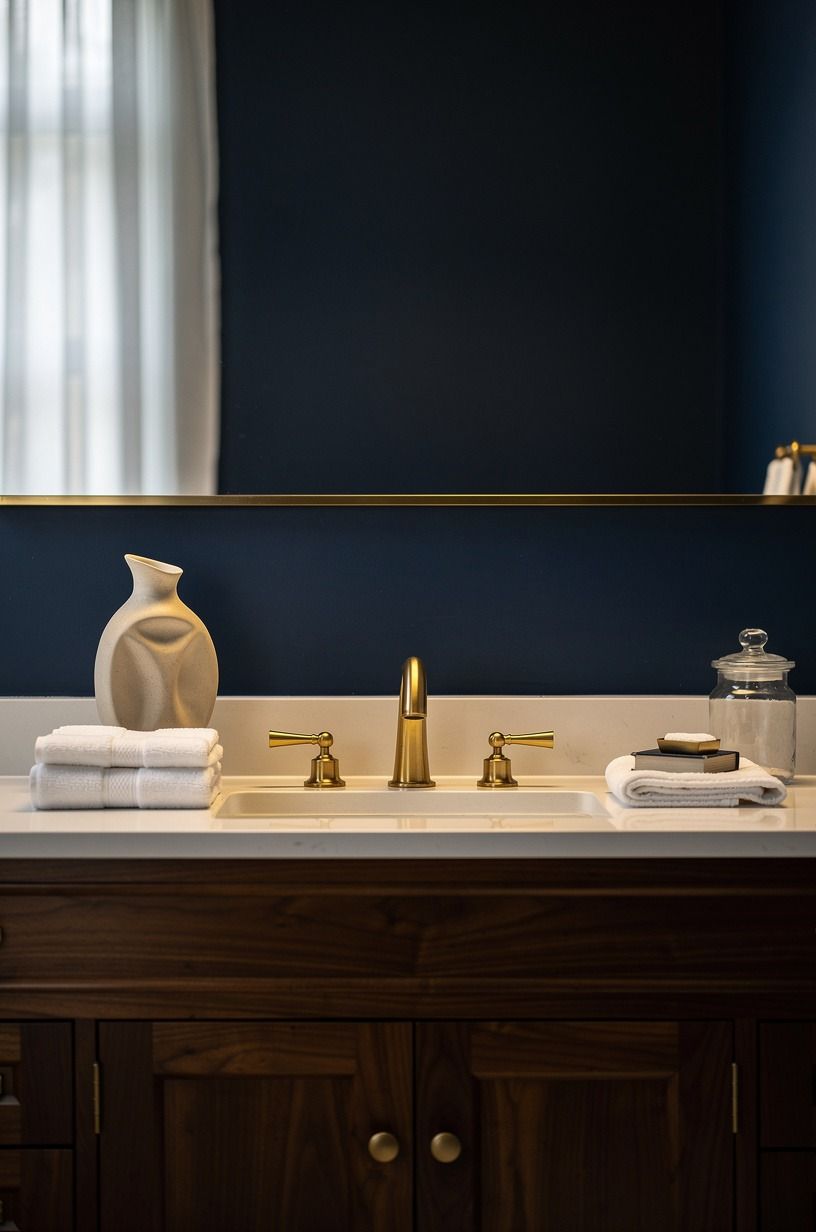
A mirror should break the color field with shape, not just reflection. Try an arched West Elm Metal Frame Mirror over a square vanity, or use a softly rounded medicine cabinet if storage is tight. You’re giving the room a bright pause without adding another paint color.
Skip the skinny frameless rectangle if you can. It disappears into midnight blue and makes your wall feel unfinished. An unlacquered brass edge developing a soft patina catches the lamp light in a gentle way, especially with navy, white, and walnut nearby.
If you’re choosing between several blue directions, this dusty blue bathroom look shows why a softened counterpoint can make a dark room more inviting. Your mirror doesn’t have to match every metal exactly.
5Mix brushed brass with blue before adding black
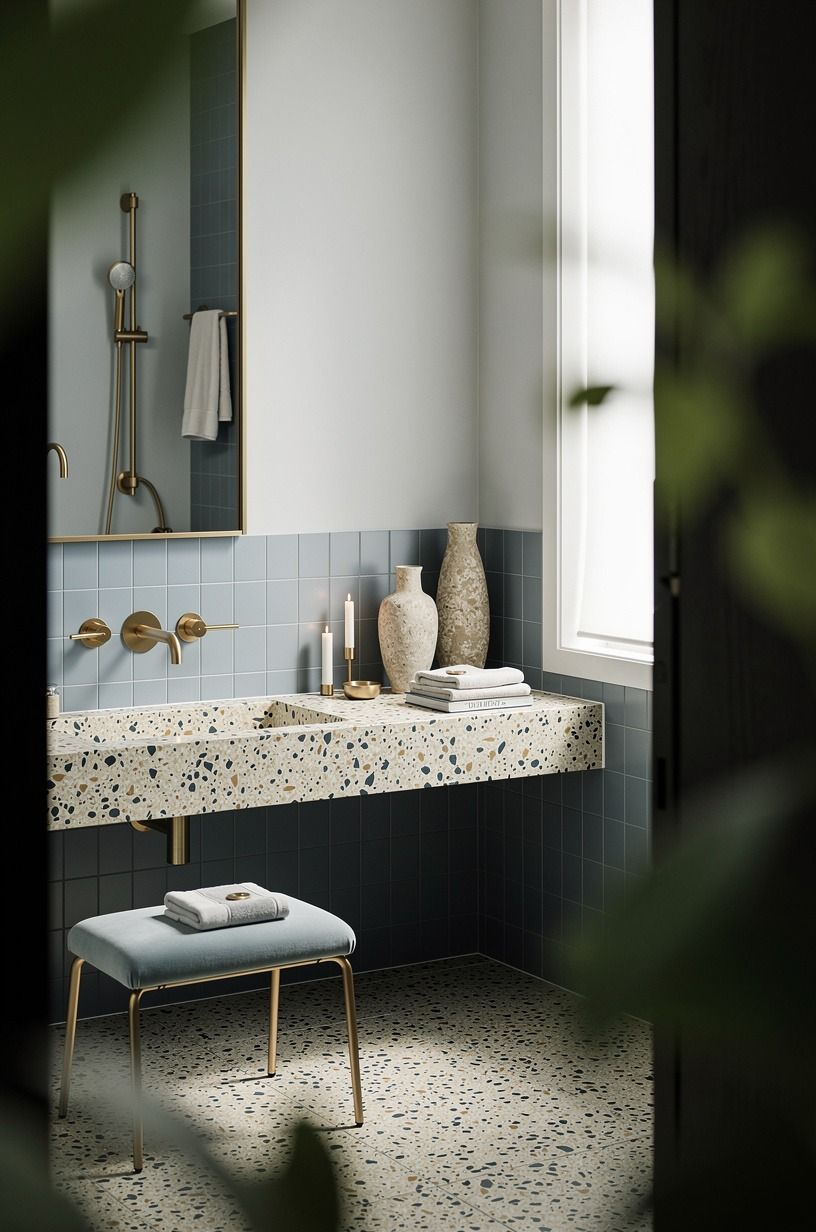
Use brushed brass faucet hardware as the warm note that keeps midnight blue from feeling stern. A typical faucet runs $120-$450, and it’s one of the few swaps you’ll touch every single day. Black hardware is popular, but I’d skip it in a fully dark bathroom because it can vanish against the walls.
Choose brass with a satin finish rather than a loud polished one. Emerald, gold, and cream make it feel richer, and an oversized-chip terrazzo surface adds a little movement without crowding the room. But don’t buy brass knobs, brass lights, brass hooks, and brass accessories all from different finish families, unless you enjoy watching them argue under the vanity light.
The best version feels gathered over time. A Kohler Purist brushed brass faucet, an old framed print, and one small tray are enough.
6Layer jewel tone bathrooms with a restrained shower tile
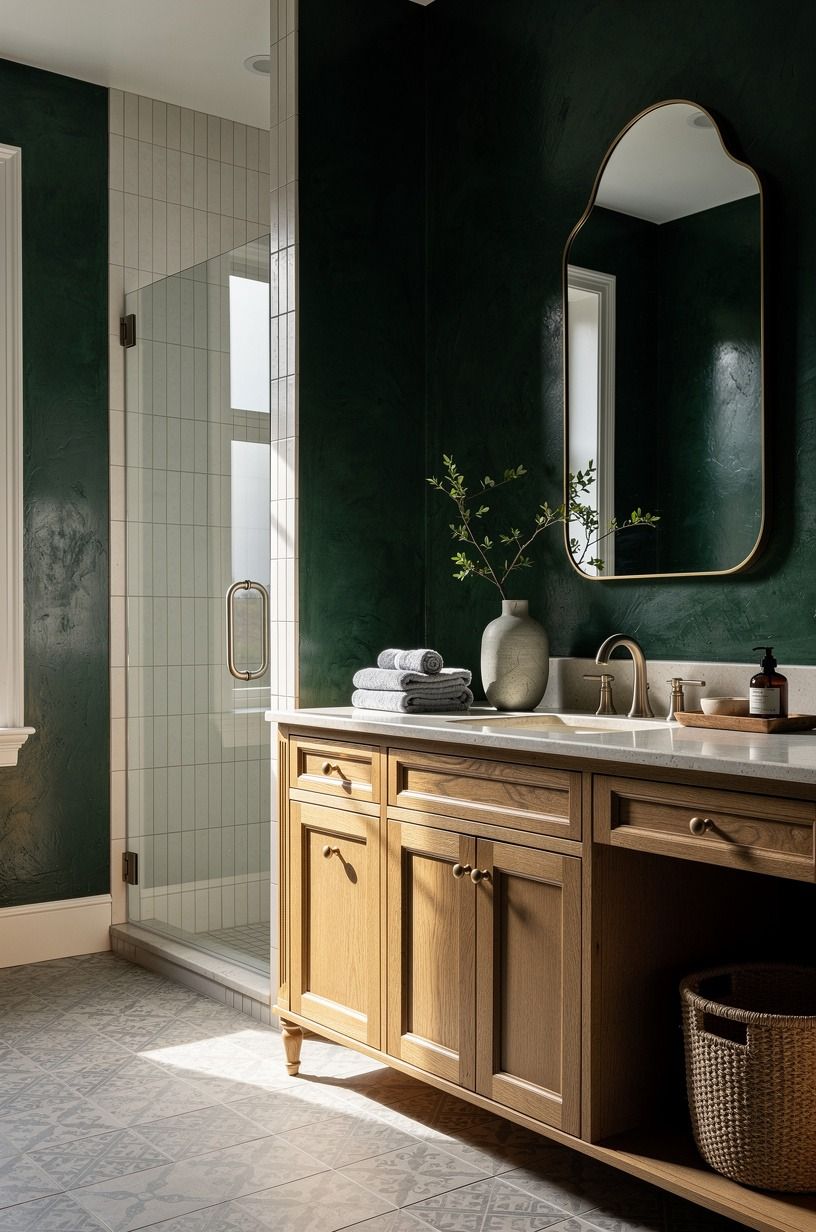
Take the blue into the shower only if you’re ready to control the tile finish. Hand-applied Venetian plaster in forest green, rust, and natural oak tones can give the room movement without relying on another hard, glossy tile surface. Glossy navy subway tile can work, but it often reads more predictable, particularly in a builder-style bath.
Use the stronger finish on one shower wall or from floor to ceiling behind the vanity. Your other surfaces can stay pale and matte. A comfortable shower needs at least 36×36 in, and darker surfaces make that footprint feel more enveloping, not smaller, when you light it well.
You’ll pay more for a hand-applied finish, but the irregular surface is the point. It catches steam and candlelight in a way machine-perfect tile simply doesn’t.
7Frame the tub using the Quiet Hotel Rule
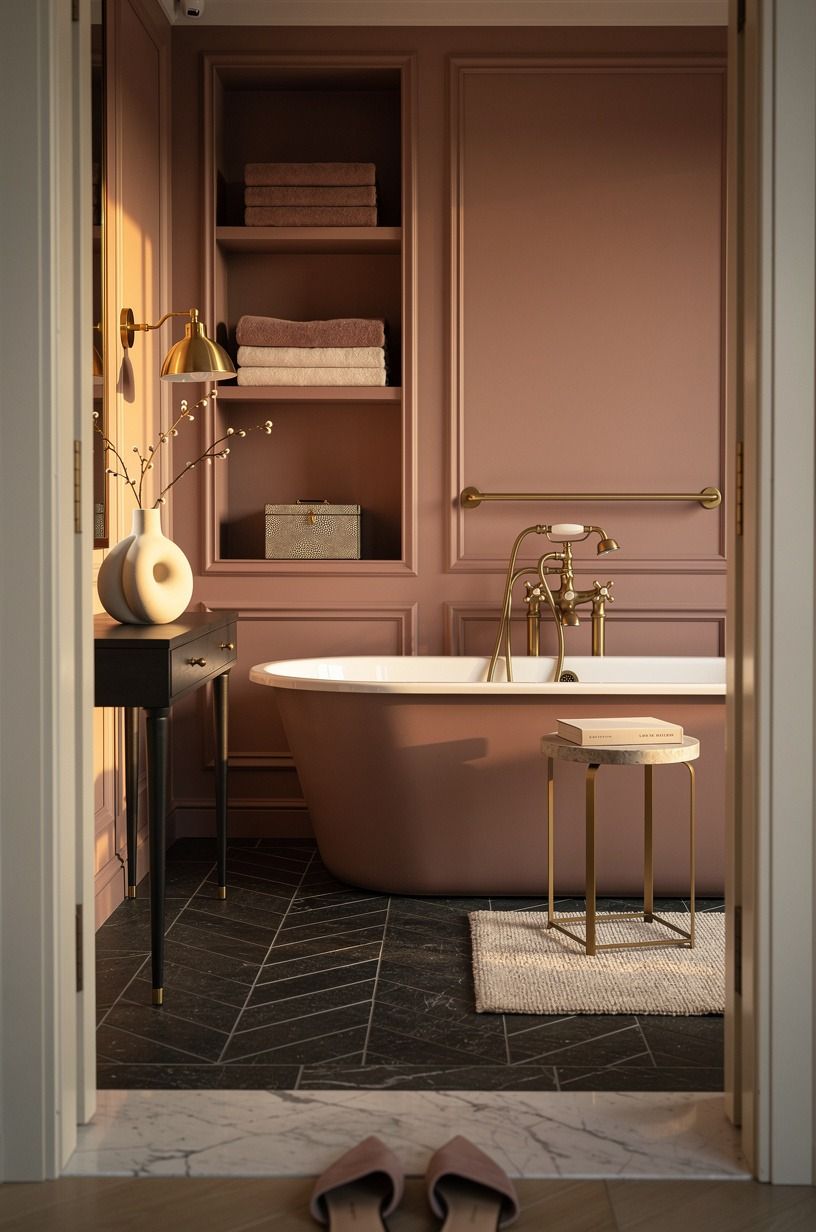
Keep the tub zone almost empty: one bath tray, one towel, one low light source. The Quiet Hotel Rule is simple, if your eye lands on five objects while you’re in the bath, remove three. Your 60×30 in standard tub already has enough visual presence against a midnight blue wall.
I like a dusty-rose textile with charcoal and brass nearby, plus one small shagreen accent near the tub. It softens echo and gives your blue walls a relaxed edge.
A plastic organizer perched on the rim is the option I’d lose first. It’s useful, sure, but it kills the peaceful mood immediately.
But don’t over-style this corner. A single wooden tray with soap and a book is plenty.
For lighter contrast around a tub, browse these powder blue bathroom ideas. You can borrow the softness without giving up the dark walls.
8Float a warm vanity against dark blue bathrooms
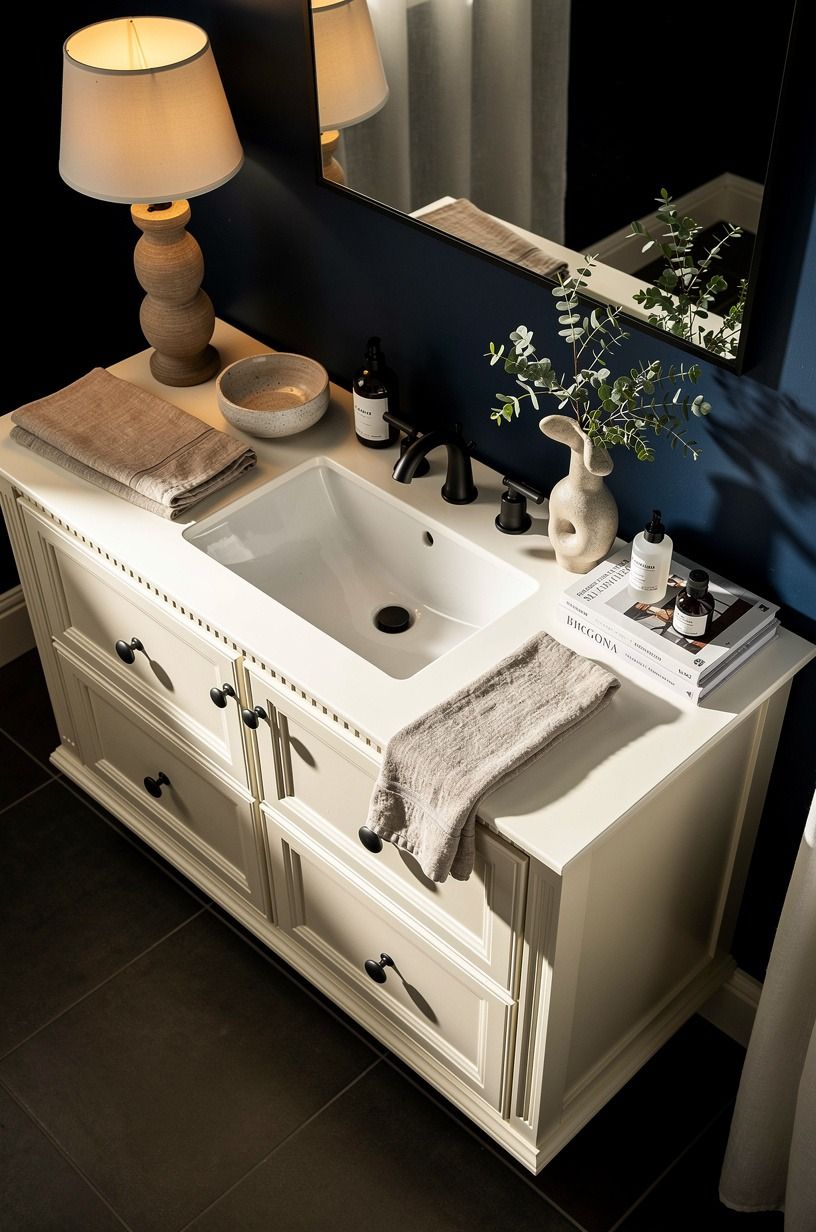
Choose a floating vanity if your floor area is modest and your wall framing allows it. Warm white, camel, and black accents keep the arrangement crisp, while washed Belgian linen can soften the room without adding more hard surfaces.
9Use navy blue bathroom inspiration to edit your textiles
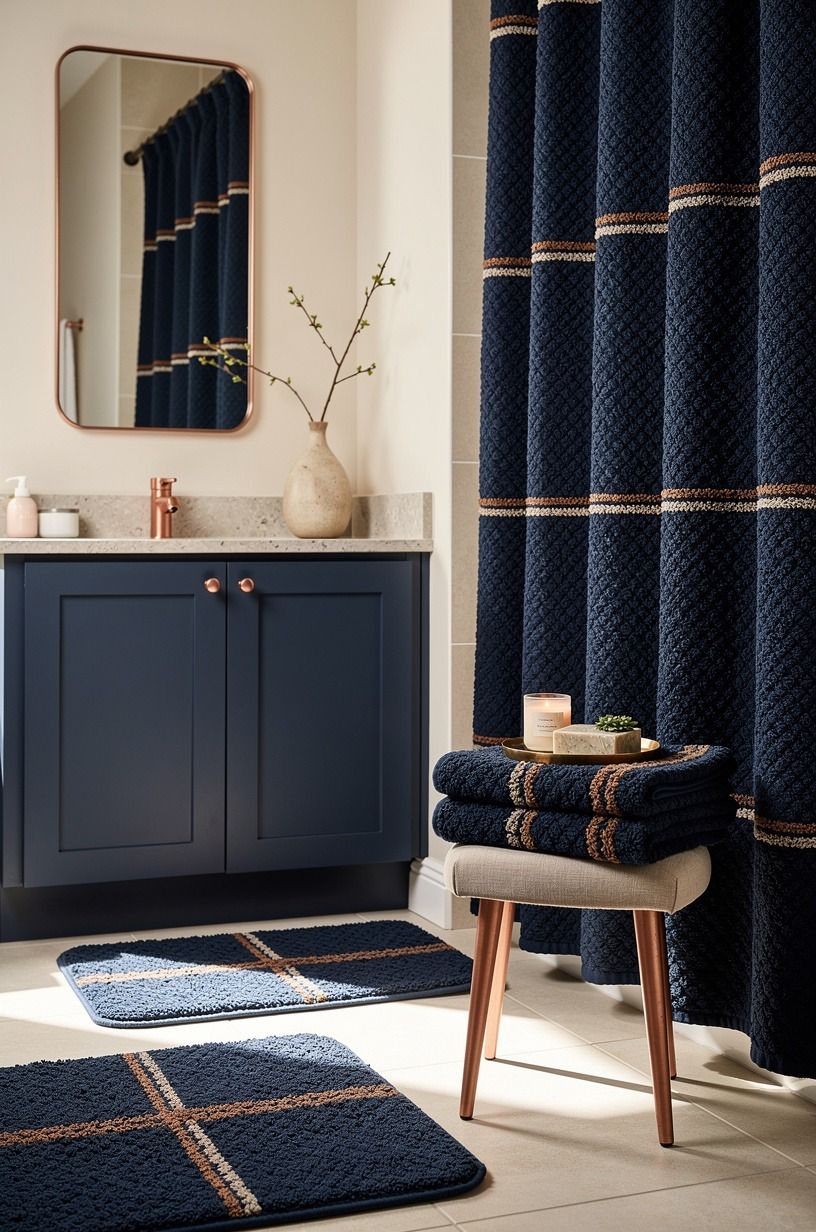
Bring in texture through towels and a bath mat, not more decorative objects. 600gsm Turkish cotton towels in cream, tobacco, or muted clay look warm against blue, while a matched navy towel set can make the room feel like a hotel supply closet. You need contrast that’s tactile.
Try one thick bath mat, two hand towels, and a small woven hamper. Midnight blue, copper, ivory, and organic bouclé make the room feel comforting without looking busy. And if you’ve got a rental, textiles are the fastest no-damage change you can make for under a modest budget.
A soft clay towel beside midnight blue paint is surprisingly good. The color looks earthy after dark, especially beside brass. That’s one of those combinations you’ll keep noticing.
10Add storage with the Closed-Door Calm Method
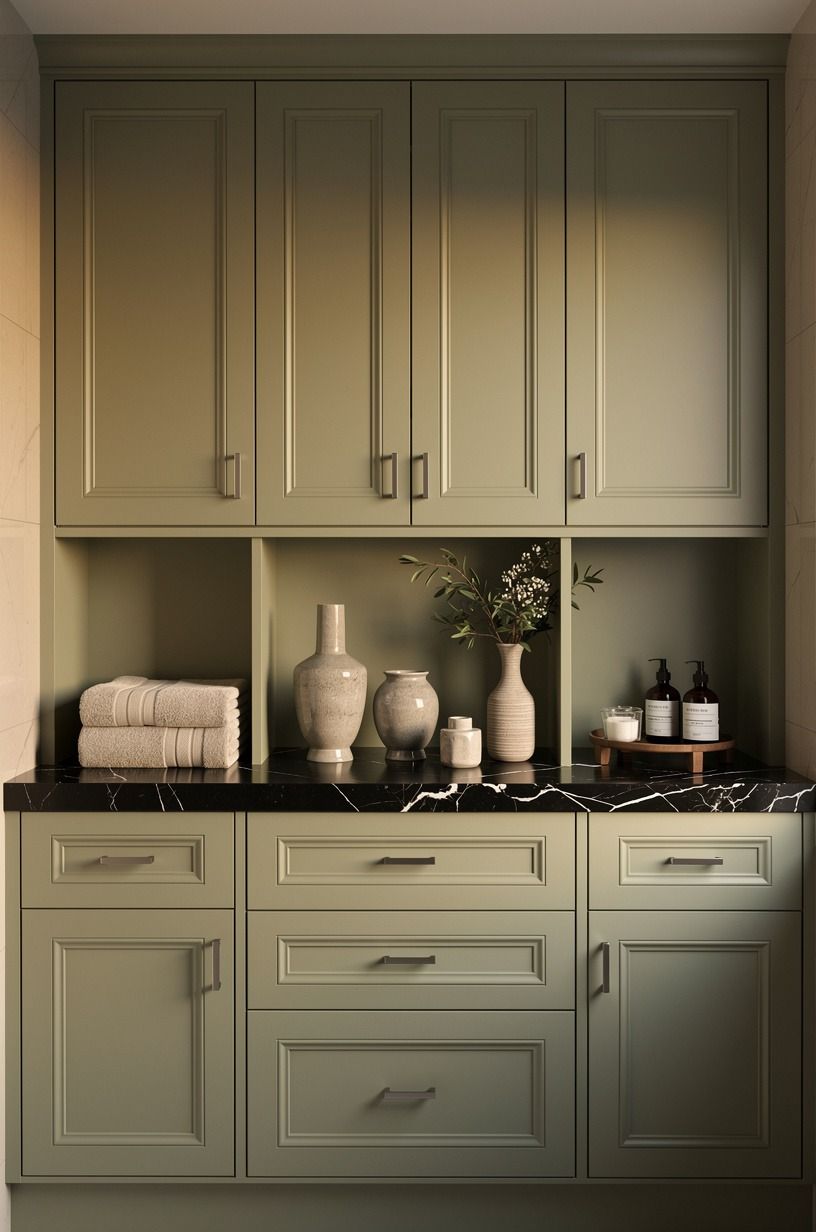
Hide the daily clutter before you add a single pretty object. The Closed-Door Calm Method means your counter holds only what you use in the next ten minutes: soap, toothbrushes, maybe moisturizer. Everything else gets a drawer, cabinet, or basket with a lid.
An IKEA GODMORGON drawer organizer helps, but you can also use matching small trays inside what you already own. Sage green, warm cream, natural wood, and Nero Marquina black marble with white veining give dark blue walls a quieter contrast. A countertop crowded with bright packaging makes even expensive tile look cheap.
I made this mistake in my own bathroom. I bought the brass canisters first, then realized the visible electric toothbrush cord was still the thing everyone noticed. Fix the boring storage problem.
Then style.
11Paint the ceiling only after you test the Shadow Canopy
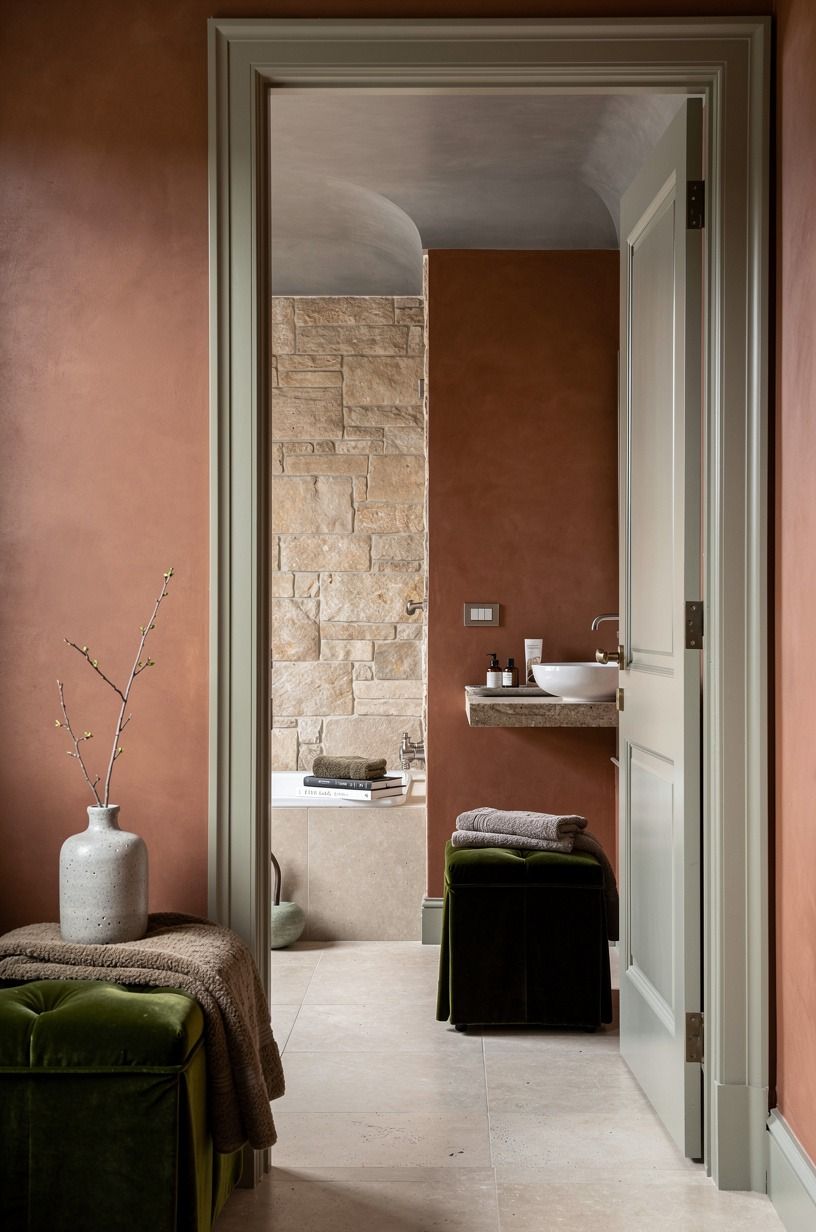
The Shadow Canopy is the move for a bathroom with decent ceiling height and one reliable light source. Paint the ceiling the same blue as the walls, then let the mirror, tile, and brass provide relief. Terracotta, stone, and olive can keep the room grounded, while deep-pile mohair velvet adds a soft note without needing more decor.
Don’t color-drench a low room with one weak overhead light. That’s not drama, it’s a cave. Instead, use midnight blue below the chair-rail line or on the vanity wall, with Sherwin-Williams Sea Salt SW 6204 overhead to keep the room airy.
What does your ceiling do at 8 p.m.? That’s the question worth asking before you commit. A sample painted above the mirror will tell you more than twenty saved photos.
You can also pull mood ideas from after-dark design inspiration, where darkness works because small points of light keep it alive.
12Finish with one personal object over more decor
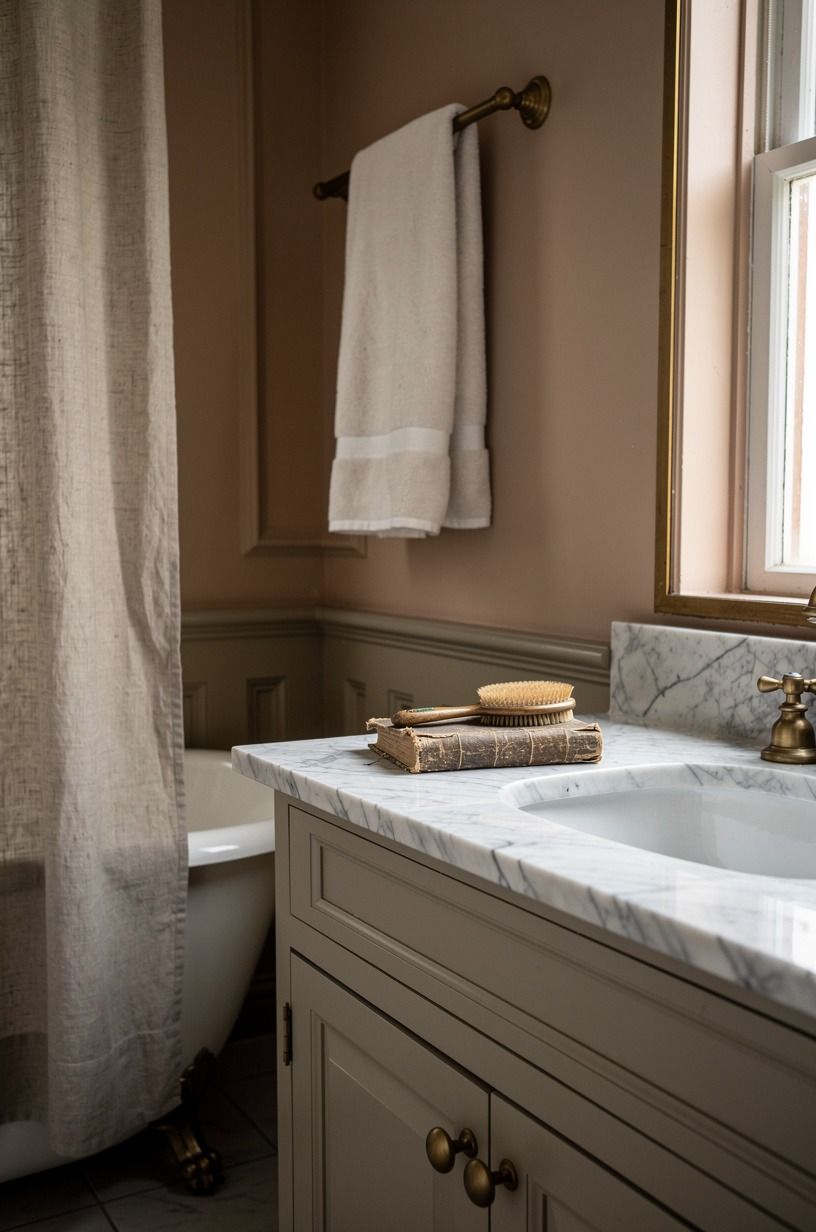
Pick one object that says somebody lives here: a small framed photograph, a weathered stool, or a hand-thrown dish for rings. Carrara marble with subtle grey veining is lovely, but it shouldn’t become a theme park. Your final layer needs a little imperfection.
I’d choose a low stool in oak over another matching tray. It gives you a place for a towel or book, and it breaks up all that tile and metal.
But keep the scale modest. In a small bathroom, one object with a job beats six objects performing “bathroom.”
This is where your room becomes lived-in. Not sterile.
Not cluttered. Just yours!
Plan the budget before you chase the mood
You can make a midnight blue bathroom feel expensive without spending high-end money, but your order matters. Put your money into paint, light, and the surface you touch most. A dramatic tile order before you’ve solved storage is a fast route to regret.
For a budget refresh, I’d paint, replace the mirror, bring in a warm faucet finish, and buy decent towels. You’ll get more after-dark atmosphere from those choices than from a cheap all-over tile job. For a higher spend, plumbing and tile are where the numbers climb fast, so plan those before ordering anything pretty.
Why midnight blue feels right now
Blue bathrooms are back because people are tired of spaces that look clean but feel anonymous. A midnight shade gives you a room that changes through the day: clear and inky in the morning, then soft and almost velvety under lamplight. It’s a more personal alternative to the endless pale-gray bathroom.
I don’t think every bathroom needs to be dark. But a small enclosed room is exactly where you can take a bigger color risk, because you’re not trying to make it behave like an open-plan living room. You’re asking it to be a pause.
My honest rule for a bathroom you’ll keep loving
I used to think the dark wall was the big decision. It isn’t.
The big decision is whether you’re willing to edit everything that fights it. Midnight blue exposes the random stuff: the cool bulb, the plastic bin, the chrome fixture you forgot was there. That sounds annoying, but it’s useful.
The room tells you what doesn’t belong.
I’ve painted over a dark bathroom once because I chose the shade from a phone screen, then installed a high-output bulb that made it look almost purple. Bad pairing.
I should’ve tested the sample at night and picked warmer lighting first. You don’t need to repeat that expensive little lesson.
Here’s the part I feel strongly about: don’t build this room around a trend photo. Build it around the hour you use it most.
If you shower at 6 a.m., you may want more pale surfaces and stronger task light. If you take a bath late, you may want the walls to close in a bit, the brass to glow, and the mirror to reflect only a small amber pool.
Both are valid, but they’re not the same project.
And you don’t have to renovate everything. A blue wall, a better bulb, and a decent towel can make an old vanity look intentional for a while.
That’s not settling. It’s knowing where the feeling comes from.
Your bathroom can be bold, serene, and practical at the same time (which is rarer than Pinterest makes it look).
The Questions Worth Answering First
What is the best midnight blue bathroom look for a small bathroom?
A midnight blue feature wall with a pale vanity is the best small-bathroom route because it gives you depth without visual clutter. Try IKEA GODMORGON storage, a rounded brass mirror, and one warm sconce. Keep your floor light so the room still has a visible edge.
Where can I buy midnight blue bathroom pieces on a budget?
Start with IKEA, Target Threshold, Wayfair, and local thrift shops for low-cost contrast pieces. Look for towels, mirrors, trays, and stools rather than matching sets. Facebook Marketplace often has solid wood mirrors that only need a new coat of paint.
How much does a midnight blue bathroom makeover cost?
A paint-and-accessories refresh usually costs about $200 to $1,200, while a vanity, partial tile, and lighting update often lands around $3,000 to $9,000. Your lowest-cost upgrade is paint plus warmer bulbs. Reusing your existing vanity saves a lot.
Can I create a midnight blue bathroom on a budget?
Yes, and you can do it with paint, edited storage, and textiles before changing tile. Your free first move is clearing the counter and removing mismatched bottles. Then add a warm bulb, cream towels, and a secondhand framed mirror.
Is a midnight blue bathroom worth it in a small space?
Yes, it’s worth it because a small bathroom can handle a more intimate color story than a large open room. The key is one pale anchor: floor, vanity, or tub. Keep your mirror generous so the dark wall has reflection and light.
Is midnight blue a good idea for a rental?
Yes, if you use removable or reversible layers. Your renter-friendly options include peel-and-stick wallpaper, a tension-rod curtain, removable sconces, and textiles. Check your lease before painting, then keep any original hardware safely labeled in a box.
Where I’d Start First
If I had to pick one step, I’d start with the lighting. Blue paint can’t look elegant under a cold bulb, and every expensive finish will fight that glare. Pin the Three-Height Light Stack for later, then let your bathroom earn its after-dark mood.