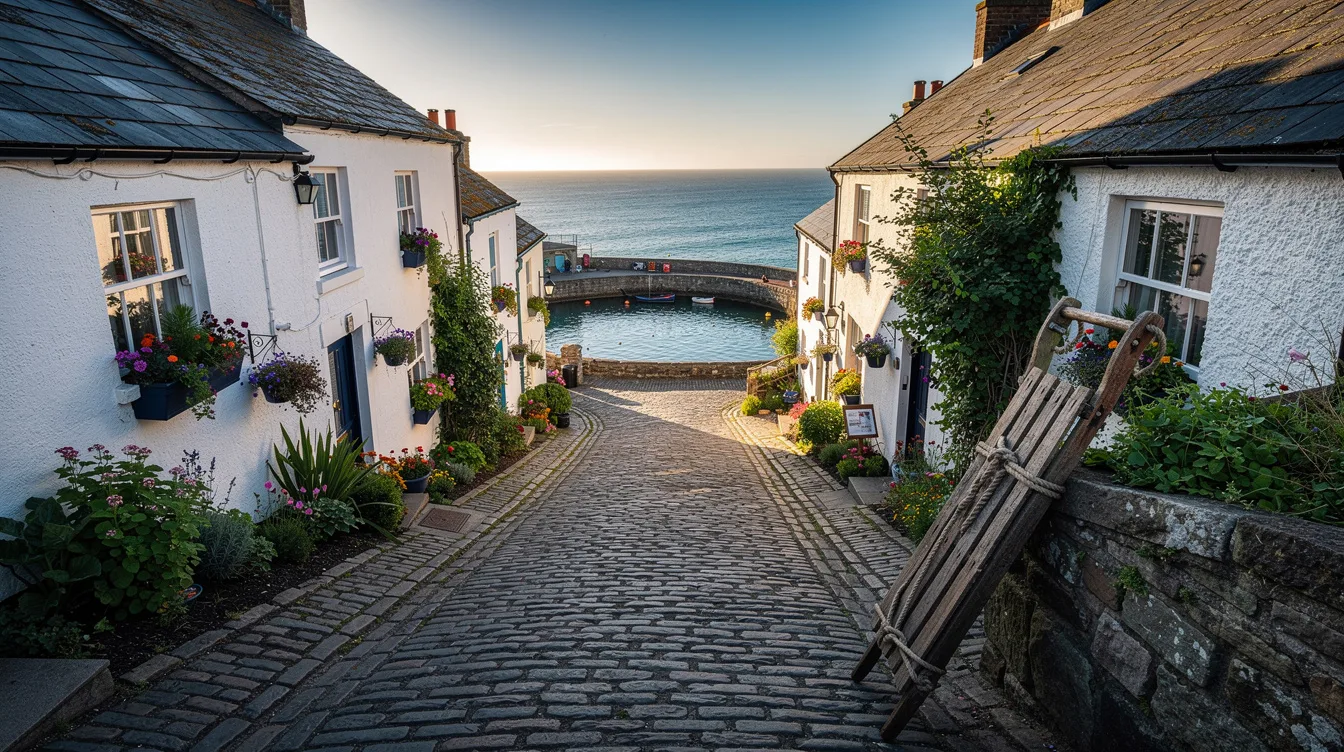
Clovelly still moves goods by sledge because its main street is too steep and too narrow for cars. This privately owned Devon village drops about 400 feet from its upper edge to the harbor, over cobbles made for feet, not delivery vans.
That sounds theatrical until you see the slope. The street is pedestrian-only, so supplies come down from the upper car park on sledges and refuse travels downhill toward a vehicle by the harbor.
A street where the hill sets the rules
You enter through a visitor center off the A39, then leave the practical world of parking behind. Clovelly’s main street pitches toward the water between pale cottages, with cobbles underfoot that demand your attention.
And that incline explains nearly everything. Cars cannot use the street, so the sledge remains a working answer to a physical problem rather than a period costume put on for visitors.
The descent has drama, but it also has consequences. Your knees will feel the downhill route, and the return climb is serious enough that anyone with limited mobility should consider the separately charged Land Rover harbor transfer.
Why sledges have outlasted delivery vans
The village has used donkeys for goods and cargo, though sledges now do most of that work. Goods are pulled downhill from the upper car park, because there is simply no route for a truck through the cobbled lane.
But this is not an attraction performed on schedule. It is daily logistics shaped by a steep street, which makes the sight of a loaded sledge more interesting than any staged historical display.
You can watch the same downhill geometry at work around the harbor. The stone, the tight corners, and the drop all make modern convenience feel secondary to getting things safely where they need to go.
More than 50 listed buildings on one descent
Over 50 of the 71 buildings on the main street are listed. That density gives the walk a remarkable continuity, with terraced cottages holding the line along a street that seems to tilt straight into the sea.
And preservation here comes with a clear trade-off. The village is tourist-facing, yet the buildings are maintained within a private estate that has managed Clovelly since 1738.
There is a fee for entry through the visitor center, which includes parking, two museums, Clovelly Court Gardens, and an audiovisual history guide. Check current opening hours and admission before you set out, since those details can change.
The harbor is the payoff, not a backdrop
At the bottom, the harbor gives the descent its purpose. Fishing activity, seawall stone, and the open reach of Bideford Bay make this the kind of waterfront that can rearrange an afternoon if you let it.
But don’t rush down only for the water and rush back up. The Fisherman’s Cottage, the Kingsley Museum, Clovelly Court Gardens, and two historic inns give you reasons to slow the pace.
You’ll also find coastal walks from the village, while the South West Coast Path reaches its upper edge. The air can carry salt from the harbor, then turn leafy as the street climbs toward the wooded cliffs.
Can you avoid the steep walk?
Yes, to a point. The harbor transfer can help visitors with limited mobility, but the cobbled main street is not wheelchair-friendly, and the village’s physical character is exactly what makes it difficult.
That is the honest bargain at this car-free harbor village. You are not arriving at a place smoothed out for easy circulation; you are entering one that still works around its terrain.
Getting to Clovelly without guessing
Clovelly sits on the north Devon coast, about 10 miles west of Bideford. The visitor center is off the A39, and Stagecoach route 319 includes Barnstaple, Bideford, and Hartland.
And if you walk in on public highways, the village is legally accessible on foot without using the visitor center route. Dogs must be kept on a lead, a small rule that matters on a narrow pedestrian street.
By the time you reach the harbor, the street above looks less like a quaint survival than a working incline. A sledge scrapes over cobbles, the water waits below, and Clovelly makes perfect sense.