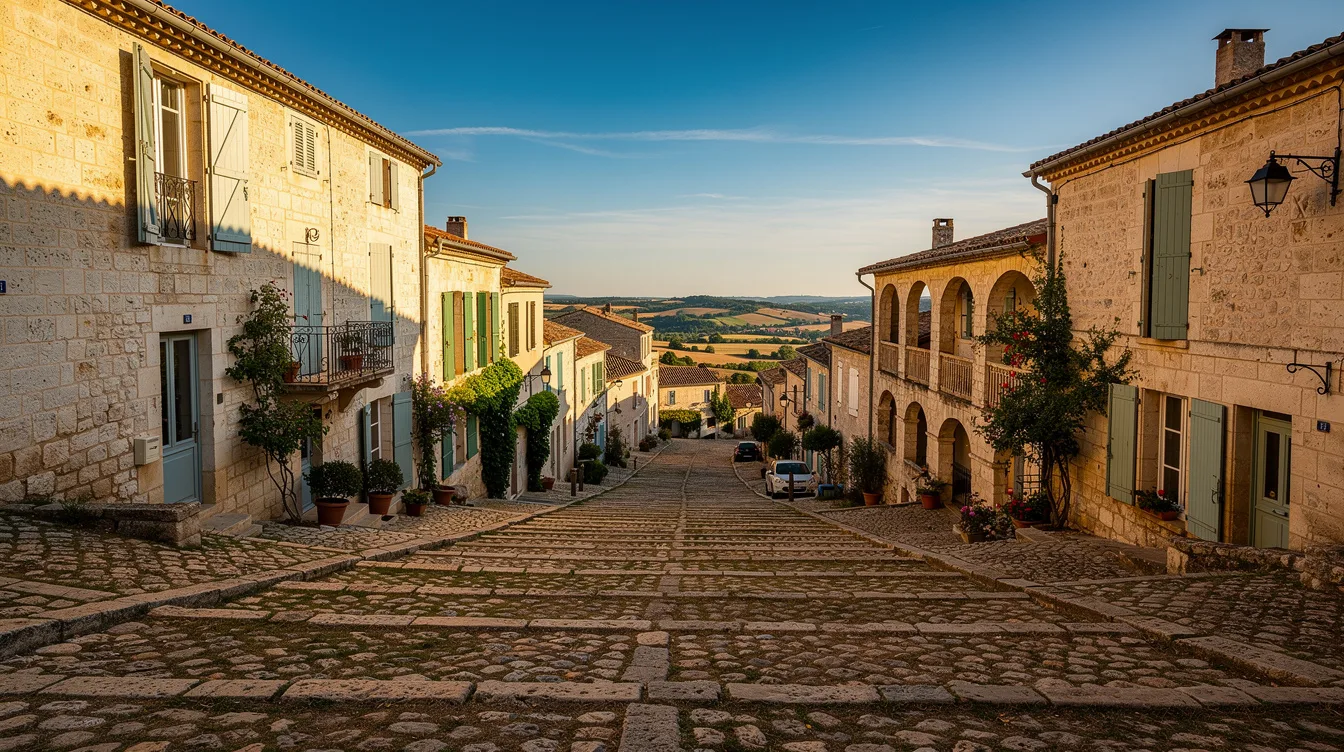
Lauzerte rises above the pale limestone hills of Quercy Blanc in northwestern Tarn-et-Garonne. Founded in the 12th century, this fortified village still catches arriving walkers at the right moment, when the climb is done and the rooftops suddenly fill the view.
It welcomes pilgrims on the Santiago de Compostela routes, yet it doesn’t feel built around them. You’ll find a working French village with about 1,460 residents, old stone underfoot, and enough silence between arrivals to notice the wind.
A Camino stop with a real village underneath
Lauzerte is an emblematic stop on the Via Podiensis, also known here as the GR 65. That matters because pilgrims arrive on foot, so the village’s perch is not a decorative detail. It’s the final push of the day.
But you don’t need to be walking to appreciate the logic of the place. The settlement sits on a promontory above parallel valleys and rivers, so its streets hold the sense of a lookout as much as a town center.
And that elevated position gives Lauzerte its best argument. You can look over the Quercy Blanc’s limestone country without needing a trail plan, a car ride, or a grand itinerary.
Place des Cornières has one unexpected corner
The place to begin is Place des Cornières, the main square framed by old houses and arcades. It’s handsome, certainly, but the square avoids museum-piece stiffness because the local market still takes place here on Saturday mornings throughout the year.
Look down before you look up. One corner of the paving lifts improbably from the ground, a contemporary work installed in 1988. It’s playful against all that age, and it gives the square a welcome flash of strangeness.
But don’t rush through after taking the obvious photograph. The arcades and large merchant doorways reward a slower lap, especially when the wrought-iron business signs start catching your eye above the street.
Can you visit without following the Camino?
Yes. You can come for the historic center, the square, artisan galleries, and wide views over the hills. But the pilgrim route gives the village its pulse, so even a short visit feels more interesting when you notice backpacks passing through.
The village belongs to Les Plus Beaux Villages de France, a designation limited to 155 villages nationwide. That’s a useful signal, though the best reason to stop is less official: Lauzerte has enough texture to hold you after the first panorama.
Small streets, big pauses
From the square, follow the narrow streets through the historic center toward the Jardin du Pèlerin. The name tells you who this place has long received, but the garden works for anyone who needs a bench and a break from stone lanes.
And the village has religious architecture without making every stop feel compulsory. The Church of Saint-Barthélemy is part of the walk, while artisan galleries add a quieter present-day counterpoint to fortified walls and old facades.
Lauzerte was founded by the Count of Toulouse and once had a castle, enclosure, towers, and six fortified gates. Much has changed since then, of course. Yet the tight geometry of the old town still makes its defensive past easy to feel.
July and August bring dinner into the square
If food is part of your travel planning, Saturday morning is the dependable choice for the year-round market. The surrounding farmland is known for Melons de Quercy, white Chasselas de Moissac grapes, and Agen prunes, so the region has plenty to put on a table.
But summer shifts the mood. Every Thursday in July and August, the main square hosts gourmet markets. Expect the social version of dinner, with the square carrying more chatter and the old walls holding the evening light.
You can visit all year, which is a genuine advantage for travelers avoiding peak-season pressure. At the same time, summer’s food markets make July and August the livelier choice, while the rest of the year leaves more room for the village’s natural hush.
Give the hill town time to settle in
Don’t treat Lauzerte as a quick roadside photo stop. The appeal builds as you move from the square into smaller lanes, then back toward the overlooks. You’ll understand more by wandering than by checking off every historic detail.
And accept the trade-off: this is a small hill town, not a city packed with monuments. Its pleasures are old paving, shuttered facades, an occasional pilgrim arriving tired, and the chalky hills spreading outward beyond the last houses.
By evening, the sounds thin out around Place des Cornières. The raised corner of paving remains in the square, lifting quietly toward the sky.