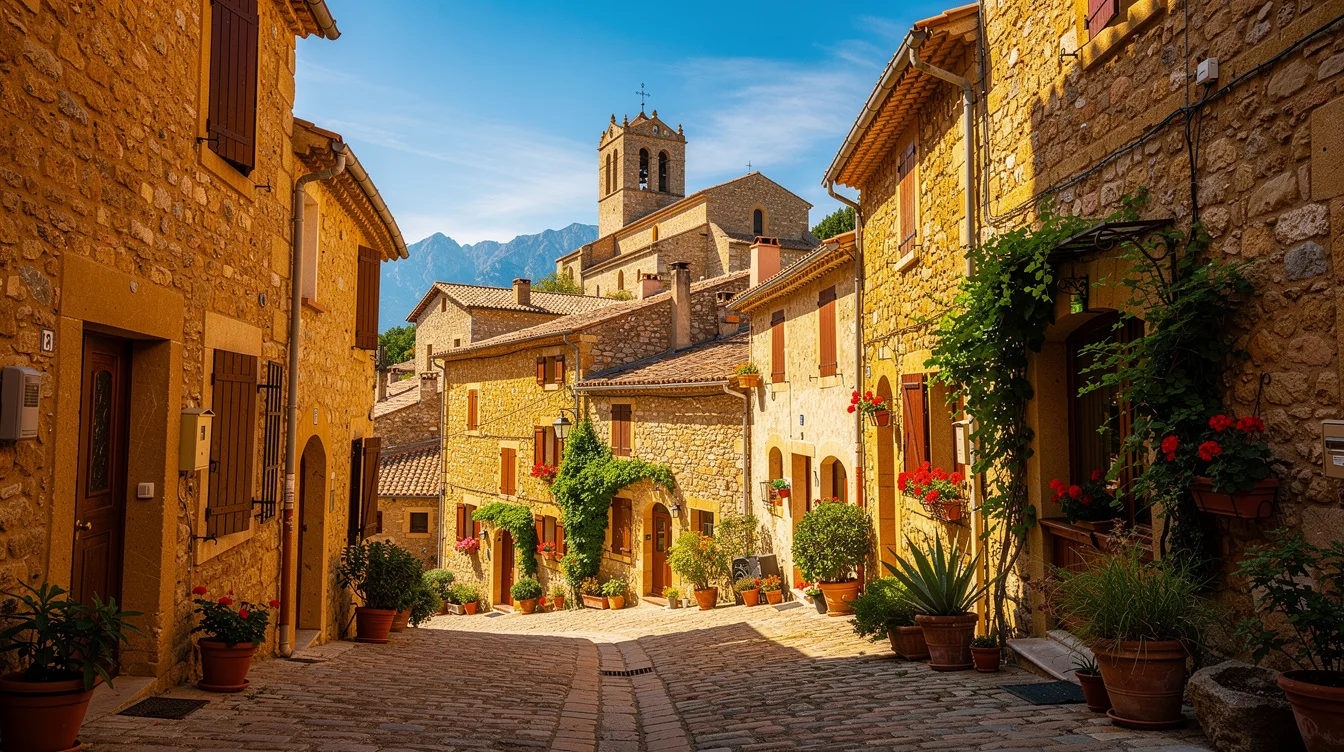
Eus rises above the Conflent in southern France, and its appeal is refreshingly direct: steep cobbled lanes lead upward to an 18th-century church. This small Catalan commune is also part of Les Plus Beaux Villages de France, a designation that feels earned once you start the climb.
You’ll find Eus in the Pyrénées-Orientales, just northeast of Prades and about 22.4 miles from Perpignan. It’s close enough for an easy detour, but its tilted streets make it feel removed from the traffic below.
A hilltop village built for wandering
Eus has roughly 386 residents, so don’t expect a packed itinerary or a town designed around rush-hour visitors. You come to walk slowly, following narrow passages, stone steps, and lanes paved with rounded pebbles.
And the incline is real. Good shoes matter because the village’s prettiest corners are reached on foot, often after another short staircase that looks harmless from below.
The terraces and façades stack up the hillside, opening toward the Conflent valley and the Canigou massif. The views pull your attention outward, but the close-up details are better: warm stone underfoot, shuttered walls, and the hush that arrives when no car can fit through the lane.
Saint-Vincent-d’en-Haut is the reason to keep climbing
At the top stands Saint-Vincent-d’en-Haut, built in the 18th century on the site of the former citadel. It dominates Eus in the practical sense, too: if you keep moving uphill, you’ll eventually reach it.
But don’t race there. The ascent works because the church appears in fragments between roofs and walls, then suddenly takes over the ridge. That slow reveal makes the final stretch feel more satisfying than a drive-up viewpoint ever could.
The church gives the village its clearest visual anchor, while the old citadel site adds a sense of how strategically this perch was chosen. Eus is compact, but it doesn’t feel small when the valley opens below you.
Is Eus easy to explore on foot?
Yes, if you’re comfortable with slopes and stairs. The lanes are narrow and steep, so this is better for an unhurried walk than for anyone needing level pavement throughout.
And that limitation is part of the point. Eus doesn’t hand over its best angles immediately, which keeps the experience intimate rather than polished into a checklist.
Two churches, separated by centuries
Before or after the climb, look for the village’s lower church. The église basse dates from between the 11th and 13th centuries, making it far older than Saint-Vincent-d’en-Haut.
That contrast gives Eus more depth than its size suggests. One church sits high above the village, while the other reaches back to the medieval period. You don’t need a long museum visit to feel the difference in time.
But keep expectations sensible. Eus is not a place with major-city layers of attractions, and that’s exactly why the walk works. Its history is folded into the route rather than presented behind ropes.
Why the light matters in Eus
Eus is often described as one of France’s sunniest places, and the village’s hillside setting makes the light part of the experience. Stone walls, terraces, and distant slopes all seem to hold it a little longer.
You’ll notice it most when you pause. The pebble paving brightens underfoot, the church above catches the eye, and the valley beyond looks broad enough to slow down an otherwise quick stop.
At the same time, sun and slope can make the visit feel more demanding than the map suggests. Bring water, wear shoes with grip, and give yourself permission to stop often.
A small detour from Perpignan that feels complete
From Perpignan, Eus is about 22.4 miles away, and from Prades it’s roughly 2.5 miles. That makes it a logical stop in the Conflent, especially if you want a village visit with a clear focal point rather than a long list of sights.
And because the village is small, you can let the terrain set the pace. Start low, follow the lanes upward, and let Saint-Vincent-d’en-Haut give the walk its finish.
By the time you turn back downhill, the church remains above the roofs, and the smooth pebbles under your shoes make the village feel less like a stop and more like a climb worth taking.