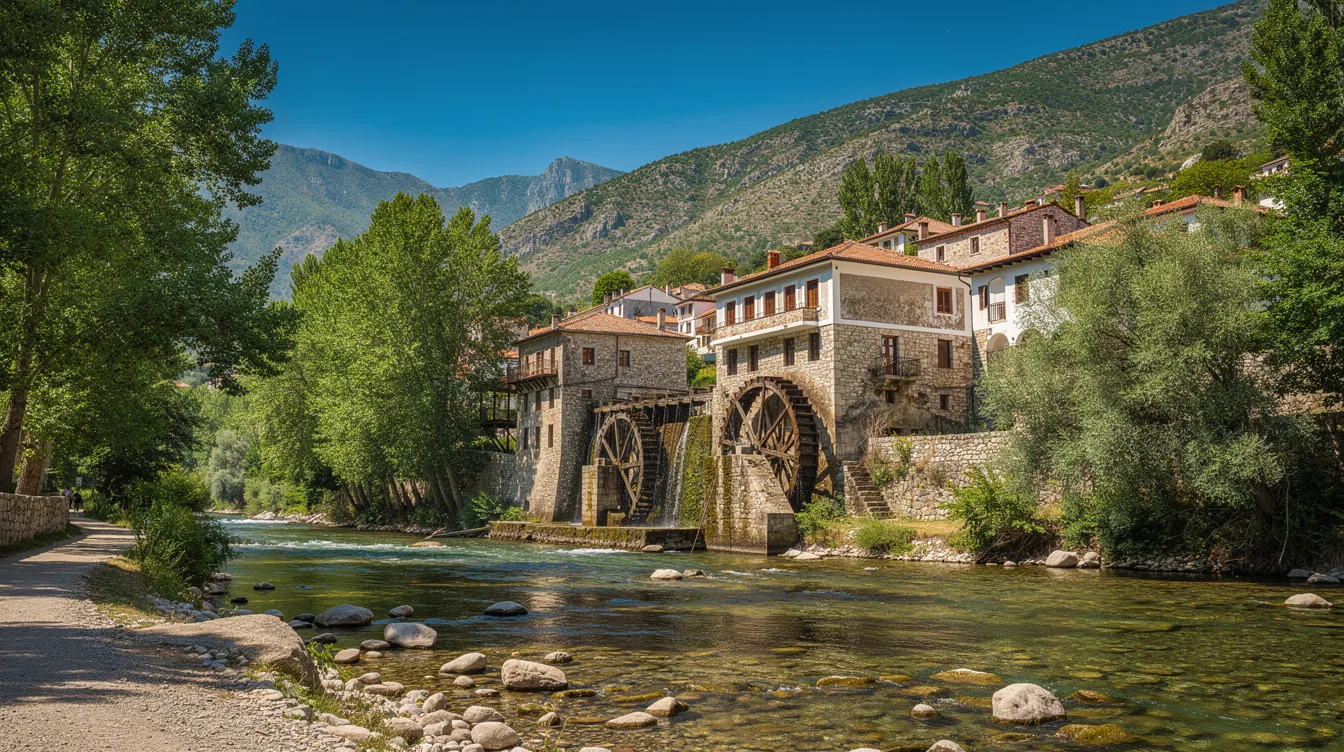
Dimitsana sits high in central Peloponnese, its stone houses looking over the Lousios Gorge. But this Arcadian village carries a harder history than its calm lanes suggest.
During the 1821 Greek War of Independence, its 14 gunpowder mills ran day and night for independence fighters. That work earned Dimitsana the name “the Nation’s powder keg.”
Fourteen mills made this mountain village matter
The central story is unusually direct. Fourteen powder mills worked without pause, turning local water power into gunpowder for Greek fighters during the war.
And the cost reached into the village’s intellectual life. Warriors used paper from the library’s collection in those mills, so part of its holdings was destroyed to keep the gunpowder supply moving.
You can feel the tension in that fact even without a reenactment. A quiet mountain settlement became part workshop, part supply line, because water-powered industry could support a rebellion.
The nickname is not decorative. “The Nation’s powder keg” is tied to a specific wartime job, and it gives the village a sharper identity than the usual stone-house stop.
Start with water power, then follow the gorge
The Open-Air Water Power Museum is the clearest place to understand the machinery behind the story. Restored pre-industrial facilities include a flour mill, a tannery, a traditional cauldron, and a gunpowder mill.
But don’t expect the village itself to feel like a museum set. Dimitsana is a traditional settlement with cobbled lanes, restored stone mansions, churches, a square, and its familiar clock tower.
The water is the connecting thread. It powered the mills, and the same terrain pulls visitors toward the Lousios Gorge, where hiking routes link Byzantine sites.
You’ll find the Old and New Philosophou monasteries and Prodromou Monastery in the gorge. The walk is the reward, though the mountain setting asks more of you than a quick village stroll.
Is the gorge worth making time for?
Yes, especially if you want Dimitsana to be more than a history stop. The gorge turns a compact village visit into a longer day of paths, slopes, stone walls, and the cooler feel of water below.
And late spring or early autumn makes the most sense for hiking. Winter has its own appeal for visitors from Athens, but the elevation can bring cold conditions and occasional snow.
A monastery founded in 963 changes the scale
The Philosophou Monastery was founded in 963. That date stretches the visit far beyond the events of 1821.
But the history is not all preserved in place. The town’s name first appears in a 967 Patriarchate document connected with the monastery, which makes the gorge feel less like scenery and more like an old route through Arcadia.
Dimitsana was built on a mountain slope. That height explains both the broad southern outlook and why winter here can feel properly cold.
You should give the center time before heading out. The lanes are tight and stony, so a slow walk suits the place better than trying to tick off every sight.
The library holds what the mills could not take
Dimitsana’s Library now holds about 35,000 books, manuscripts, and documents. After learning that wartime paper was sacrificed for gunpowder, that number lands differently.
The library also contains a museum with weaving, looms, handicrafts, and archaeological material. It is a compact counterweight to the mill story, showing that this village has long been a place of study as well as production.
And that contrast is the reason to come. Dimitsana is solemn, but not frozen in its past. Its square, post office, hotels, and school keep it rooted in ordinary village life.
Getting there takes a car and a little patience
Dimitsana lies about 126.1 miles from Athens. The drive from Athens generally takes about 2.5 hours via Tripoli and mountain roads toward Gortynia.
A car is strongly preferable because the gorge, monasteries, and nearby villages spread beyond the center. That said, the approach is part of the point: the road trades speed for a slow arrival in Arcadia.
Plan 2-3 nights if you want history and hiking without rushing. By evening, the stone lanes quiet down, and the mountain air makes the old clock tower feel less like a landmark than a final note.