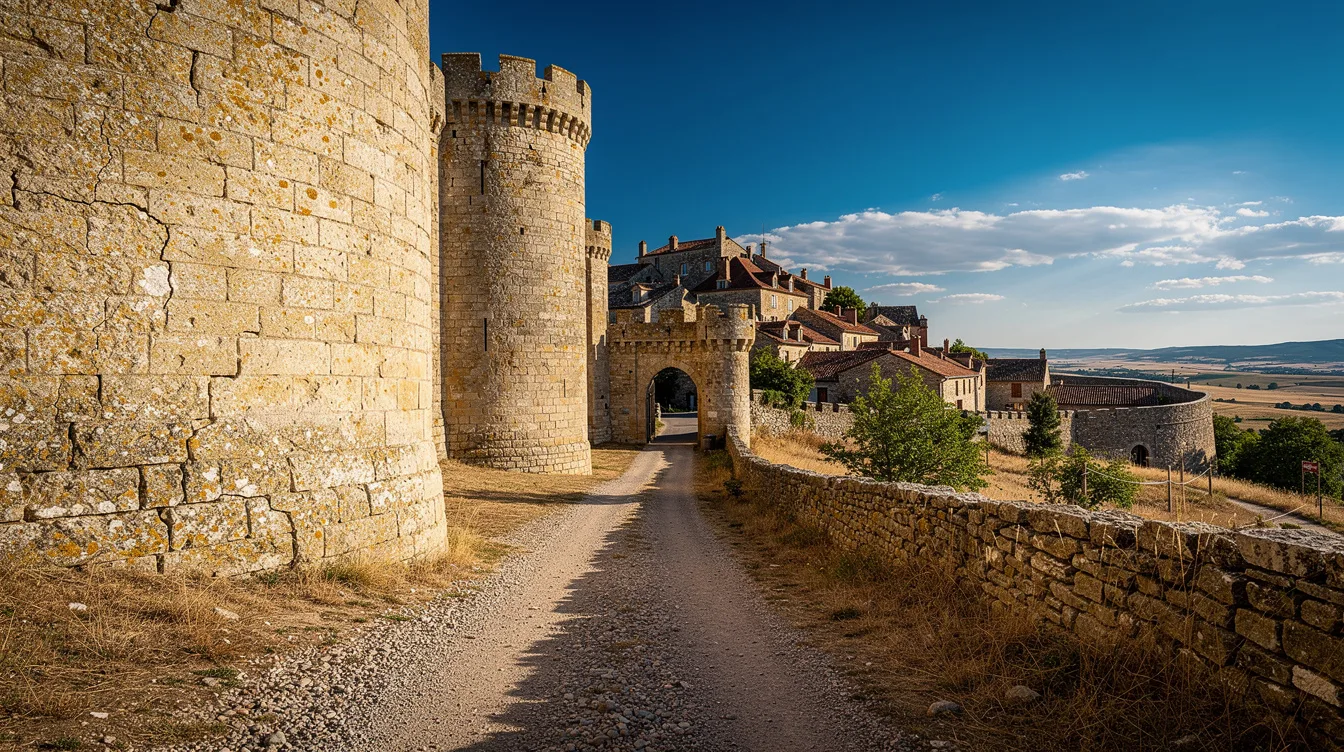
La Couvertoirade keeps its medieval walls because the Hospitallers built them between 1439 and 1450. That date matters. The stone circuit is not a vague relic of the Templars, but a later response to a changed order on the Larzac plateau.
You arrive in a commune of Aveyron where the walls still set the mood before you enter. They are solid, close, and almost stubborn. But the village’s story begins earlier, with the Templars holding this land from the 12th century.
The walls came after the Templars
The Templars controlled La Couvertoirade under the Commandery of Sainte-Eulalie-de-Cernon. Their fortress dates to the 12th and 13th centuries, although its two upper floors have disappeared. And that missing height makes the surviving stone feel less like a museum piece than an argument with time.
When the Templar order was dissolved in 1312, its property in the causses passed to the Knights of St John of Jerusalem, also called the Hospitallers. They then built the curtain wall that still largely encloses the village. You can see the handoff in the architecture: an older fortress within a later defensive ring.
This is the point the history makes best on foot. The 15th-century towers don’t merely frame a pretty old center. They explain why La Couvertoirade still has such a clear edge, where open plateau gives way to narrow stone lanes.
Inside the 15th-century enclosure
The ramparts are the main event, and they deserve your first unhurried circuit. Stone streets lead past houses with lauze roofs, former sheepfolds, and the communal bread oven. The air can feel dry and bright on the causse, while the lanes hold a quieter shade.
But don’t mistake compact for slight. The village has the Templar castle, built in 1249, plus Saint-Christol church, which was connected first to the Templars and later to the Hospitallers. You’re reading two religious-military eras in one small place.
La Couvertoirade is listed among Les Plus Beaux Villages de France and belongs to the UNESCO cultural setting of the Causses and Cévennes. Those labels can raise expectations. Here, they fit because the old structures remain part of the village’s actual shape, not isolated behind barriers.
The Larzac is part of the visit
Beyond the enclosure, a restored windmill stands outside the walls. It gives the village some breathing room, and it reminds you that this was never only a fortified cluster of buildings. The Larzac plateau is present in every open horizon and exposed path.
You can take an easy loop from the village across the causse. It covers 6.6 miles, takes about 3 hours 20 minutes, and gains 486 feet. That is manageable for many walkers, but it is still a real outing, so bring water and allow for the plateau’s openness.
Is the walk worth adding?
Yes, if you want the setting as much as the stonework. The village lanes are intimate, while the loop opens the scale of the Larzac around them. And that contrast is La Couvertoirade’s best trick: enclosed and watchful inside, broad and spare once you leave the gate.
There is a practical limit. The sources don’t specify the best months or on-site services, so don’t build a visit around assumptions about weather or opening hours. Check current arrangements before you go, especially if the walk is your priority.
Getting there without losing the plot
La Couvertoirade lies about 26.1 miles southeast of Millau and roughly ten minutes from the A75. That makes it accessible by road, but it doesn’t make it feel urban. Once you reach the Larzac, the setting slows the day down.
The strongest approach is simple: arrive with time to walk the wall, find the 1249 castle, then step beyond the ramparts toward the mill. You don’t need an elaborate itinerary. The village’s compact scale lets the details surface gradually, from lauze roofs to the old sheepfolds.
And stay long enough for the stone to change tone in the light. By the time you turn back toward the walls, the plateau is quiet again, and the towers hold the edge of the village like they have since the Hospitallers’ project.