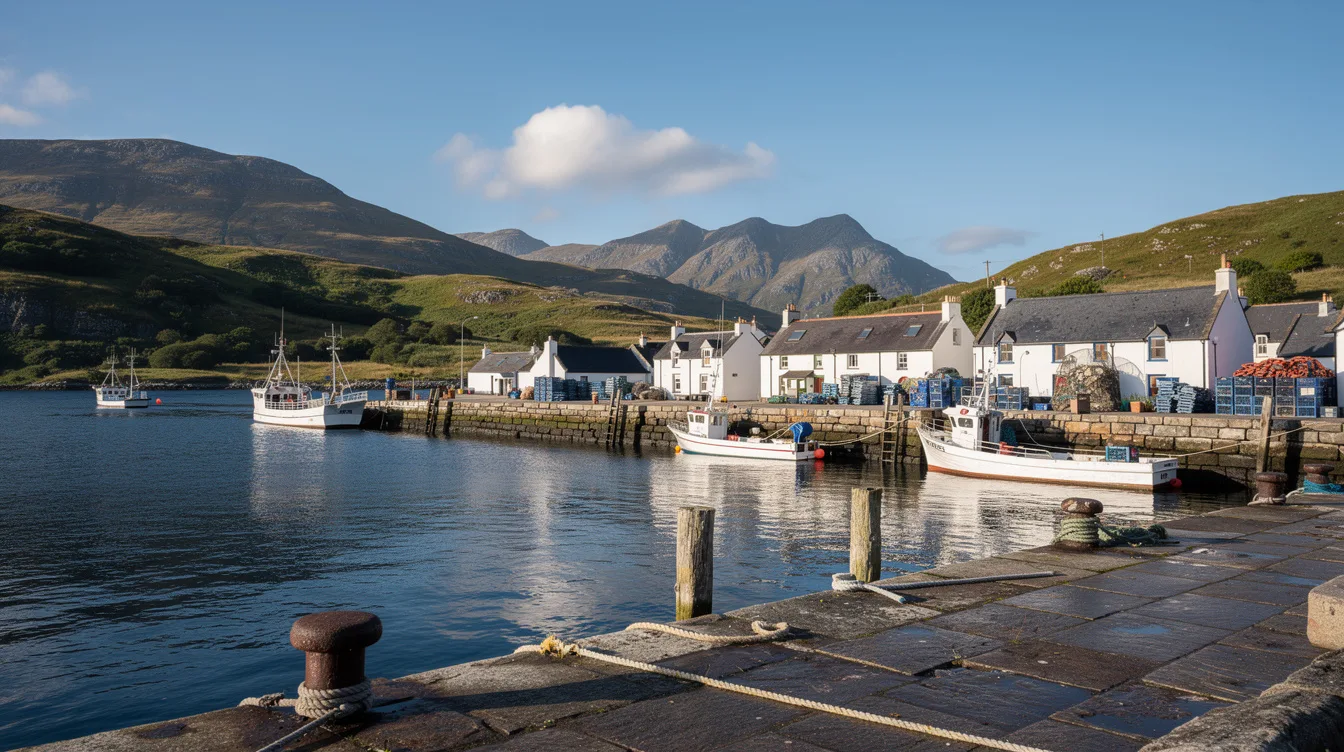
Ullapool began in 1788 with a very specific job: land herring. The British Fisheries Society founded this Loch Broom port for the trade, and the village feels purposeful instead of merely quaint.
Set about 45 miles northwest of Inverness, Ullapool is compact, whitewashed, and busy around the water. You arrive to a harbor that still earns its keep, with fishing vessels, leisure boats, and ferries sharing the deep sea loch.
A herring port drawn on purpose in 1788
Before the port, this spot was a hamlet of just over 20 households. Then the British Fisheries Society founded Ullapool as a herring port, because Loch Broom offered a significant natural harbor on the east shore.
And Thomas Telford designed the new town. That fact matters when you walk its orderly streets: Ullapool wasn’t shaped slowly by chance, but laid out around the harbor.
The original herring purpose isn’t a museum label pasted onto a resort town. The harbor remains a fishing port, yachting haven, and ferry terminal, so you still hear the practical rhythm of a place built around departures and arrivals.
But don’t expect an old port frozen in place. Ullapool has pubs, seafood, the Ullapool Museum, and places to stay, which makes the historic center easy to enjoy without pretending its daily work has stopped.
Loch Broom makes the harbor possible
Loch Broom is a deep sea loch, and that shelter is the town’s whole logic. The water reaches into rugged Highland country, so the harbor feels protected even as mountains rise beyond the roofs.
You’ll see Bheinn Ghobhlach to the west and An Teallach to the southwest across the loch. The latter is a challenging climb and a considerable distance from the nearest road, so it asks more of you than a quick harbor-side stroll.
And that contrast is Ullapool’s appeal. The village itself is manageable on foot, but the country outside it quickly gets serious, with shoreline walks on one side and Highland summits on the other.
The area is also associated with the Moine Thrust Belt, a major geological structure extending from Loch Eriboll south toward Skye. You don’t need a geology degree to feel the scale, though the setting is hard to ignore.
The ferry keeps Ullapool connected
The harbor is not simply scenic. Caledonian MacBrayne runs a roll-on, roll-off car ferry from Ullapool to Stornoway on the Isle of Lewis, across to the Outer Hebrides.
That route makes Ullapool a gateway to Lewis and Harris, and it gives the waterfront an urgency that many small ports lack. Cars queue, passengers gather, then the ferry pulls the town’s attention toward open water.
But the same connection can make the village busy in high season. If you’re bringing a car or relying on the ferry, book accommodation and passage ahead, because Ullapool’s small scale doesn’t leave much room for last-minute improvising.
You can also use the town as a base for the northwest Highlands. With a car, nearby options include Inverpolly National Nature Reserve, Stac Pollaidh, Assynt, Corrieshalloch Gorge, and Falls of Measach.
Small town, working-waterfront energy
Ullapool had 1,520 residents in 2016, making it the largest settlement in Wester Ross. That is enough population for useful services and a lived-in feel, but not enough to dilute the sense that the harbor remains the center.
And you can choose your pace here. Take an easy shoreline route, look for seabirds on a Summer Isles day trip, or join a more demanding mountain walk. Dolphins or porpoises are possible offshore, though nature doesn’t run on a timetable.
There is culture too, from the arts center to music at local venues. The Ullapool Guitar Festival takes place annually in early October, but the town is more convincing in its ordinary moments than during any programmed weekend.
The road from Inverness passes through Ullapool on the North Coast 500 route, which helps explain the traffic. Still, the road also makes the village practical, and that practicality is part of its character rather than a flaw.
Come for the origin story, stay for the harbor
Ullapool works best if you treat it as a port first and a postcard second. Its 1788 herring-town plan, working boats, and Stornoway ferry give the place a reason to exist that many coastal stops can’t match.
But leave room to stand by the water without an agenda. By the time the ferry moves out across Loch Broom, the harbor returns to its smaller sounds, and the white buildings face the Highland slopes.