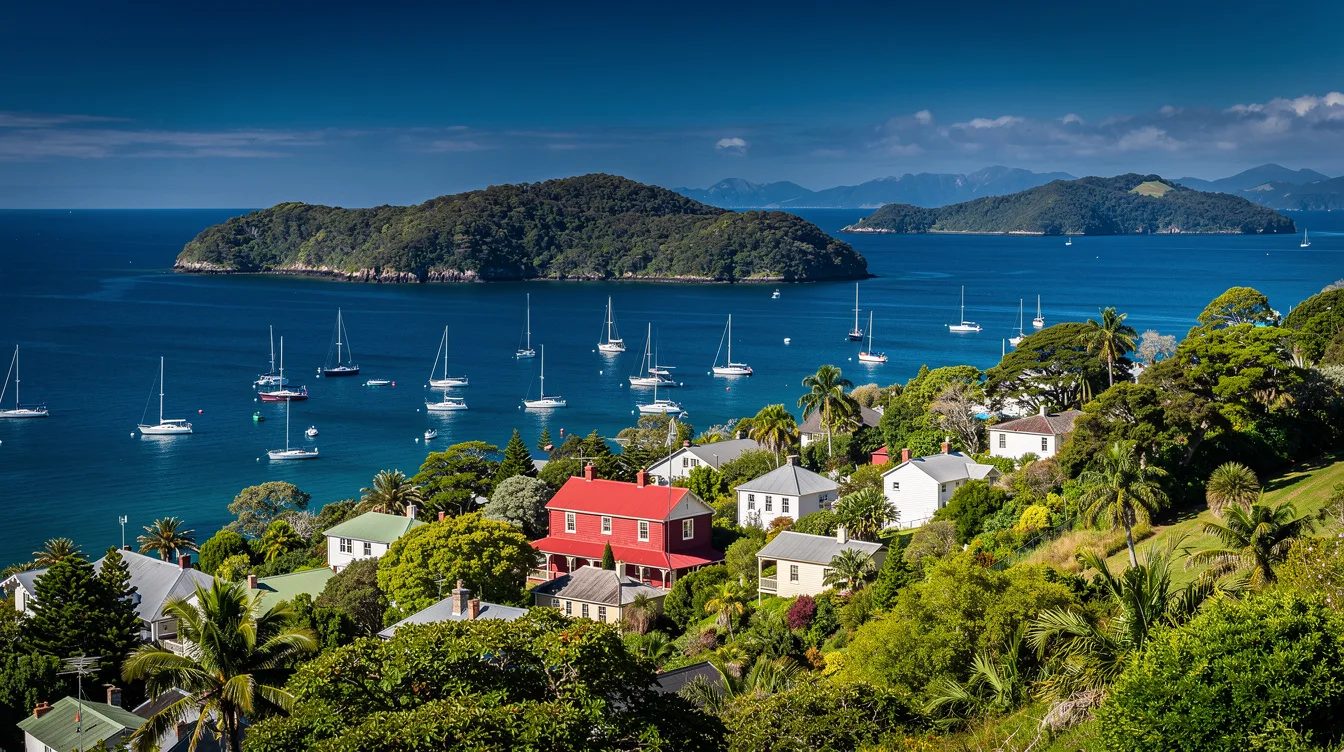
Russell sits across the water from Paihia in New Zealand’s Bay of Islands, and its name carries a trick of history. The place first called Russell was nearby Ōkiato, chosen as the country’s first capital in 1840. Then the name moved to the former Kororāreka.
That swap is more than a footnote. It gives this small Northland town an unusually layered feel, where a waterfront cafe can sit a short walk from places tied to the country’s earliest European settlement.
You arrive by passenger ferry from Paihia in about 15 minutes, crossing the inner Bay of Islands toward a narrow peninsula. The ride is brief, so Russell feels reachable. But the water creates enough separation that the pace changes almost immediately.
A capital’s name, moved across the bay
Ōkiato, also called Old Russell, became New Zealand’s first capital in 1840. It had been named Russell after a British political figure, then the name was transferred to the older Kororāreka settlement nearby.
And Kororāreka is still part of the story. The Māori name remains in use, which matters because this was not an empty harbor waiting for a new label. It was one of New Zealand’s earliest permanent European settlements and its first seaport.
The modern town has roughly 820 residents, based on a June 2025 estimate. That scale explains its appeal: you can absorb the waterfront without treating it like a checklist, yet the Bay of Islands gives you plenty of reasons to get back on the water.
But don’t expect a museum-piece town. Russell has waterfront restaurants, cafes, galleries, heritage buildings, and the practical rhythm of a tourism base. You can spend a morning looking at history, then watch boats leave the harbor after lunch.
Kororāreka was never a quiet beginning
Russell’s early history was tempestuous. It grew as a whaling port and frontier settlement, and the Battle of Kororāreka remains part of the town’s 19th-century record.
That past gives the place more edge than its calm waterfront first suggests. You’re not visiting a polished colonial set. You’re walking through a port town whose identity changed hands, changed names, and carried the pressure of early settlement.
Christ Church, built in 1835, is one of New Zealand’s oldest churches. Its historic graveyard makes an especially direct stop if you want the town’s past without a long detour or a heavy program.
And the dates are close enough together to sharpen the story. A church from 1835, a first capital in 1840, and a name transferred afterward all make Russell feel like a place where national history happened at harbor scale.
The bay is why people stay longer
Russell is now a departure point for Bay of Islands cruises, sailing trips, fishing, dolphin watching, island excursions, and journeys toward the Hole in the Rock. The harbor supports both game and commercial fishing, so boats are part of the town’s daily view.
For you, that means the town works best as a base rather than a one-hour ferry stop. The waterfront is pleasant, but the real advantage is choosing a day on the bay without needing to relocate afterward.
Long Beach is nearby and known for good swimming. It’s a useful counterweight to the history, especially when you want salt water and open sky instead of another heritage building.
But this isn’t a place to rush. The attractions are spread between the harbor, the shore, and the hillside, and the best day may be one with fewer plans. A ferry departure, a beach swim, and a slow return to town is enough.
Can you explore Russell without a car?
Yes, if you come by the passenger ferry from Paihia and keep your focus on town and the waterfront. Road access is available, and there is also a car ferry route via Ōkiato from Opua, but the passenger crossing is the simplest arrival from across the bay.
The trade-off is straightforward. A car gives you more flexibility beyond town, while the ferry keeps the visit compact and removes the need to think about parking or driving after a day on the water.
Walk uphill when the harbor gets busy
Flagstaff Hill and the Russell Walkway offer a different angle on town. The walkway passes through native forest and kauri trees, so you can leave the waterfront behind without leaving the peninsula’s central story.
And that contrast is Russell’s strongest quality. It is a resort town, but it also has a working relationship with its harbor and a past that refuses to stay tucked behind souvenir windows.
Pompallier Mission House and Print Museum and the Russell Museum add more context when you want it. Still, don’t schedule every hour. This town makes more sense when you allow room for the water to interrupt your plans.
By the time the ferry heads back toward Paihia, Russell’s waterfront is reduced to low buildings, boats, and the pale line where the peninsula meets the bay.