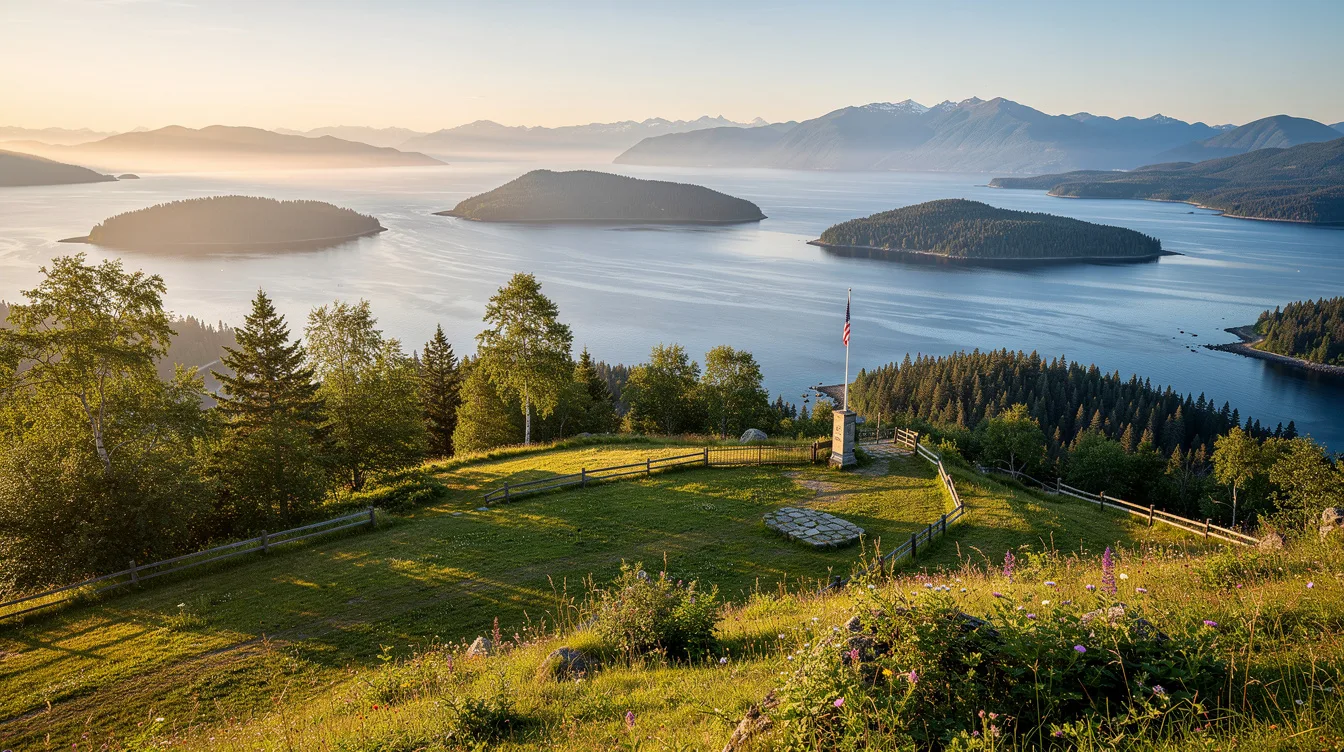
Sitka tells the Alaska transfer story where it actually happened, on Castle Hill. On October 18, 1867, Russia formally handed Alaska to the United States here, turning a small town on Baranof Island into the setting for one of the country’s stranger border changes.
But the story didn’t begin with Russia, and Sitka makes that clear if you pay attention. The area was originally a Tlingit settlement, so the transfer ceremony is only one chapter in a much longer local history.
Castle Hill puts the transfer in its proper place
Castle Hill is the essential stop because the ceremony occurred on this ground, not in a museum display somewhere else. You can stand there and picture the formal change of flags, then look back toward a town whose streets still carry Russian-era traces.
And that physical proximity matters. The handover can feel abstract in a textbook, but in Sitka it becomes a specific event tied to a specific hill, with the Pacific coast close by and the town gathered below.
The town had already become Novo Arkhangelsk, or New Archangel, after the 1804 Battle of Sitka. Russians founded the settlement after that conflict, and it became the capital of Russian America as well as a fur-trade center.
The Russian chapter is real, but it isn’t the whole story
Sitka’s Russian past has weight because it lasted in the built environment and in public memory. Yet the earlier Tlingit presence changes the way you should read the place: this wasn’t empty territory waiting for a foreign flag.
But don’t rush through the tension. The 1804 battle involved Tlingit forces and the Russian-American Company, and the site preserved today connects that conflict directly to the town visitors see.
After the 1867 ceremony, Sitka remained the territorial capital until 1906. That makes the town more than a one-day backdrop for the Alaska Purchase, even if Castle Hill is where the national-history headline lands.
Sitka National Historical Park keeps 1804 in view
If you want the deeper version of Sitka, go to the park. It preserves the battle site and the Kiks. Ádi Fort site, while coastal rainforest trails give you room to absorb history without staying inside all afternoon.
And the setting is part of the point. The trail moves through damp-looking coastal forest, while totem poles bring Tlingit and other Native artistic traditions into the walk. It’s reflective, but not silent about conflict.
The site began as a national monument in 1910 and became a national historical park in 1972. You can also find cultural exhibits, carving demonstrations, and ranger-led walks, which give the history more texture than a plaque alone.
Can you see Russian colonial architecture here?
Yes. The park includes the Russian Bishop’s House, one of the few surviving examples of Russian colonial architecture in North America. That’s a compelling reason to slow down, though the park’s broader Tlingit history deserves equal attention.
Downtown makes history feel unusually close
Downtown Sitka holds the first Orthodox cathedral built in North America, Russian-era blockhouse remains, a World War II naval operating base, and several National Historic Landmarks. It’s a dense historical mix, but it doesn’t read like a theme park.
And you don’t need to choose only one era. The city museum’s collection follows Sitka from Tlingit history through European exploration, the Russian period, and what came after, with further archives available for research through staff.
Old Sitka State Historic Site marks the first Russian settlement on Baranof Island. It has interpretive signs and forest trails, but few structures remain, so go for context rather than a restored fort-town experience.
Getting there is part of Sitka’s character
Sitka sits on Baranof Island in southeast Alaska, about 93.2 miles southwest of Juneau. Its outer-Pacific position gives the visit a slight sense of separation, which suits a place shaped by competing powers and overlapping histories.
But remote doesn’t mean empty of meaning. You’ll find a town where the 1867 transfer still has a physical address, while the sites around it insist on a fuller account of what came before.
By the time you leave Castle Hill, the useful image isn’t just a flag ceremony. It’s the hill above Sitka, with the town below and older histories still close enough to walk toward.