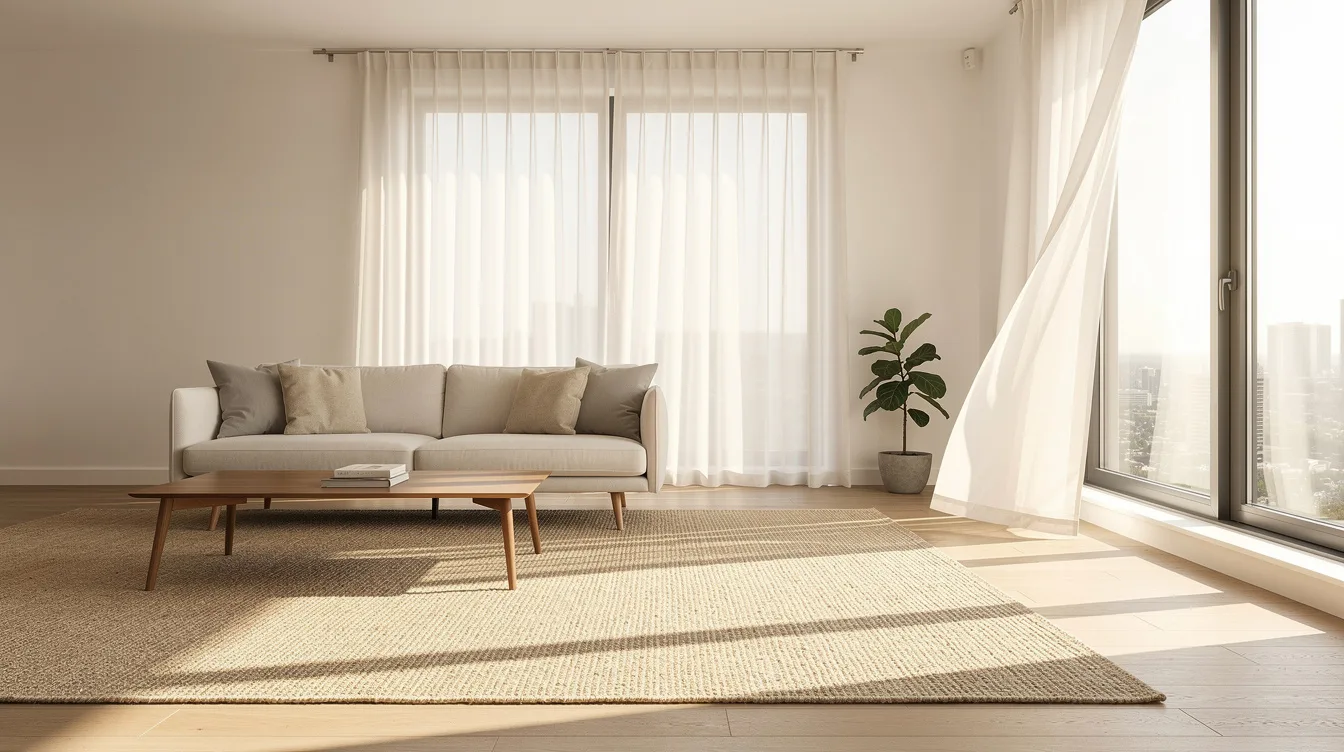
My south-facing living room hit 82 degrees by Memorial Day weekend, and I’d just hung thick charcoal curtains and rolled out a wool remnant I’d found on clearance. The space felt like a padded cell: dark, heavy, and somehow smaller than its 14×18 feet. I started pulling things that same afternoon.
Swap Out Heat-Trapping Rugs for Flatweaves
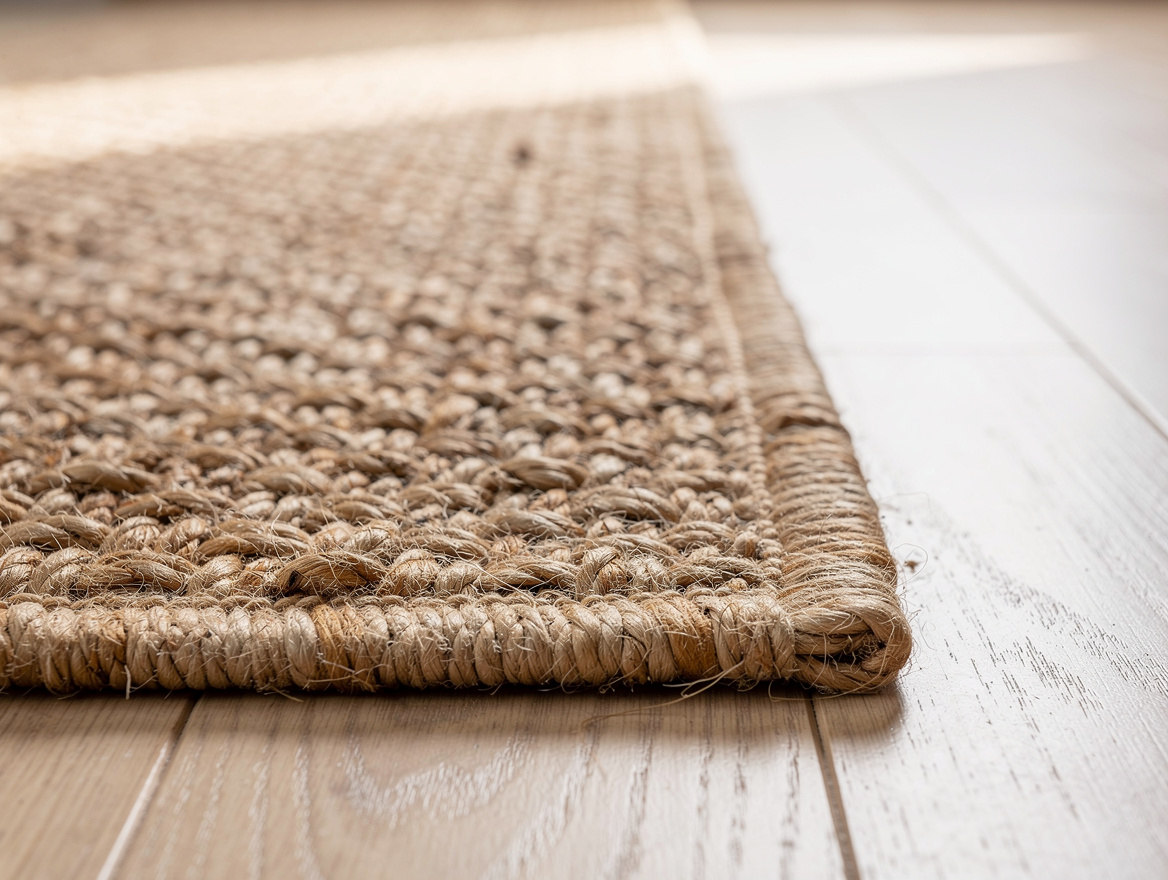
Thick wool or shag rugs function like floor insulation, holding warm air against your feet and visually chopping the room into a heavy dark block. I pulled my living room’s 2-inch shag in June and the temperature difference was immediate.
Flatwoven natural fibers let air pass through. The IKEA LOHALS jute rug at roughly 5’3″×7’7″ runs about $75, $95 and leaves floors feeling cooler underfoot. Ruggable’s washable flatweave line, around $260, $340 for a 5’×7′, works if you’ve got kids or pets tracking in grass.
Leave 12, 16 inches of bare floor around the rug’s edge. That exposed perimeter tricks the eye into reading more square footage than you actually have.
Hang Sheers High and Wide
Blackout drapes in navy or charcoal hung directly on the window frame do double damage: they absorb solar heat and visually lower your ceiling by drawing the eye to a squat horizontal line. My bedroom felt like a basement until I moved the rod.
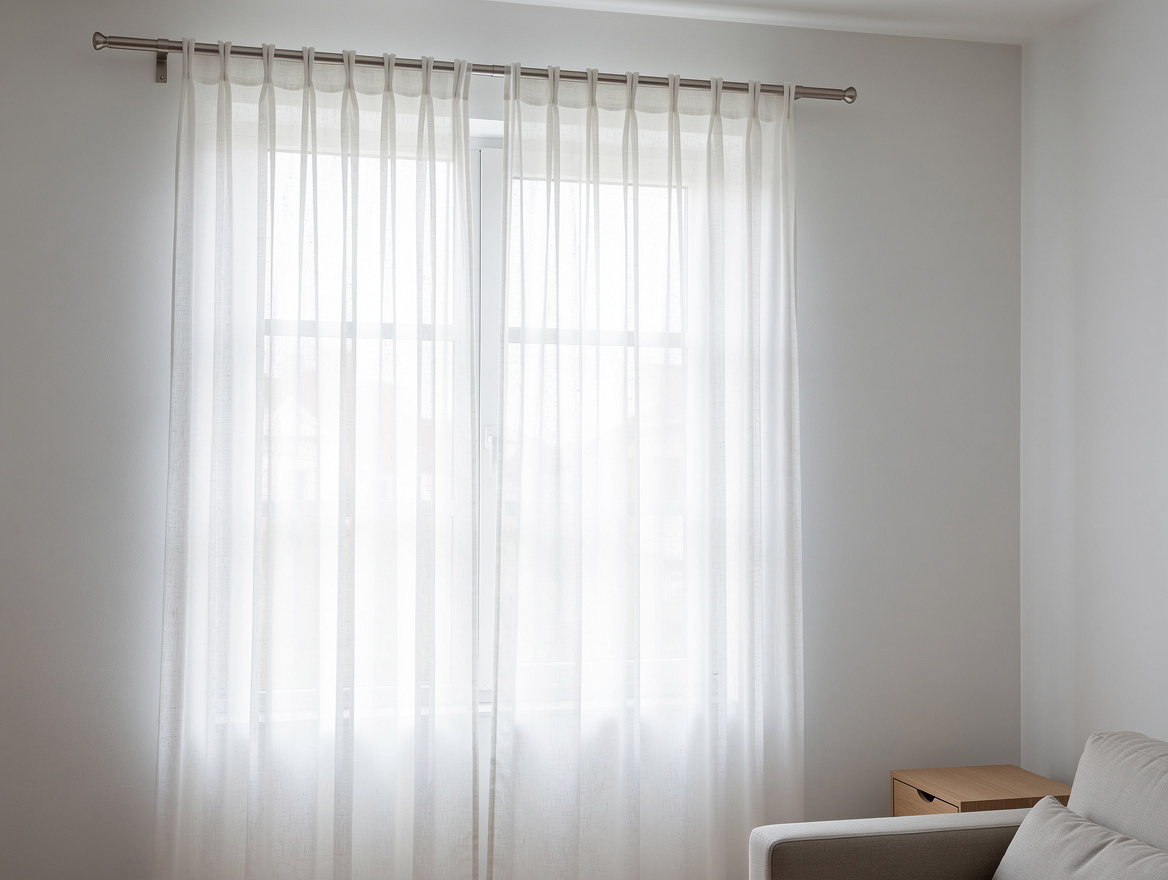
IKEA LILL sheers, about $12, $18 per pair, diffuse harsh afternoon light without trapping it. For more texture, H&M Home’s linen-blend panels at $45, $65 per pair add softness without the thermal mass of triple-weave polyester.
Mount rods 4, 6 inches above the frame and extend 4, 8 inches past each side. Panels should fully clear the glass when open, pushing the room’s perceived boundaries outward.
Cool Down Your Color Story
Deep browns, rust reds, and charcoal walls don’t just absorb radiant heat; they advance visually, making walls feel closer than they are. I learned this in a 10×12 guest room painted “warm espresso” that became unbearable by 2 PM.
Mid-range cool whites and soft greys run roughly $35, $55 per gallon at Home Depot or Lowe’s. Benjamin Moore’s “Chantilly Lace” or Behr’s “Polar Bear” bounce light rather than drinking it. If you’ve already got dark furniture, keep walls pale and limit warm accents to one or two small pieces.
Pastel blues and sage greens read as receding colors, pushing walls back psychologically even if the tape measure says otherwise.
Edit Visual Noise on Every Surface
Gallery walls with twelve 5×7 frames, clustered trinkets, and competing patterns create visual static that makes rooms feel packed tight. In summer, all those objects also disrupt air circulation along walls and furniture edges.
Replace clusters with single large statements. A Target Threshold framed canvas at 23″×33″ above a sofa reads cleaner than six small frames fighting for attention. On shelves, try the rule of three: one tall object, one medium, one low and horizontal.
I cleared half my mantelpieces last July and the room felt both larger and breezier, even before I touched the thermostat.
Scale Furniture to Your Actual Footprint
That deep-sectional with 42-inch arms and a 20-inch-thick coffee table might look plush in the showroom, but in a compact living room it blocks walking paths and stops air from circulating. Bulky silhouettes read as permanent obstacles.
Look for pieces with visible legs: a Wayfair mid-century sofa with 6-inch tapered legs, typically $450, $650, lets air and light flow underneath. Coffee tables under 16 inches high with open lower shelves, like IKEA’s LACK at $25, $40, maintain sightlines across the room.
Measure your traffic lanes: 30 inches minimum between sofa and coffee table, 36 inches for main walkways. Anything tighter feels like squeezing through a storage aisle at Costco.
Replace Dense Textiles with Breathable Layers
Velvet cushions, chunky knit throws, and faux-fur blankets belong in December. In July they signal heat visually and physically, trapping humidity against your body when you sit down.
Target’s Hearth & Hand cotton-linen blend throws, around $30, $45, layer without the thermal weight. For cushions, IKEA’s GURLI cotton covers at $5, $8 each in pale colors swap in cheaply. Cotton percale or linen sheets, $40, $80 at Home Depot or Amazon Basics, beat microfiber for sleeping cool.
Store winter textiles in vacuum bags under beds. Empty baskets and bare sofa arms read as spaciousness you can’t buy at any price.
Redirect Light with Mirrors and Pale Surfaces
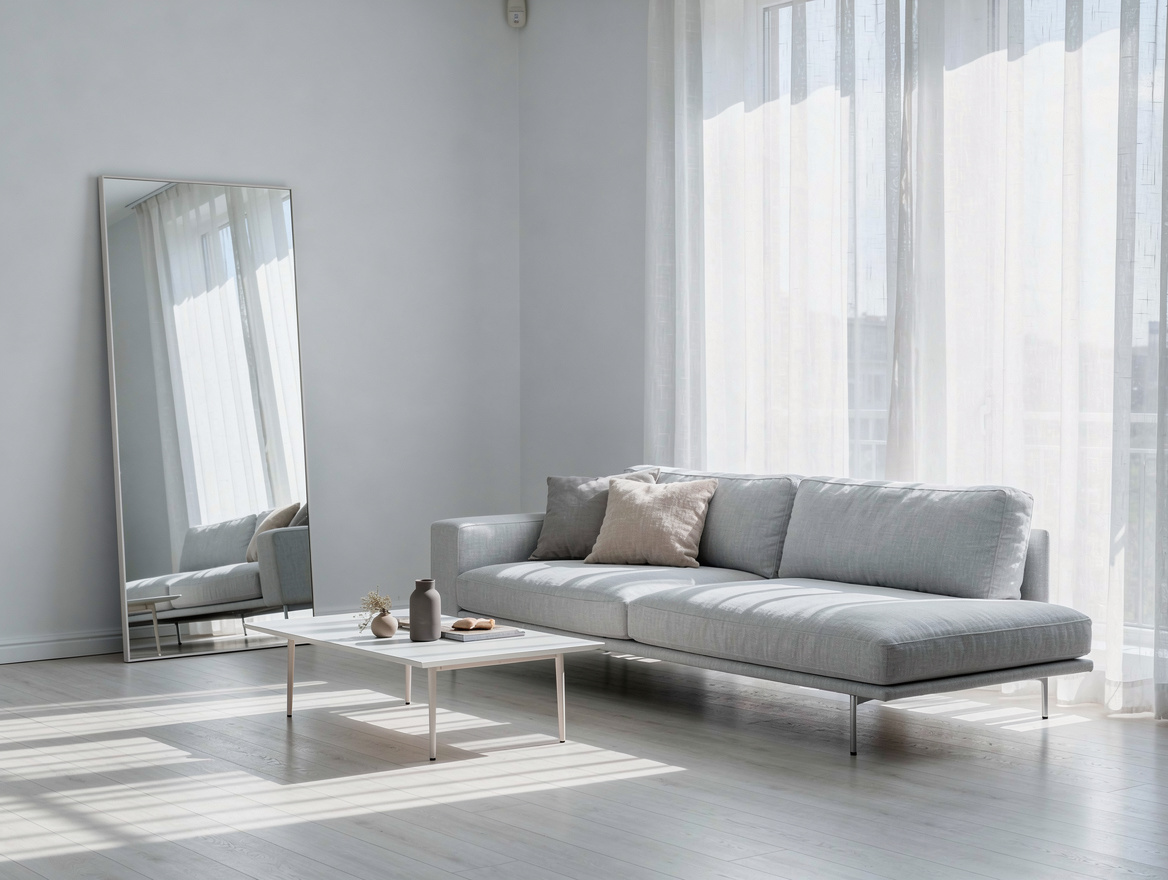
Dark wood absorbs both light and heat; glossy or pale surfaces reflect them. If your room has one window and brown furniture, you’re working against yourself all afternoon.
A IKEA HOVET mirror at 30″×47″, roughly $130, positioned opposite or adjacent to your window doubles apparent light without adding watts. For tabletops, a white lacquer tray or pale marble-look surface from Wayfair’s Project 62, $25, $40, bounces ceiling light downward.
I swapped a dark walnut side table for a white-painted one from a Facebook Marketplace find, and the corner brightened noticeably even on overcast days.
Start with what’s underfoot and what’s covering your windows; those two swaps alone will drop the perceived temperature faster than any single change. The rest is editing, not shopping.
Mia Carter writes about small-space living and budget home makeovers. She has restyled three rentals and tests most ideas in her own 45 sqm flat.