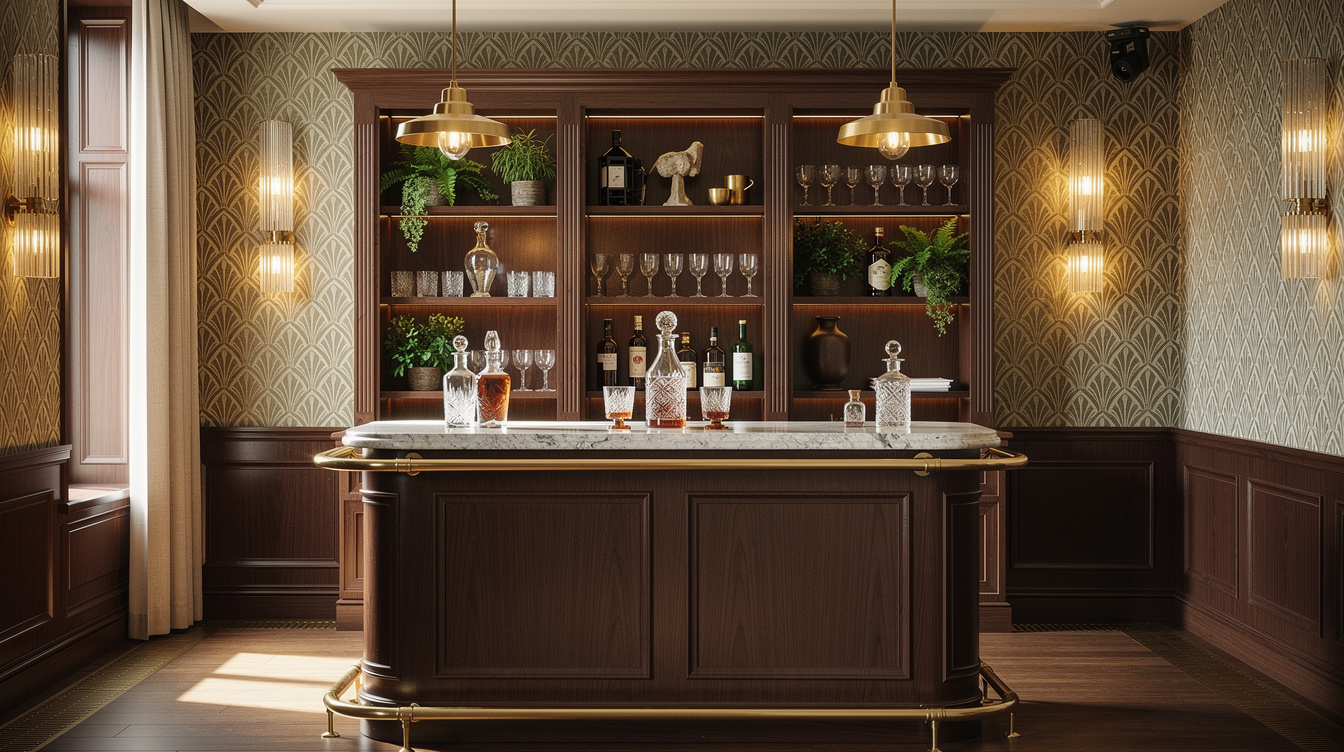
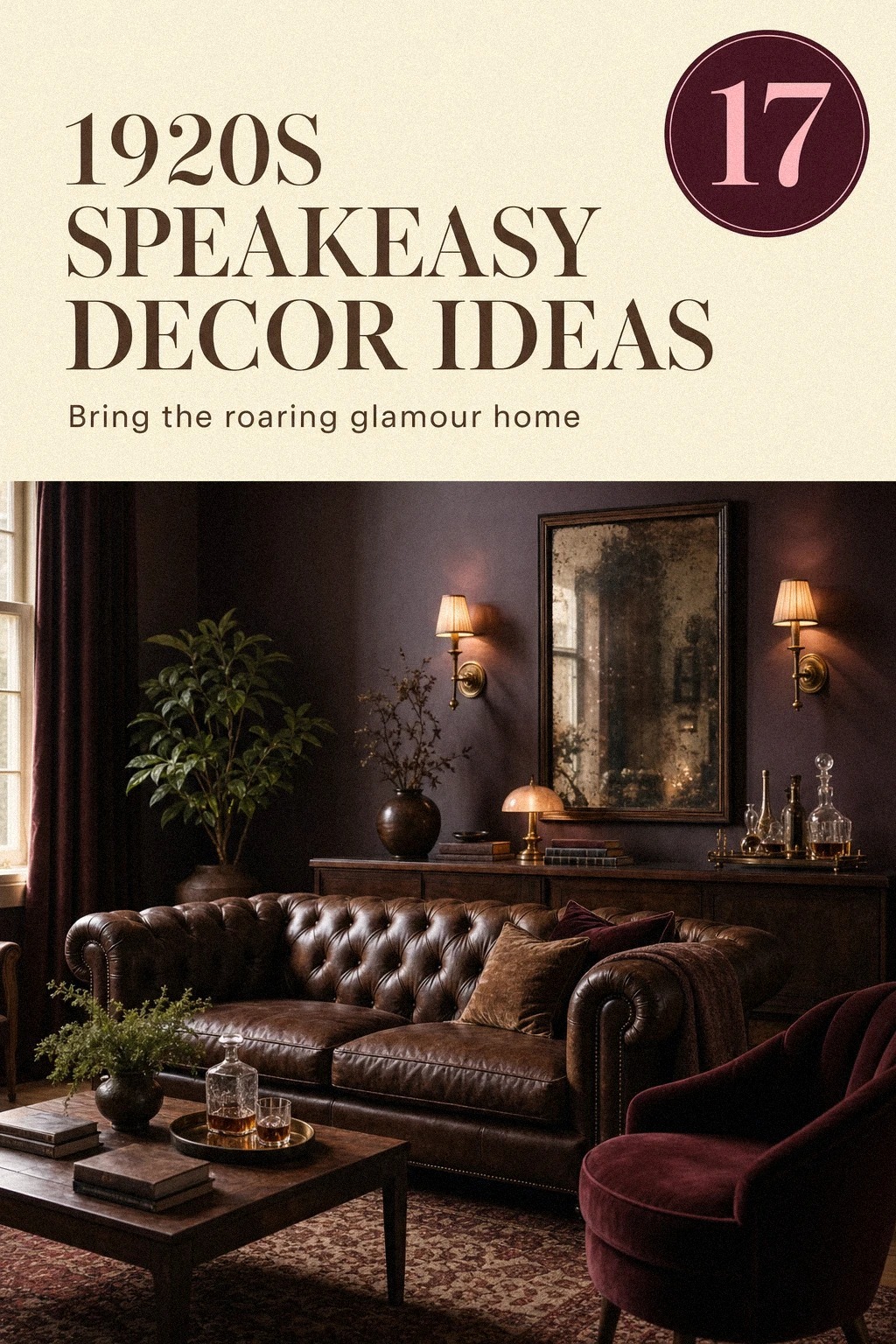
I‘ve tried a lot of living room formulas, and the ones that feel like an actual destination rather than a furniture showroom always have one thing in common. They commit to a mood. A 1920s speakeasy aesthetic isn’t about novelty props or a “theme night” vibe. It’s about layering materials that age well, lighting that flatters, and a layout that invites people to settle in and stay. The short answer: you can build this feeling for about $300 if you’re strategic, or $12,000+ if you’re replacing every surface. Most people land somewhere in the middle. That’s where the magic happens!
- ✓ Start with a deep leather chesterfield as your anchor
- ✓ Drape a velvet curtain across an arched doorway
- ✓ Line the mantel with brass candlesticks of varying heights
- Start with a deep leather chesterfield as your anchor
- Drape a velvet curtain across an arched doorway
- Line the mantel with brass candlesticks of varying heights
- Install a tin ceiling with a dark patina finish
- Prop a vintage phonograph in the corner as a sculptural piece
- Layer a geometric rug over stained hardwood floors
- Hang a sunburst mirror above a tufted chesterfield sofa
- Stock a bar cart with cut-glass decanters and crystal tumblers
- Paint the ceiling a deep tobacco brown for intimacy
- Mount swing-arm sconces with amber glass shades
- Display framed black-and-white portraits in gilded frames
- Upholster an accent chair in emerald green mohair
- Add a gramophone-horn pendant light over the coffee table
- Stack leather-bound books beneath a glass-top side table
- Frame the windows with heavy silk tassel tiebacks
- Set a brass peacock fireplace screen as the room’s focal point
- Lay a Persian runner along a dark-walled hallway nook
1Start with a deep leather chesterfield as your anchor
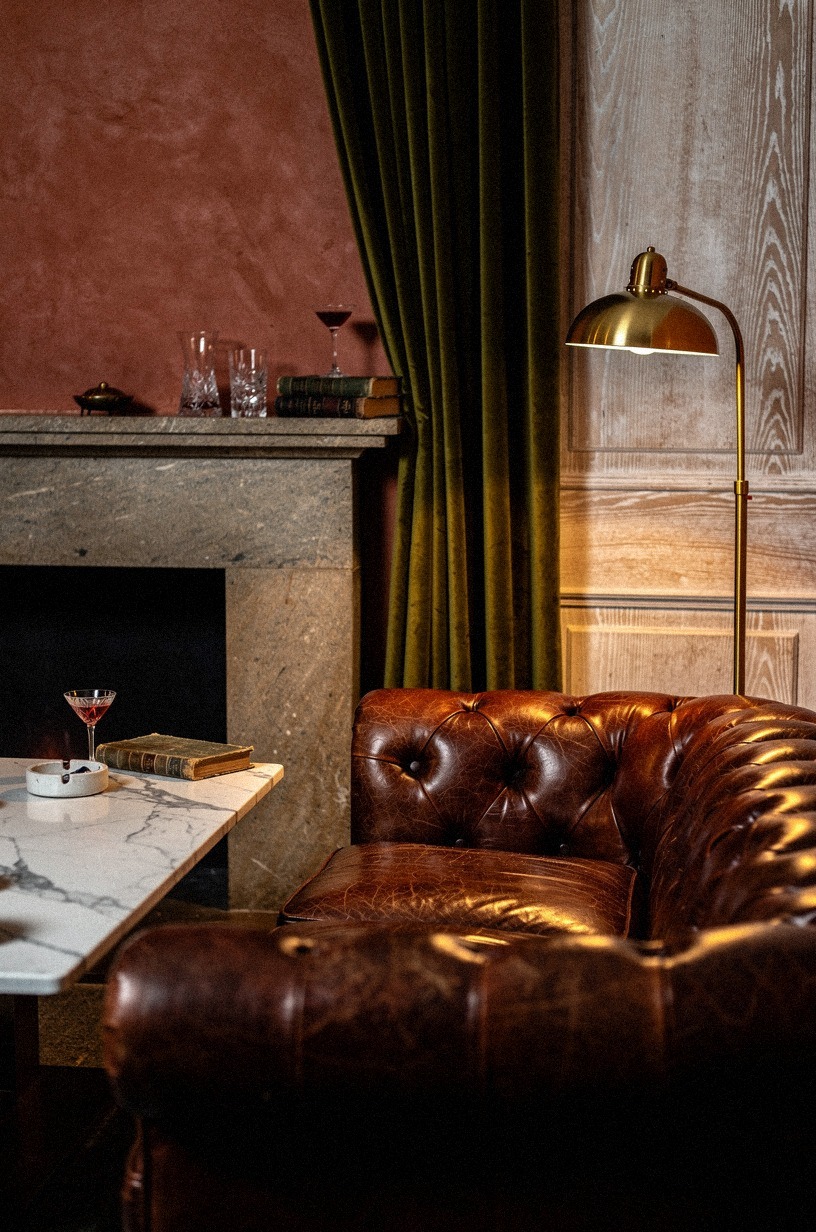
A chesterfield sofa in a deep, worn leather is the gravitational center of any speakeasy living room. The tufting catches low light, the roll arms frame the space, and the patina tells a story whether the piece is vintage or new.
You don’t need a $4,000 antique. A quality reproduction in full-grain leather starts around $1,200 and develops character faster than you’d think.
But pair it with a low marble cocktail table, Carrara or Calacatta Gold with warm veining works best. The height should sit 16 to 18 inches, roughly two-thirds the sofa length.
Too tall and it blocks sightlines. Too low and it becomes a footrest nobody asked for.
A brass floor lamp with a warm bulb, ideally 2700K or lower, casts the pools of light that make a room feel like evening at 3 p.m. Skip anything with a white LED. The goal is amber, not clinical.
And truth is? The first time you dim that lamp and pour a drink, you’ll understand why this aesthetic refuses to die.
2Drape a velvet curtain across an arched doorway
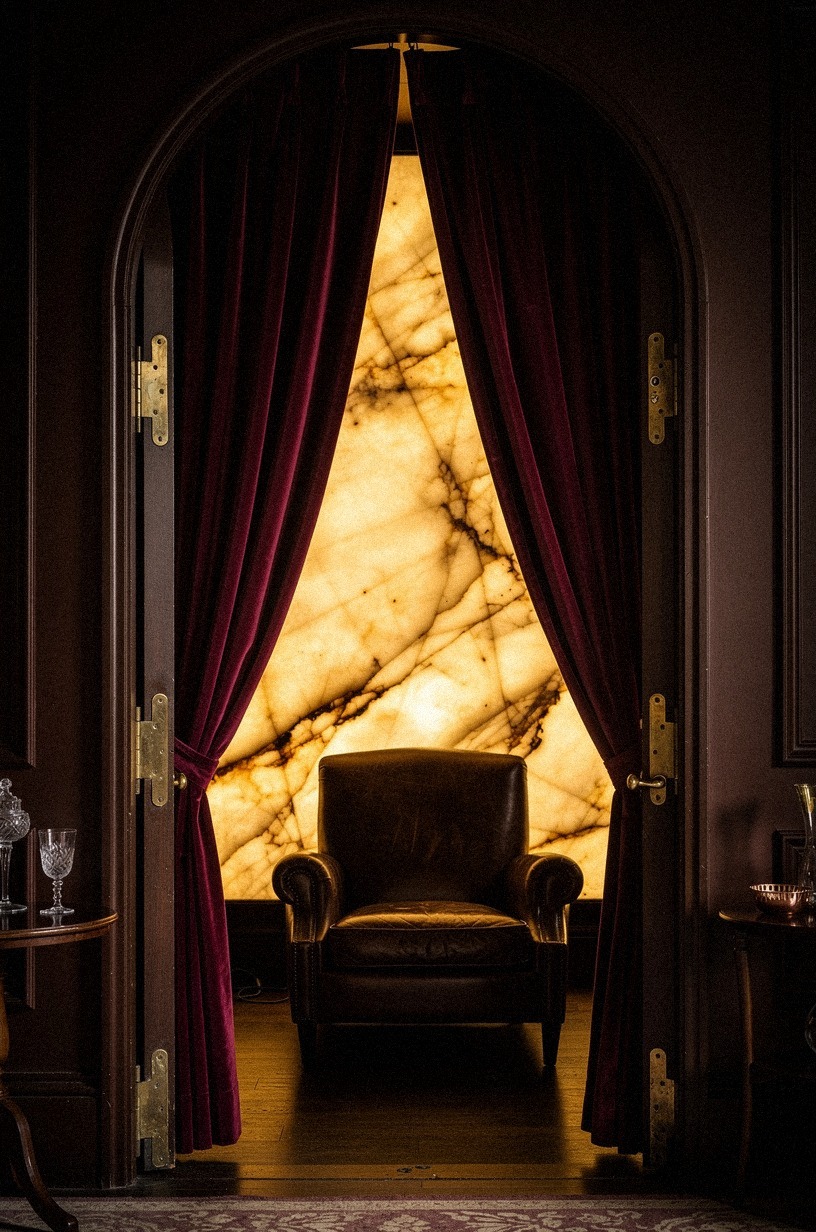
Nothing signals a hidden space like a heavy curtain blocking a threshold. A velvet curtain in plum or deep forest green, hung from a brass rod with round finials, turns an ordinary doorway into a theatrical entrance. The fabric should be heavy enough to fall in thick folds, not wispy or sheer.
You’re going for secrecy, not romance.
The arch itself is the frame. If you don’t have one, a simple paint treatment can fake it: Benjamin Moore Black Forest Green HC-188 on the door frame and surrounding wall, fading into Farrow & Ball Down Pipe on the adjacent walls, creates a visual arch without carpentry. The curtain should puddle slightly on the floor, an inch or two of excess fabric that signals luxury in a way that hemming to the exact length never does.
Behind the curtain, a small bar nook with a walnut countertop and a few crystal tumblers visible through the gap completes the illusion. You don’t need a full room.
A closet, a corner, or a converted alcove works. The point is the reveal.
Pull the curtain back, and the space beyond should feel like a discovery. That’s the speakeasy energy in a single gesture.
3Line the mantel with brass candlesticks of varying heights
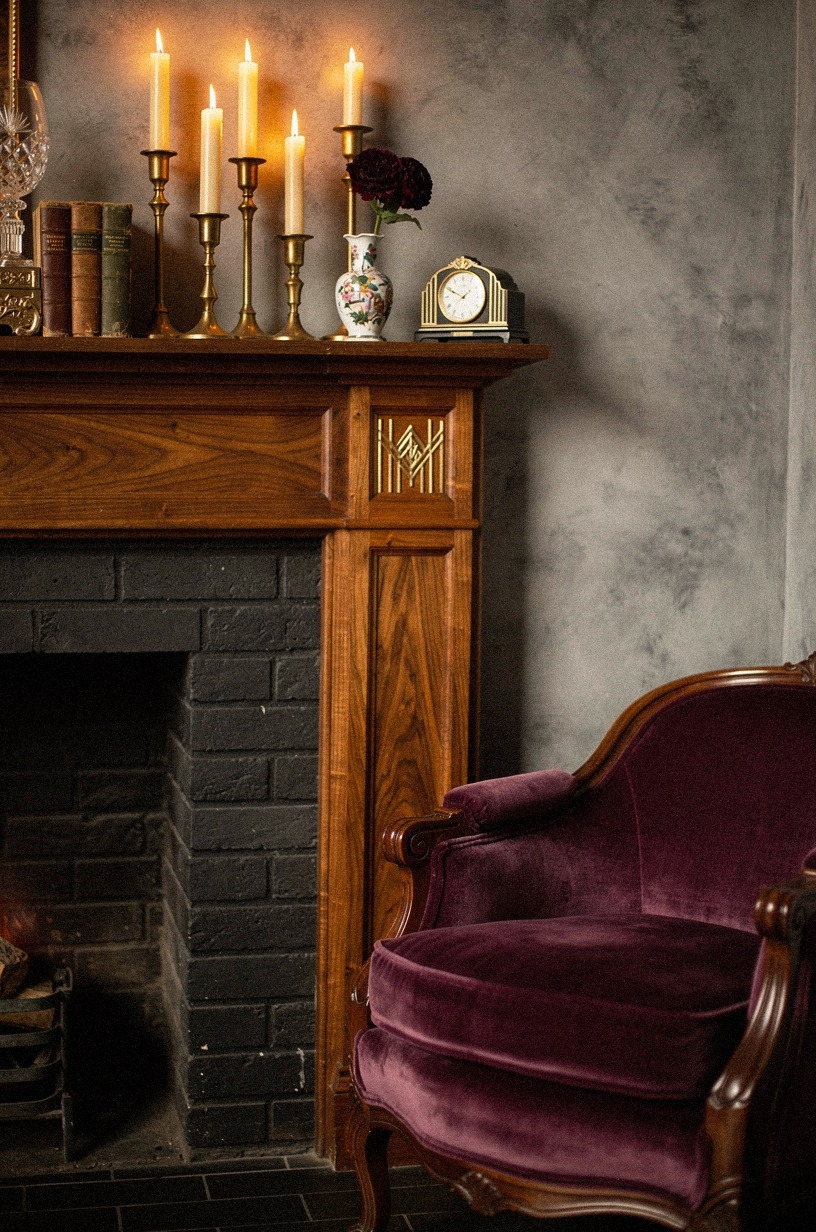
A fireplace in a speakeasy room isn’t about the fire. It’s about the frame.
Book-matched walnut paneling flanking the hearth creates symmetry that feels intentional and expensive. The grain should mirror itself like a Rorschach test.
If you’re buying new, ask for “slip-matched” veneer. If you’re stripping old paneling, work with what you’ve got, uneven patina is better than over-restored gloss.
And on the mantel itself, cluster brass candlesticks at three distinct heights. Five is the minimum number that looks collected rather than staged.
Mix finishes: one polished, two with soft patina, two nearly black with age. The plum velvet armchair beside the fireplace should sit close enough to feel the heat but angled slightly away, so the conversation flows back into the room.
A grey plaster wall behind the paneling, something like Farrow & Ball Hague Blue (No.30) shifted two tones lighter, gives the wood a place to breathe. Dark wood on dark wood feels like a bank lobby. You want contrast, not competition.
4Install a tin ceiling with a dark patina finish
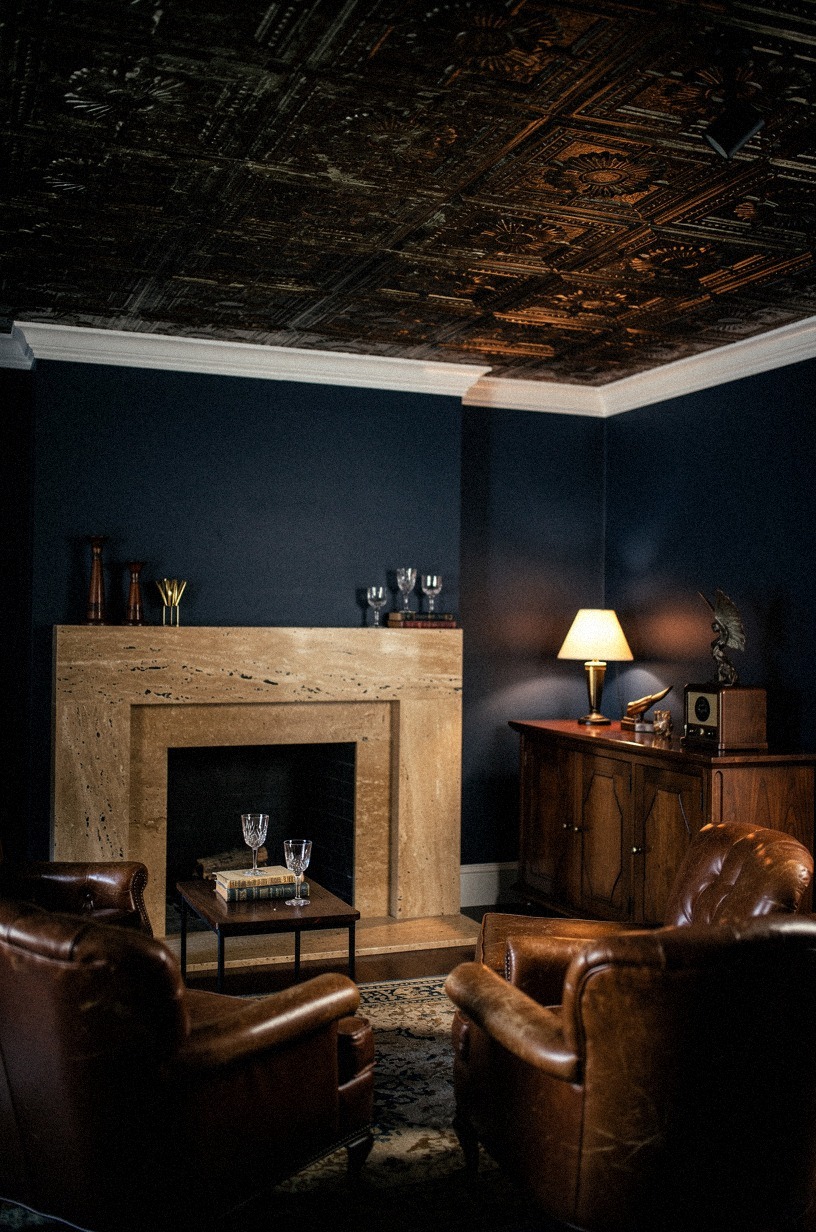
This is the move that separates the dabblers from the committed. A tin ceiling in dark patina, pressed with a geometric pattern, reads as historic even if you installed it last Tuesday.
The panels run about $8 to $15 per square foot installed, and you’ll see the impact immediately. The ceiling becomes a surface instead of a void.
Keep the walls below it disciplined. Navy walls with crisp white crown molding ground the room and let the ceiling be the star. A warm travertine fireplace surround adds the stone element every speakeasy needs, something earthy to balance all the metal and velvet.
The walnut bar cabinet against the opposite wall should be compact. You’re not running a commercial operation.
A 36-inch wide piece with a marble top, a small sink if plumbing allows, and storage for six bottles and a set of crystal tumblers is enough. The rest is theater.
And theater, done right, is what makes a living room feel like a destination. No hidden formula needed.
5Prop a vintage phonograph in the corner as a sculptural piece
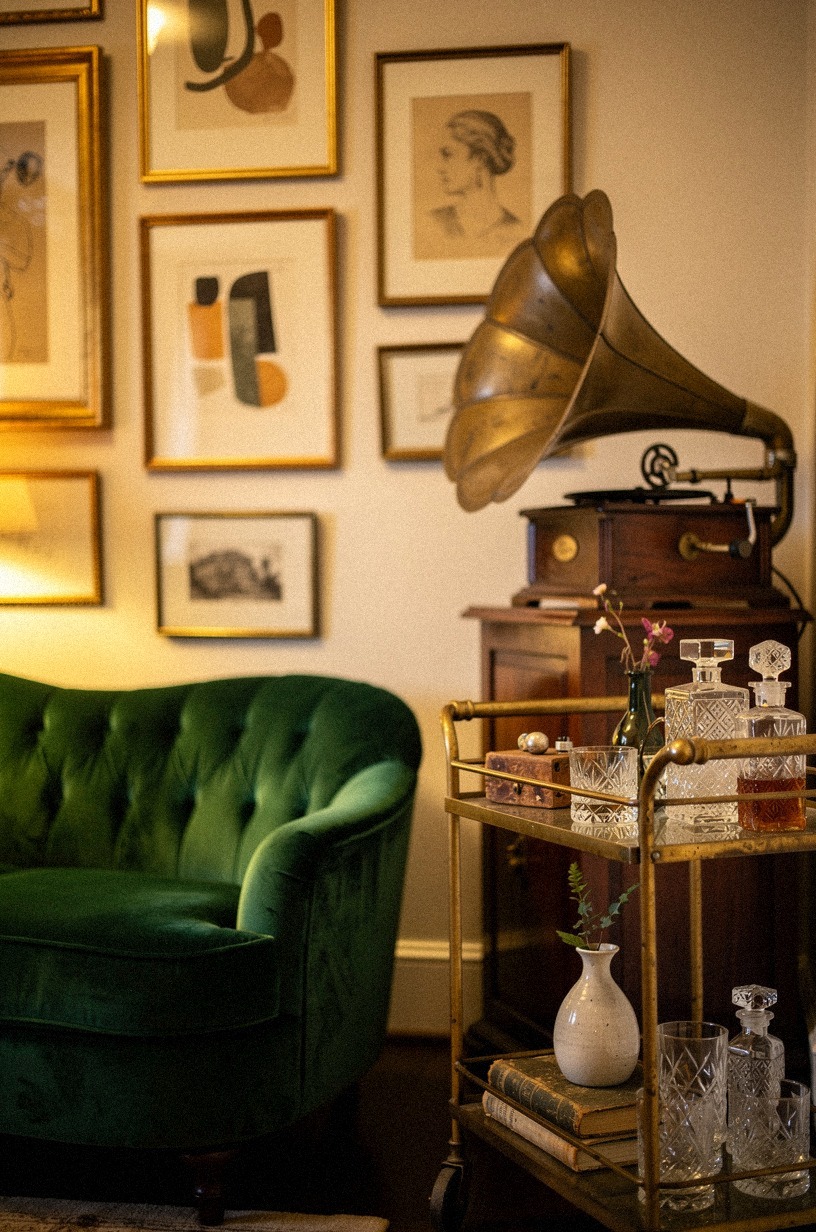
You don’t need to play it. You need to look at it.
A vintage phonograph with a brass horn and a wooden base, even if it’s non-functional, adds vertical interest to a corner that might otherwise hold a sad fiddle-leaf fig. The silhouette is instantly recognizable.
And oddly comforting!
Place it near an emerald velvet sofa, not the same one as the chesterfield, this is your secondary seating, and let the green and brass talk to each other. Gold picture frames on cream walls above the phonograph should hold black-and-white prints: jazz musicians, cityscapes, or architectural details.
The frames don’t need to match. In fact, they shouldn’t.
An unlacquered brass side table beside the phonograph, something small and round, gives you a place to set a drink while you pretend to browse your vinyl collection. The patina will shift over months. That’s the point.
Everything in this room should feel like it’s been here longer than you have. And truth is?
The first guest who asks if it still works makes the whole thing worth it.
6Layer a geometric rug over stained hardwood floors
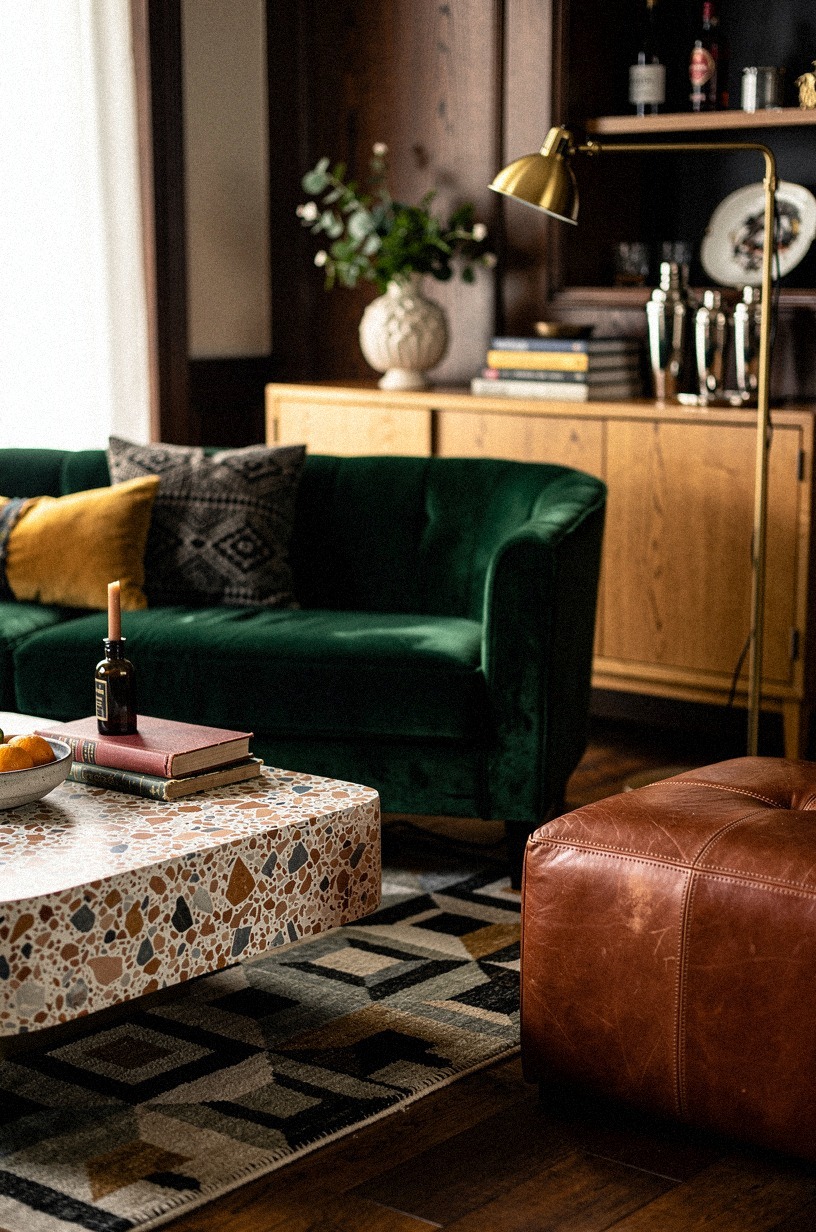
But the floor is your foundation. Stained hardwood in a dark walnut or espresso stain sets the stage.
Over it, a geometric patterned rug in muted tones, charcoal, rust, cream, and a whisper of gold, defines the seating area. The pattern should be bold but not busy. Think Art Deco geometry, not Moroccan chaos.
Your forest green velvet sofa anchors the rug’s center. A rust leather ottoman in front of it, something you can put your feet on or use as extra seating, adds the second material layer.
The natural oak sideboard against the wall should feel utilitarian. Drawers for board games, bottles, or blankets.
No glass doors. No display lighting.
This is a speakeasy, not a museum.
The oval coffee table in the center, perhaps a Carrara marble top with an iron base, ties the rug to the rest of the room. Keep it low.
Keep it simple. And keep it clear of clutter.
A single book, a single candle, a single glass is the maximum. More than that, and you’ve lost the plot.
7Hang a sunburst mirror above a tufted chesterfield sofa
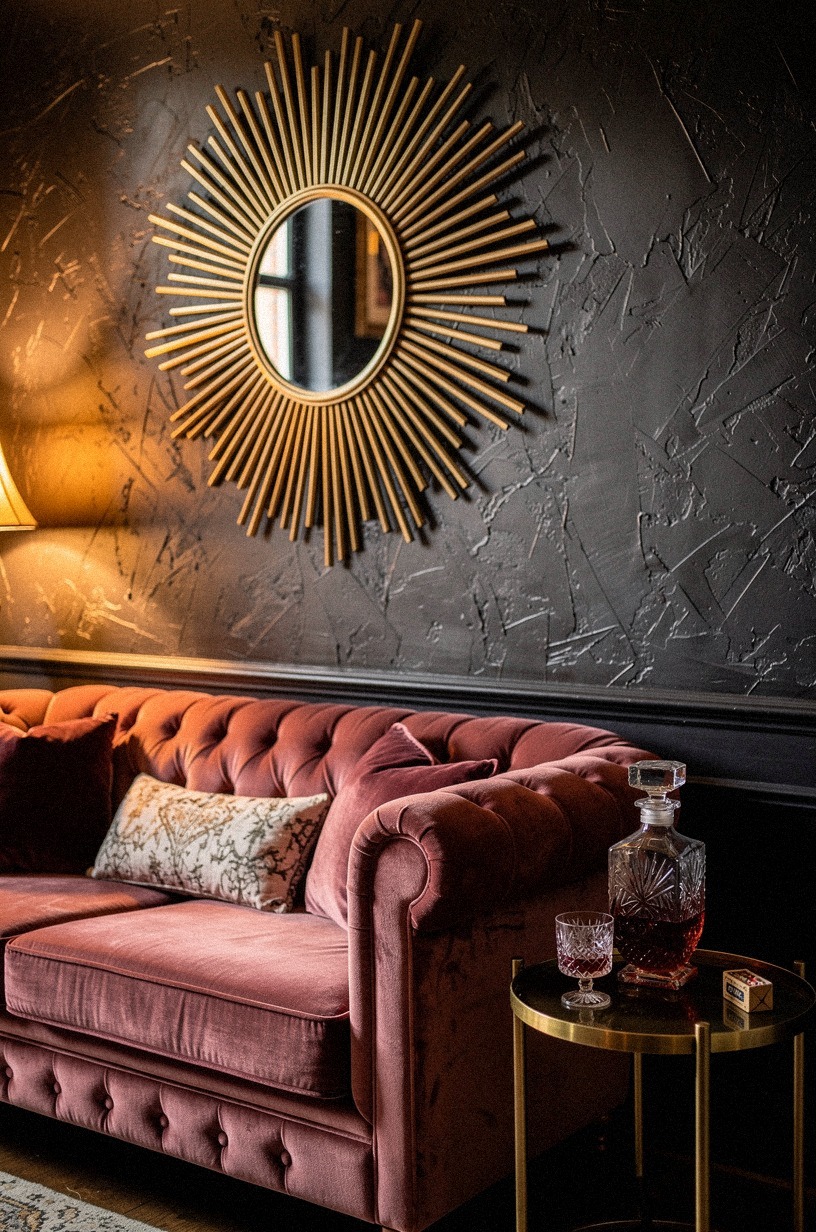
The sunburst mirror is a cliche for a reason. It works.
The radiating frame catches light from every angle and throws it back into the room in shards. Above a tufted chesterfield sofa, it creates a focal point that draws the eye up and makes the ceiling feel higher. Choose a frame in unlacquered brass or aged gold, not bright yellow metal.
The finish should look like it came from a 1920s Paris apartment, not a 2024 big-box store.
Dusty rose velvet cushions on the sofa soften the masculinity of the leather and brass. The color is unexpected in a speakeasy palette, which is exactly why it works.
Charcoal walls with hand-applied Venetian plaster texture give the mirror a rough, imperfect backdrop. Smooth drywall would make the whole thing feel like a hotel lobby.
And the texture of the plaster matters. You want variation.
You want the occasional thumbprint or trowel mark. Perfection is the enemy of atmosphere.
If you’re hiring this out, find a plasterer who understands “old world” finish. If you’re doing it yourself, stop before you think you’re done.
That’s usually the sweet spot.
8Stock a bar cart with cut-glass decanters and crystal tumblers
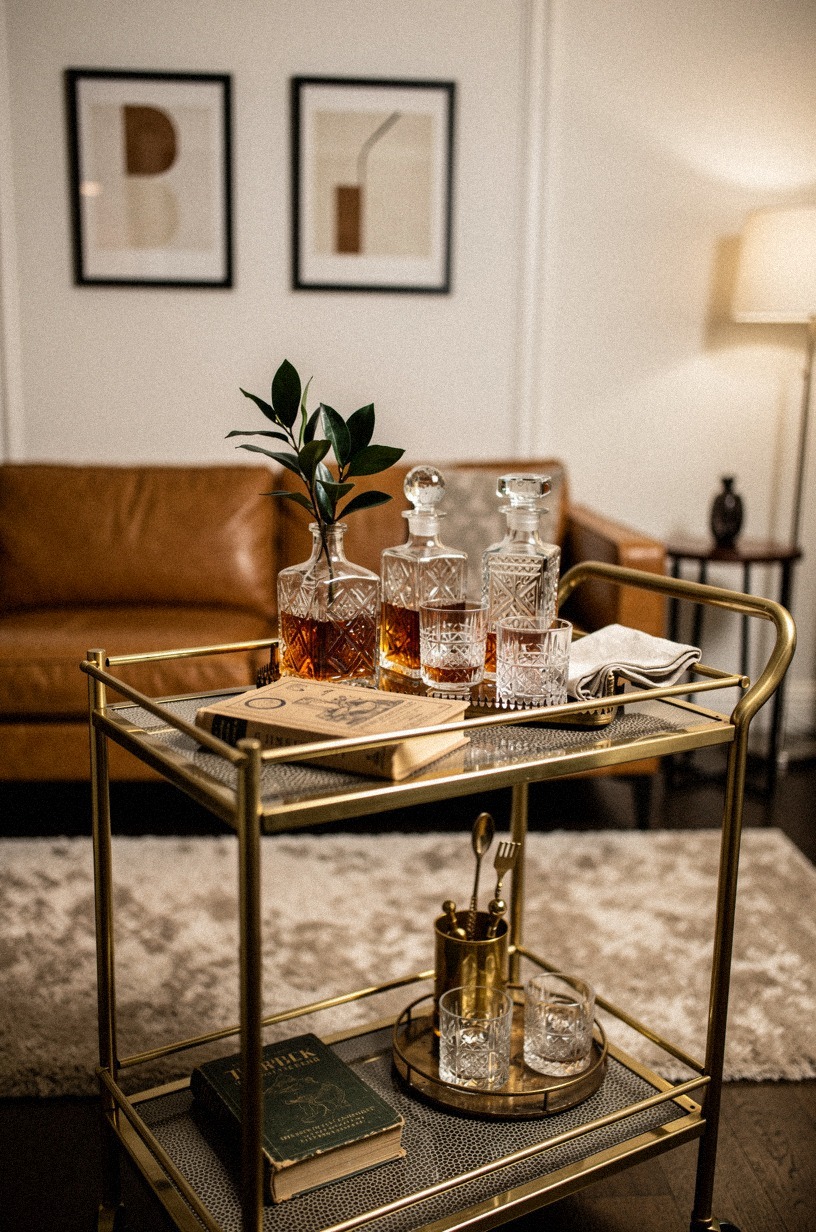
A brass bar cart is non-negotiable. Not a side table with bottles on it.
A real cart, on wheels, with two tiers. The top holds your service: cut-glass decanters for whiskey and gin, crystal tumblers with some heft to them, a small silver tray for olives or nuts.
The bottom holds backup bottles and maybe a stack of linen coasters.
The cart should live against warm white walls, something like Benjamin Moore Revere Pewter (HC-172), a color that shifts between grey and beige depending on the light. A camel leather sofa nearby gives the eye a place to rest from all the reflective surfaces. Black accents in picture frames, lamp bases, or small sculptures add the necessary weight.
The key is restraint. Six bottles maximum.
Three glasses per type. One ice bucket.
Anything more, and you’re running a bar. Anything less, and you’re pretending.
The sweet spot is the moment a guest asks, “What are you pouring?” and you have an answer ready. That’s the speakeasy energy in a single exchange.
9Paint the ceiling a deep tobacco brown for intimacy
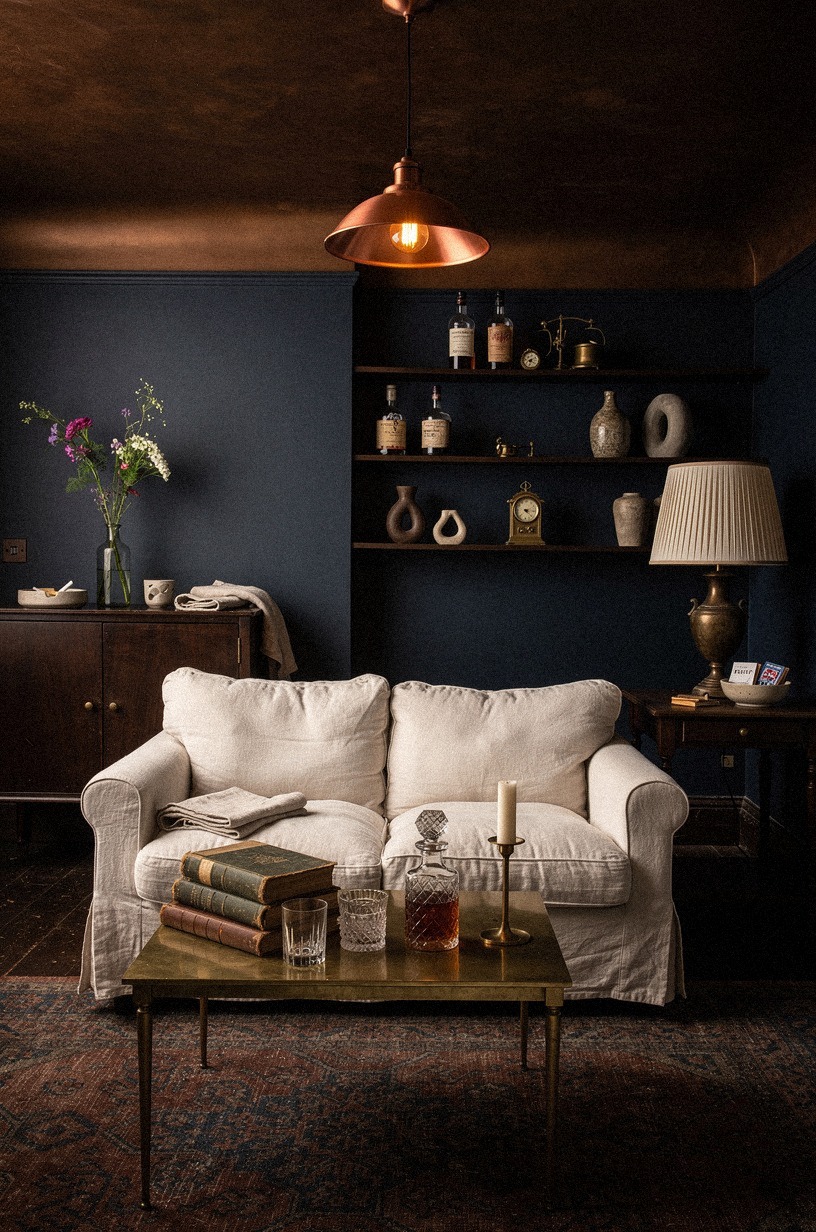
This is the move most people fear and every designer respects. A deep tobacco brown ceiling, something like Farrow & Ball Hague Blue (No.30) mixed with umber until it reads as warm earth rather than cool navy, drops the visual height of the room and wraps it like a hug.
It sounds claustrophobic. It feels like a nest.
Pair it with midnight blue walls and a copper pendant light over the center of the seating area. The metal should be bare, not lacquered.
Copper darkens over time, and that darkening is part of the story. An ivory washed Belgian linen sofa keeps the room from feeling like a cave.
The light value of the upholstery bounces what little ambient light exists back into the space.
This is the most dramatic transformation on the list. It’s also the cheapest. A gallon of quality paint and a roller is maybe $80.
The labor is a Saturday. The result is a room that feels like it was designed by someone who understands that intimacy is a spatial quality, not just a mood.
10Mount swing-arm sconces with amber glass shades
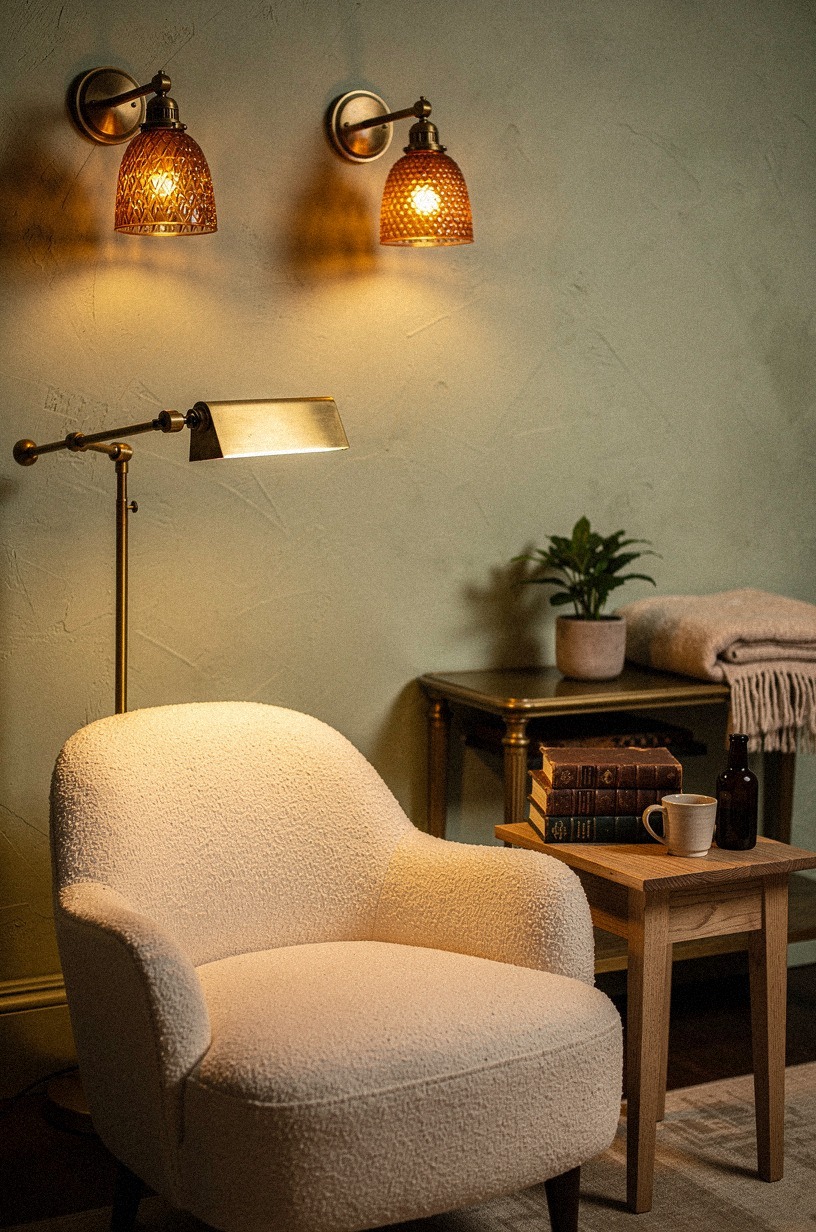
Overhead lighting is the enemy. Swing-arm sconces with amber glass shades mounted beside the sofa or flanking a reading chair give you control. You can pull the light closer for a book, push it back for atmosphere, or angle it toward the wall for a wash of warm glow.
The sage green plaster wall behind them, something earthy and muted, makes the amber glass pop without shouting.
A warm cream organic bouclé armchair beneath the sconces invites you to sit down and stay. The texture of bouclé, looped, slightly irregular, soft to the touch, is the tactile equivalent of the visual warmth you’re building. A natural wood side table beside it, perhaps walnut or cerused oak, holds the drink and the book.
The wiring can be a challenge if you don’t have junction boxes where you want them. Surface-mount conduit in a matching brass finish is an honest solution.
Don’t hide it. Let it be part of the industrial story.
The best speakeasy rooms look like they were adapted from something else, not built from a catalog. And the glow from those amber shades?
It turns every evening into an event worth staying home for.
11Display framed black-and-white portraits in gilded frames
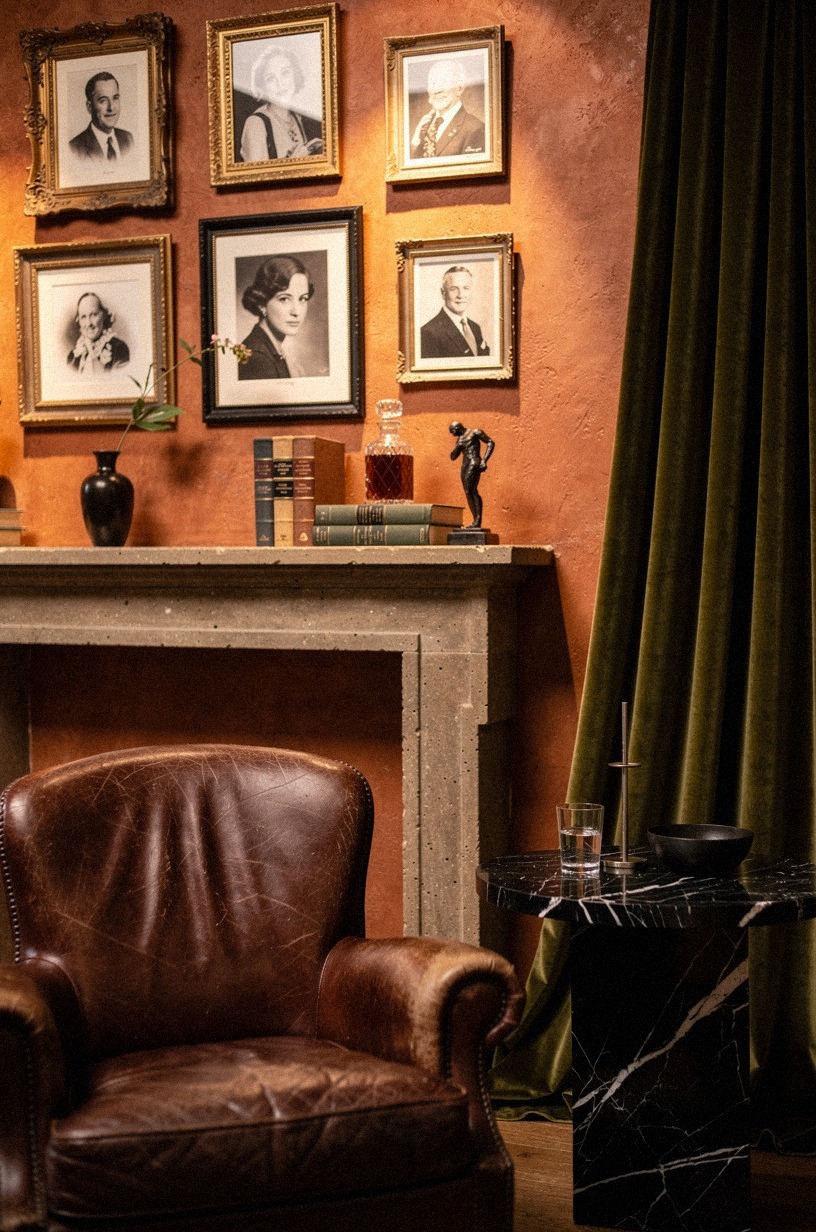
Walls need faces. Not family photos, those live in the hallway. In the speakeasy living room, framed black-and-white portraits in gilded frames create a sense of history and narrative.
The subjects don’t need to be famous. They need to be interesting.
A woman in a cloche hat. A man with a cigarette and a skeptical expression.
A group shot where nobody is looking at the camera.
But arrange them on a terracotta plaster wall in a loose grid, not a perfect matrix. The stone mantelpiece below should be simple.
Limestone or honed travertine. Nothing carved.
The olive velvet drapes beside the fireplace should puddle slightly on the floor. An inch or two of excess fabric at the bottom signals luxury in a way that hemming to the exact length never does.
The frames should vary in size and ornamentation. Some thin, some heavy.
Some rectangular, one oval. The collection should look assembled over years, not purchased in an afternoon. If you’re buying reproductions, distress the gold slightly with steel wool.
New gold is bright. Old gold is warm. You want warm.
12Upholster an accent chair in emerald green mohair
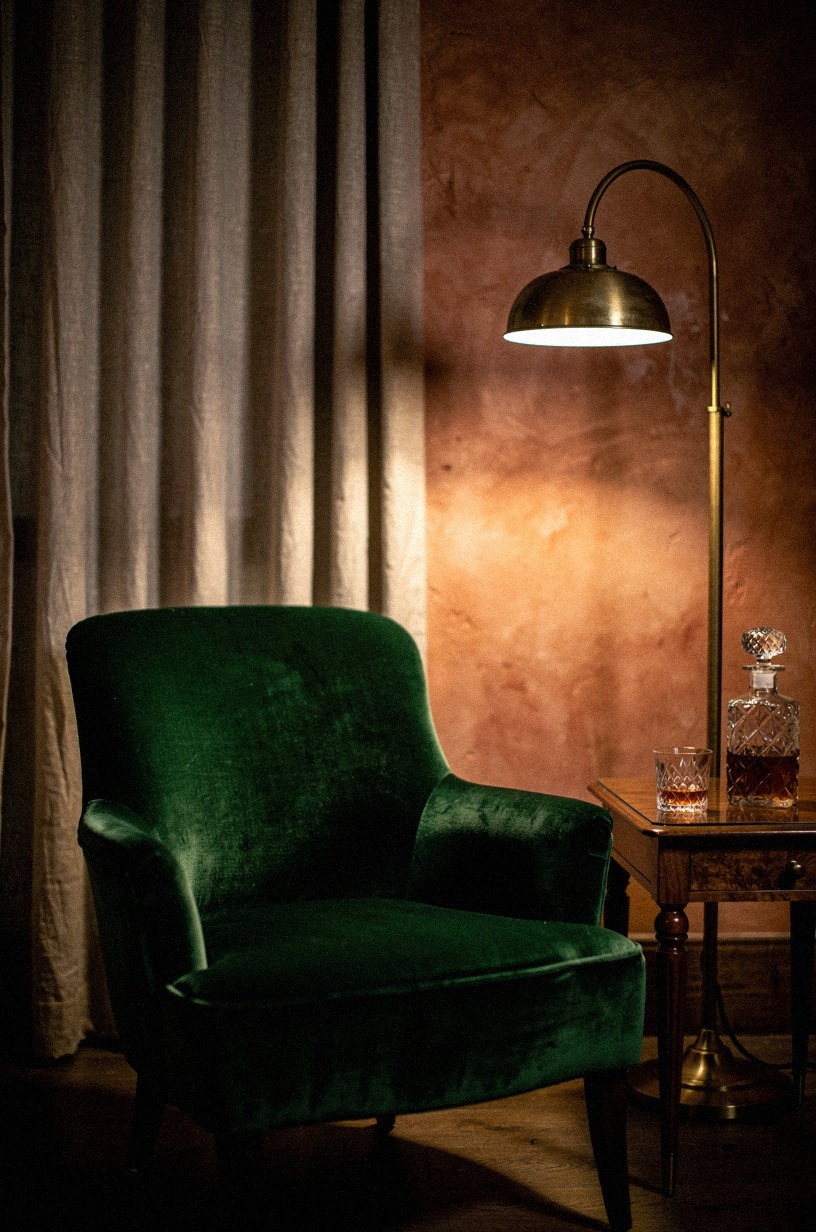
An accent chair in emerald green mohair is the exclamation point of the room. Mohair has a subtle sheen that catches light differently than velvet or linen.
It’s also surprisingly durable. A deep emerald reads as rich and slightly decadent without feeling like a casino.
And position it beside a clay plaster wall, something warm and earthy, like Benjamin Moore Revere Pewter (HC-172) shifted toward terracotta. Linen drapery in a natural, unbleached tone softens the window and frames the chair. An aged brass floor lamp with a wide shade, positioned behind and to the side, creates a pool of light that makes the mohair glow.
The chair should be comfortable enough to sit in for an hour. Not a lounge chair. Not a desk chair.
Something upright but padded, with arms wide enough to hold a drink. The deep charcoal rug beneath it should be low-pile.
You don’t want the chair to sink. You want it to sit on top, commanding attention.
13Add a gramophone-horn pendant light over the coffee table
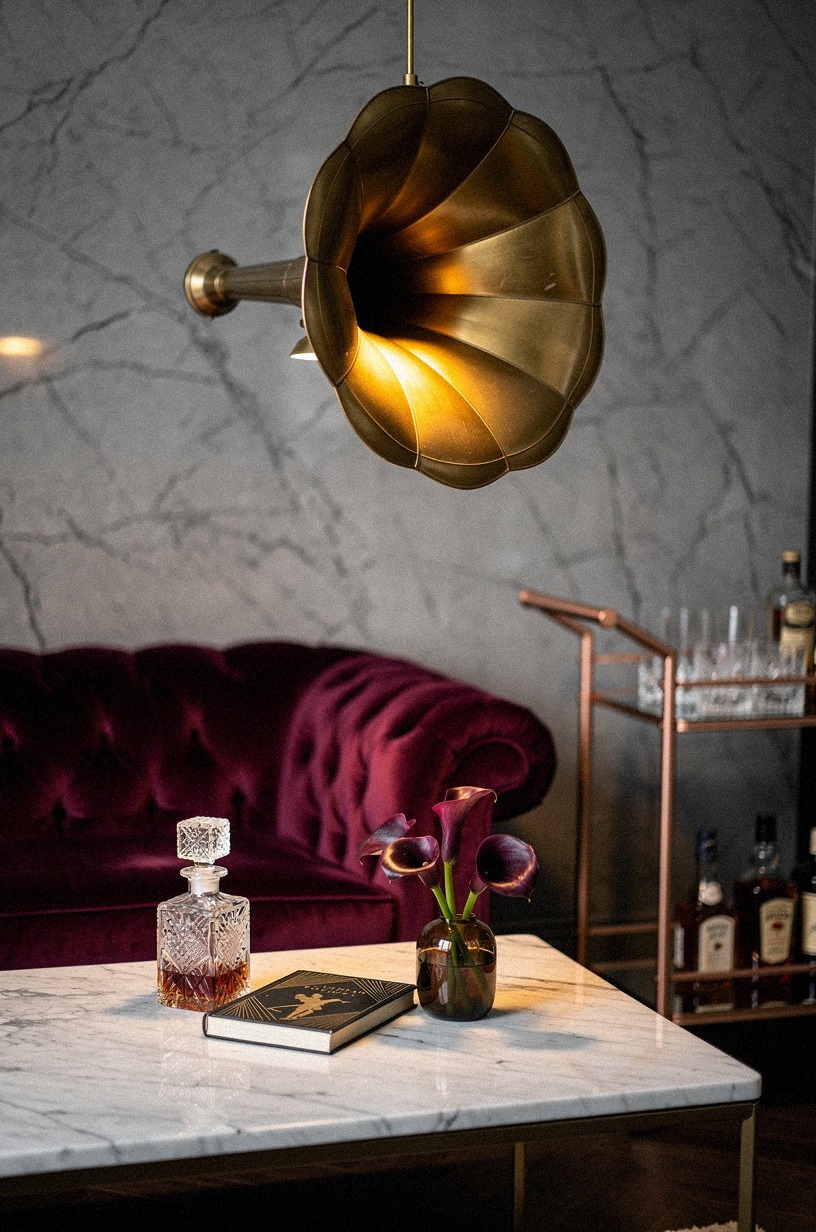
This is the conversation starter. A gramophone-horn pendant light, brass or copper, hung low over the Carrara marble coffee table creates a dining-room intimacy in a living-room setting.
The light is directional, focused, and slightly theatrical. It’s not for reading. It’s for talking.
Below it, the plum velvet chesterfield sofa should be positioned so the light falls on the center of the seating area, not into anyone’s eyes. Grey walls with subtle grey veining, yes, veining in the plaster itself, achieved with a dragging technique and two tones of grey paint, give the room a stone-like quality without the weight of actual stone.
You’re aiming for 30 to 36 inches above the table. Any higher, and it loses intimacy.
Any lower, and it becomes an obstacle. The bulb should be dimmable and warm.
The shade, if there is one, should be amber or smoke glass. Clear glass is too bright.
Opaque is too dark. You want the light to feel like it’s coming through whiskey.
14Stack leather-bound books beneath a glass-top side table
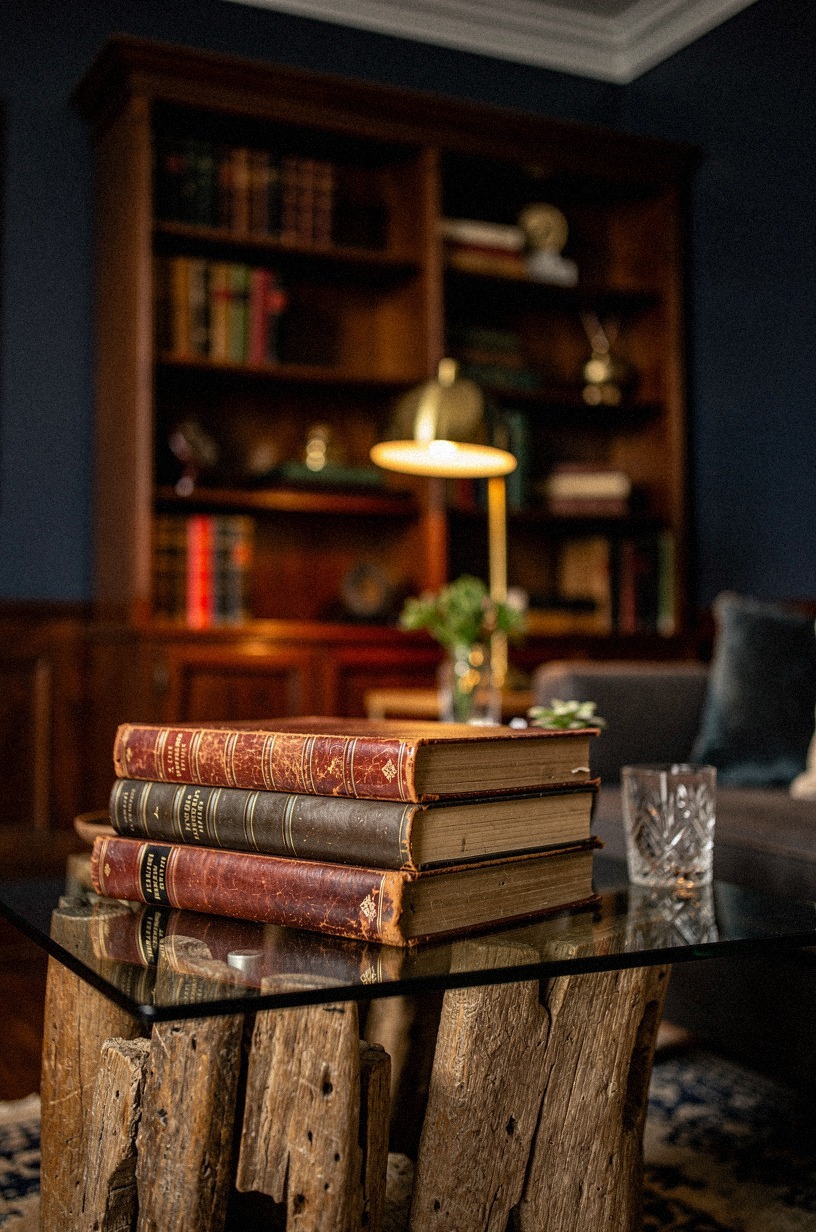
This is the detail that proves you’re not trying too hard. A glass-top side table with a stack of leather-bound books beneath it, visible through the clear surface, is both functional and narrative.
The books don’t need to be rare first editions. They need to look like they’ve been read. Scuffed spines.
Faded gold lettering. A mix of sizes and colors.
The navy walls behind the table, trimmed with white crown molding, give the books a formal backdrop. A walnut bookshelf nearby, filled with more books and a few objects, a brass magnifying glass, a small sculpture, a framed postcard, extends the story. The reclaimed weathered teak tray on top of the table holds the practical items: a coaster, a lighter, a small bowl for keys.
The glass should be thick. Half-inch minimum. Thin glass feels temporary.
Thick glass feels permanent. And the stack beneath should be at least four books high, with the largest on the bottom and the smallest on top. It’s a simple rule.
But simple rules, followed consistently, create the illusion of effortless taste. No hidden formula needed.
15Frame the windows with heavy silk tassel tiebacks
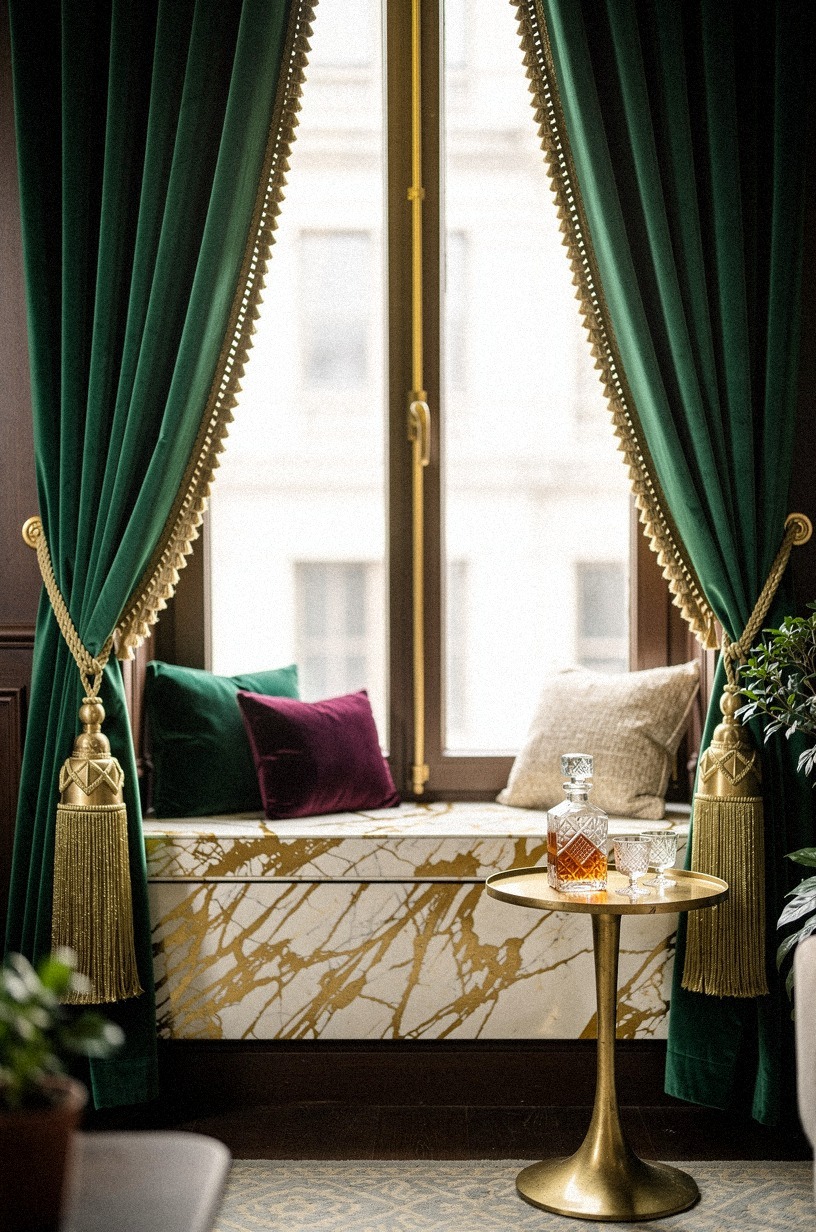
Windows in a speakeasy room should feel dressed, not just covered. Heavy silk drapes in charcoal or deep plum, lined and interlined for weight, frame the glass like a stage curtain. The tassel tiebacks should be oversized, almost theatrical, a single tassel the size of your fist, in a contrasting gold or brass thread.
They’re jewelry for the room, and they should feel a little excessive.
The drapes should puddle on the floor by at least two inches. If they break at the sill, they look like office curtains.
If they hover above the floor, they look like a mistake. The rod should be brass, mounted as close to the ceiling as possible, with the drapes extending well beyond the window frame on both sides.
This makes the window feel larger and the ceiling feel higher, two tricks that cost nothing but change everything.
Behind the silk, a linen sheer in a warm ivory filters the daylight without killing it. The combination of heavy outer drape and soft inner sheer lets you control the mood from afternoon to evening.
Pull the sheers for a soft glow. Close the silk for total darkness.
The tassel tiebacks hold the silk in a loose swag when you want to see out. It’s a small detail.
But in a room where every detail is intentional, small details are the whole story.
16Set a brass peacock fireplace screen as the room’s focal point
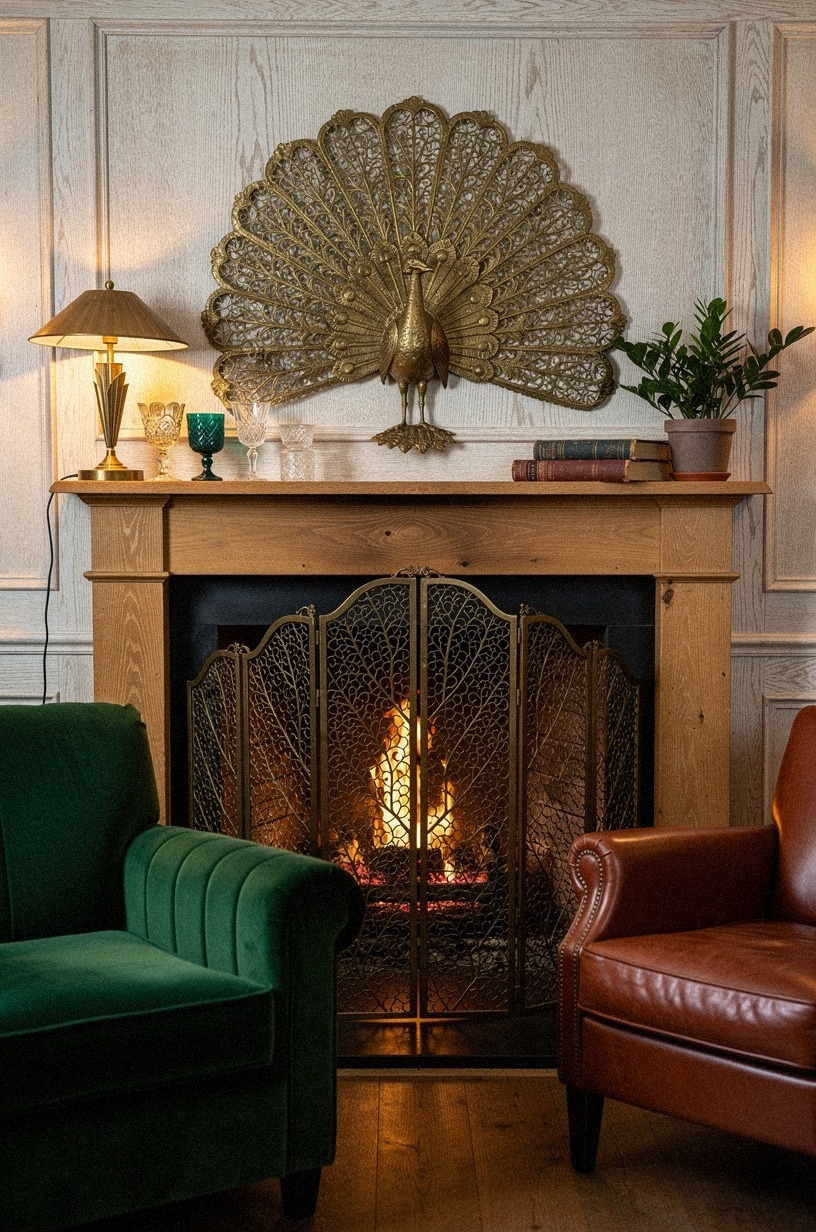
A brass peacock fireplace screen is the single most dramatic object you can put in this room. The radiating fan shape, the pierced metalwork, the way it catches firelight and throws patterns on the walls, it’s a functional sculpture. Even when the fire is out, the screen holds the room’s attention.
Position it in front of your forest green velvet sofa and a rust leather armchair, arranged in a conversational cluster. The natural oak mantelpiece above should be simple.
A beam, a shelf, something that doesn’t compete. The cerused white oak side table beside the armchair should hold one object.
A lamp. A book. A glass.
Not all three.
The screen should be polished but not perfect. A little tarnish in the recesses adds depth.
If you find one that’s already aged, resist the urge to restore it. The patina is the story. And in a speakeasy room, story is everything.
17Lay a Persian runner along a dark-walled hallway nook
Not every speakeasy room is a single box. If you’ve got a hallway nook, a small vestibule, or a transition space, treat it as part of the story.
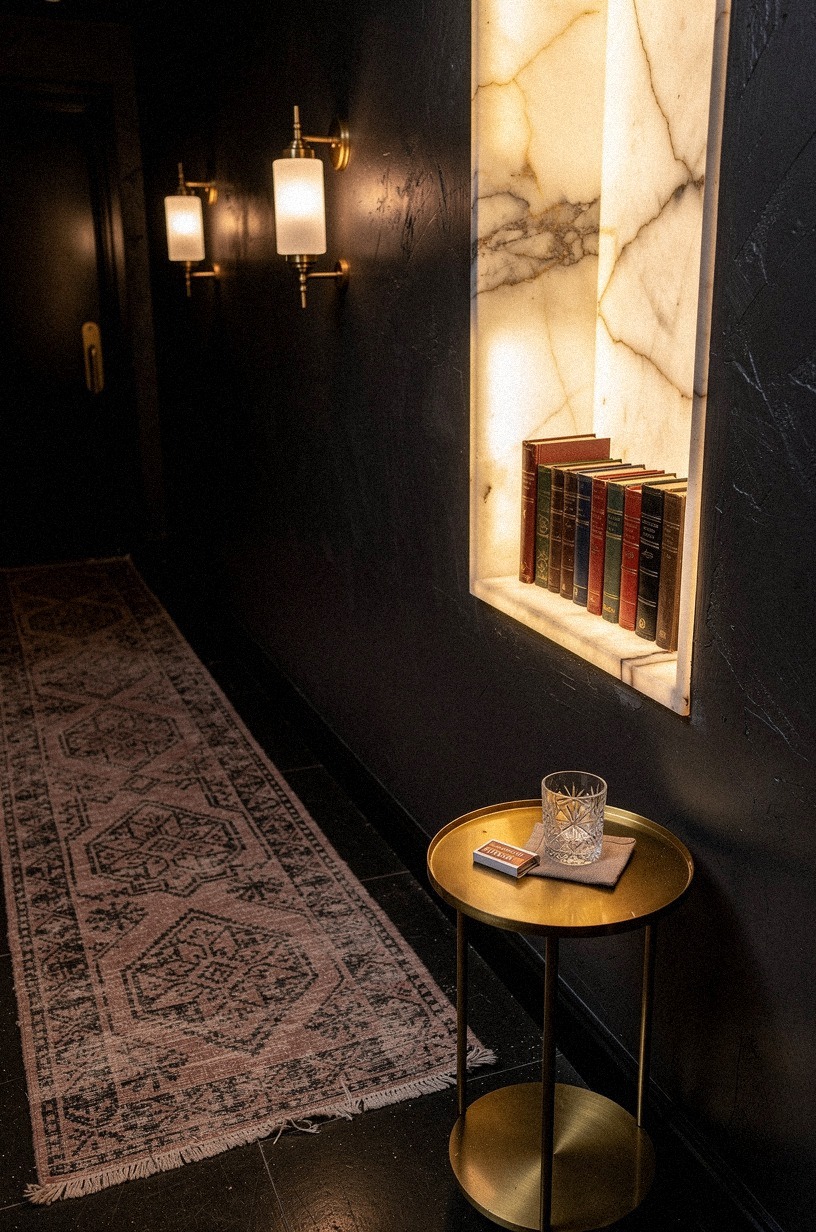
A Persian runner in dusty rose and charcoal, laid along a dark-walled hallway, extends the aesthetic beyond the main room. The pattern should be traditional, not modern.
The pile should be low, so it doesn’t feel like a bedroom.
And brass wall sconces along the hallway, matching the swing-arm sconces in the main room, create continuity. A backlit translucent onyx niche with a leather bench beneath it turns the hallway into a destination.
A place to sit and put on shoes. A place to wait for a friend.
A place to pause.
The walls should be the same dark tone as the main room. The trim should be the same white.
The hardware should be the same brass. Consistency across spaces is what makes a house feel designed rather than decorated.
And design, at its best, feels inevitable.
The Budget Reality: What This Costs
Most people can hit the “Budget” tier in a single weekend and see a real transformation. The paint, the rug, the curtains, and a few brass candlesticks change the feeling of a room more than you’d expect.
The “Mid” tier is where you start replacing the big pieces: the sofa, the lighting, the coffee table. The “High” tier is for the committed. Custom millwork, a stone fireplace surround, a tin ceiling.
That’s the territory of designers and serious enthusiasts.
The honest truth is that you don’t need the high tier to get the feeling. The feeling comes from the lighting, the materials, and the restraint.
A $300 room with the right paint color and a single good lamp feels more like a speakeasy than a $12,000 room with too many competing elements. Start with the mood.
The objects will follow.
Why the Speakeasy Aesthetic Keeps Coming Back
There’s a reason this look resurfaces every decade. It’s not nostalgia.
It’s physics. A room with low light, warm materials, and enclosed seating triggers something primal.
We feel safe. We feel held. We feel like we’ve stepped out of the stream of daily life and into a space where time moves differently.
The 1920s origin matters because it was the last moment before electric overhead lighting became the default. Gaslight and early incandescent bulbs were warm, dim, and directional.
They created shadows. Shadows create mystery.
Mystery creates intimacy. And intimacy, in a living room, is the whole point.
You’ve probably sat in rooms that cost a fortune and felt nothing too. I’ve sat in rooms with a single leather chair, a brass lamp, and a good rug and felt completely transported.
The difference is intention. The speakeasy aesthetic isn’t a style. It’s a decision to prioritize atmosphere over efficiency.
To choose the dimmer switch over the bright white LED. To let the room wrap around you instead of exposing every corner.
That’s why it works in 2026. That’s why it will work in 2036. The need for shelter, for warmth, for a place that feels like it was waiting for you, that doesn’t go out of style.
But here’s the thing most people miss: you don’t need a historic brownstone or a Craftsman bungalow to make this work. I’ve seen it done in a 400-square-foot studio apartment with a single good lamp and a gallon of dark paint. The architecture is irrelevant.
The commitment is everything. When I walk into a room and the light drops by half, my shoulders drop too. And yours will as well.
Your breath slows. You stop scanning and start seeing.
That’s not design theory. That’s biology.
And biology, unlike trends, doesn’t change.
The Questions Worth Answering First
What is the best 1920s speakeasy decor for a small living room?
Start with paint and lighting. A dark ceiling and warm bulbs do more for atmosphere than any sofa. For furniture, a compact IKEA KALLAX unit painted black and topped with marble becomes a bar.
A single Article Sven leather chair anchors the seating. Add a geometric rug and brass candlesticks. The room will feel intentional, not crowded.
Check our budget living room refresh for more small-space tricks.
Where can I buy 1920s speakeasy decor pieces on a budget?
IKEA has surprisingly good brass lighting and simple frames. Target Threshold carries velvet pillows and basic barware.
Wayfair is useful for rugs and accent chairs if you read the reviews carefully. But the real finds come from Facebook Marketplace and thrift stores.
Brass candlesticks, old books, vintage frames, these are everywhere once you start looking. The hunt is part of the aesthetic.
How much does a 1920s speakeasy living room makeover cost?
About $300 to $1,200 for a budget refresh with paint, textiles, and accessories. A mid-range redo with a new sofa, quality rug, and layered lighting lands around $2,500 to $8,000.
A full custom build with millwork and a stone fireplace starts at $12,000 and climbs fast. Most people see the biggest impact at the budget tier.
Can I create a 1920s speakeasy look on a budget?
Yes, and the constraints help. Paint the ceiling dark. Buy a single good brass lamp.
Hunt for velvet curtains secondhand. Stack books you already own under a glass table. The aesthetic is about mood, not money.
Less than dinner out! A dark room with warm light and a few meaningful objects feels richer than a bright room full of expensive clutter.
Is a 1920s speakeasy aesthetic worth it in a small space?
Absolutely. Small spaces in practice benefit from the intimacy.
Dark walls and low lighting make a 12-foot room feel like a private club instead of a cramped box. The key is restraint. One statement piece per wall.
One color story. One light source per seating position.
Everything else is noise.
Is 1920s speakeasy decor a good idea for a rental?
Yes, with swaps that don’t damage. Peel-and-stick wallpaper in a dark pattern replaces paint.
Tension rods hold curtains without drilling. Removable LED strips create backlighting.
A bar cart on wheels moves with you. The only thing you leave behind is the mood, and that’s easy to recreate in the next place.
See our lighting guide for renter-friendly bulb swaps.
Where I’d Start First
If I had to pick one, I’d start with the lighting. A single brass floor lamp with a warm bulb, positioned beside your main seating, changes the feeling of the room after dark more than any paint color ever could. Get the glow right first.
Everything else lands.