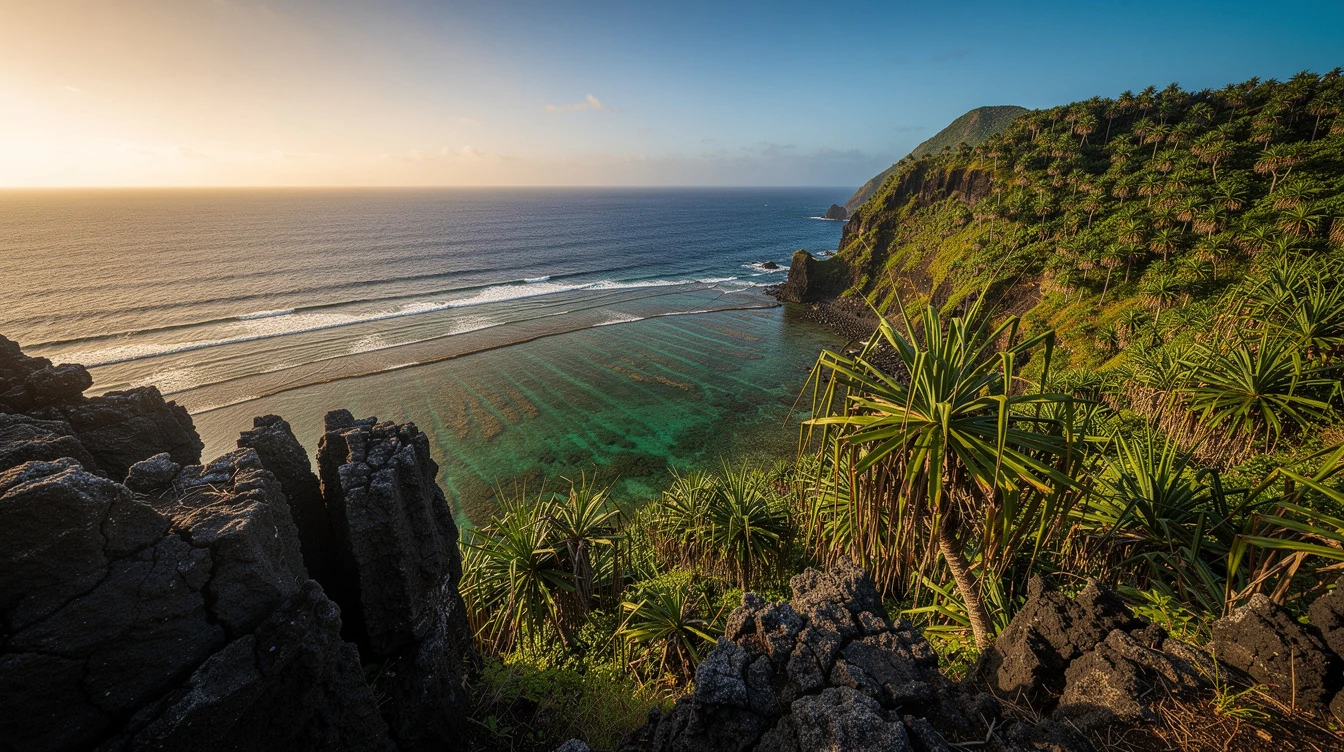
Rodrigues sits 560 km east of Mauritius, and that’s the whole point. It’s small enough, at 108 km², that you can cross it quickly. But the gap of open ocean around it is what keeps the place honest. No cruise ships. No duty-free malls. Just a volcanic hump rising 398 m at Mont Limon, surrounded by a reef that grew here alone.
The loudest sound ever recorded traveled 4,800 km to reach here
In 1883, the eruption of Krakatoa sent a pressure wave across the Indian Ocean. Naval ships at Rodrigues heard it as “the roar of heavy guns” and went to investigate. The sound had traveled 4,800 km. That’s the farthest any documented noise has carried. The island was so quiet, so removed from the shipping lanes of that era, that a distant catastrophe registered as a local emergency.
That isolation still defines the place. The island was named after a Portuguese explorer in 1528, but it sat off the actual routes seafarers used. The Dutch stopped by for fresh food starting in 1601. A Huguenot named François Leguat tried farming in 1691 and failed. The French brought African slaves in the 1700s to raise stock. The British took over in 1809. By 1843, the population had collapsed to 250 people.
How to get there, and when the weather works
Can you fly direct?
You can’t. Air Mauritius runs the connection from the main island, and schedules shift with demand. The flight covers open water. That air link is the only practical route, and it keeps visitor numbers low.
September and October are the driest months. The mean temperature hovers around 25.9 °C in summer and 22.3 °C in winter, but the real issue is cyclone season. From November through April, storms hit Rodrigues more often than they do Mauritius. The climate is hotter and drier than the main island, and the trade winds blow year-round.
What 43,650 people built on 1.5 million years of rock
The island is young, geologically speaking. 1.5 million years old, born from volcanic activity along the Mascarene Plateau. Over time it developed limestone deposits and caves, unique among the Mascarene islands. A fringing reef encloses a lagoon with 18 small islets inside it.
That reef is biologically unusual. It receives no coral zooplankton from elsewhere. It had to seed itself. The result is a species-poor ecosystem where what does live here is highly adapted. Several species of coral, damselfish, and crustaceans are found nowhere else.
The human population has recovered from that 1843 low. The 2022 estimate is 43,650, up from 41,669 in 2014. Most residents are of African descent, part of the wider Mauritian Creole community. The main language is Rodriguan Creole, close to Mauritian Creole but with its own pronunciation. English and French handle government and business.
What you’ll actually find on the ground
The capital is Port Mathurin, on the north coast. It’s the largest settlement and the administrative center. The island runs its own affairs through the Rodrigues Regional Assembly, a setup granted in 2002. Before that, it was the tenth district of Mauritius, managed from afar.
The economy runs on fishing, farming, and handicraft. Tourism is developing, but slowly. There are no large resorts. The infrastructure is functional rather than polished. A boat captain who has run the lagoon for decades will know the reef passages better than any chart.
Grande Montagne, Anse Quitor, and two islets, Île aux Sables and Île aux Cocos, are protected as nature reserves. The François Leguat Giant Tortoise Reserve sits near Anse Quitor, a nod to the two endemic giant tortoise species that were eaten to extinction after human arrival. The Rodrigues flying fox hangs on, listed as endangered. Two endemic bird species remain: the Rodrigues fody and the Rodrigues warbler.
What this island is, and what it isn’t
Rodrigues is not Mauritius with smaller crowds. The interior is different from plantation landscapes, and the lagoon has its own character. But the water stays shallow and warm.
It is not Réunion’s wild volcanic drama either. Mont Limon is a hill, not a peak. The island’s age means the erosion has softened the contours. What you get instead is a kind of stripped-down tropical life. The kind of place where a reservoir built in the hills above Port Mathurin still matters, because there is no other source of reliable fresh water.
The island became autonomous in 2002, and that political fact shapes daily life more than most visitors notice. The regional assembly meets weekly. The chief commissioner reports to the Mauritian prime minister, but the budget and the decisions are local. The last election was in February 2022. The Alliance party took nine seats, the Organisation du Peuple de Rodrigues took eight.
The trade-off, stated plainly
You come to Rodrigues for the gap, not the amenities. The 560 km of ocean between here and Mauritius is what preserves the place. But that same gap means limited medical facilities, limited flight schedules, and a food supply that depends on what grows here and what comes by air.
The reef is healthy in parts, damaged in others. The endemic species are hanging on in reserves. The tortoises are gone, but the reserve breeds similar species to fill the ecological role. It’s a work in progress, not a museum.
By the time the afternoon trade wind picks up, the lagoon turns choppy inside the reef. The sound is local now, just wind and water. No cannon roar from across the ocean. Just the island, doing what it has done for 1.5 million years, quietly.