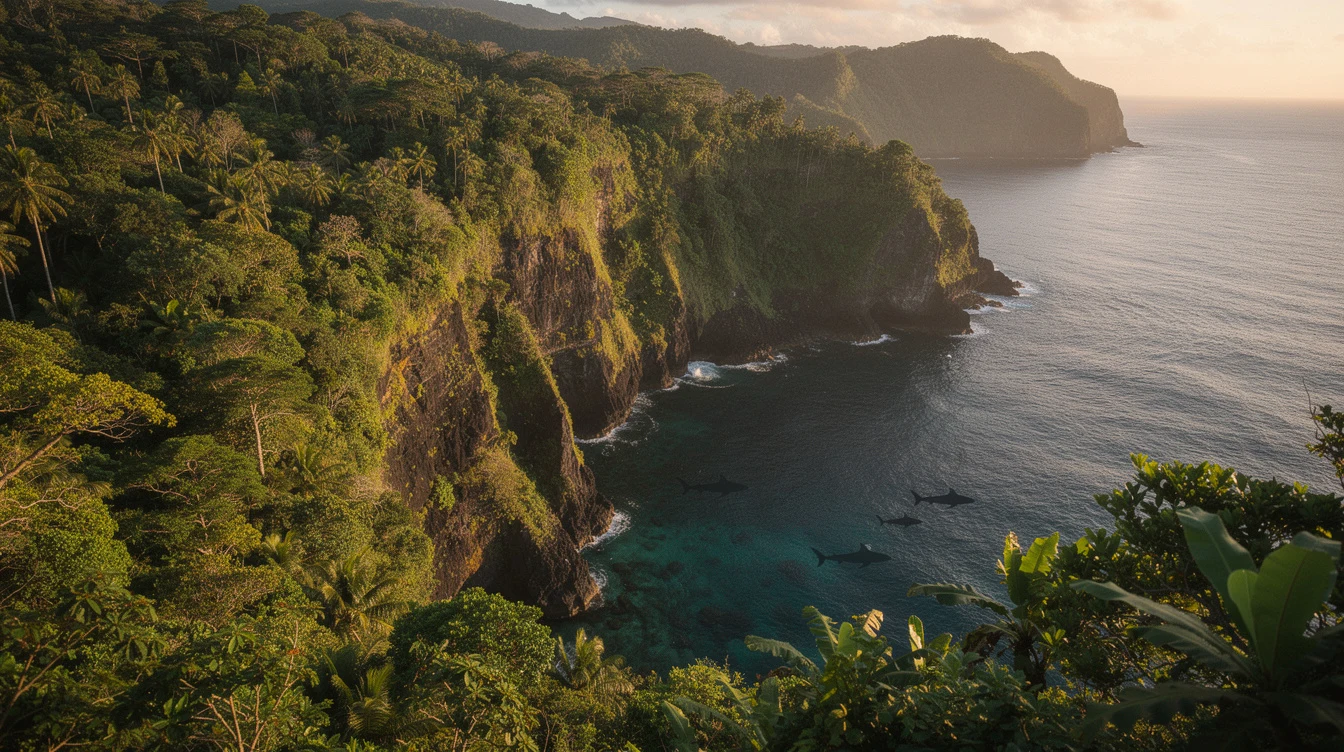
The hammerheads arrive in numbers that sound made up. Isla del Coco sits 342 miles southwest of the Costa Rican mainland, and the crossing from Puntarenas takes 36 to 48 hours by boat. That distance is the filter. It keeps the island’s waters clear of casual traffic, and it keeps the shark schools intact.
Why the crossing is the point, not the obstacle
You do not stumble onto this island. The boat ride is long enough to lose phone signal, sleep through a full night, and wake to water that has changed color. The Pacific here runs deep and cold, with counter-currents that pull nutrients up from the bottom. That is why the hammerheads gather, and why they stay.
Jacques Cousteau called it the most beautiful island in the world in 1994. He had seen plenty of islands. The fact that he kept returning says more than the quote itself.
What the diving actually looks like
The island is only 9.2 square miles above water. Below it is different. The drop-offs start close to shore, and the walls fall fast. At Bajo Alcyone, the hammerheads swim in columns that can number in the hundreds. They are not a possibility. They are the default.
Encounters with dozens or hundreds of these animals are nearly certain on every dive. That is not marketing language. That is what the dive logs say, consistently, across years. The same current that made the crossing rough brings the pelagics in. You do not get one without the other.
At Dos Amigos Grande, there is a natural underwater arch. At Manuelina Garden, coral holds against the current. The small fish are as thick as the big ones. The reef is one of the most extensive in the southeastern Pacific, and it feels like an afterthought compared to the sharks.
Who lives there, and who does not
The island has 33 residents. All are Costa Rican park rangers. They stay in camps at Wafer Bay and Chatham Bay. No one else is allowed to remain overnight. Tourists and crew can land, but only with permission, and camping is prohibited.
This is not a soft rule. The rangers enforce it because the island has been a national park since 1978, and a UNESCO World Heritage Site since 1997. The protected marine zone was expanded to 771 square miles in 2002. The land itself is roughly rectangular, volcanic, and the only thing above water on the Cocos tectonic plate.
Can you actually set foot on the island?
Yes, but briefly. The rangers may grant permission to come ashore, but you cannot stay. The trails are steep, the interior is wet, and the purpose of the visit is the water. Most divers see the island from the boat, or from the edge of a zodiac. That is enough. The island is the reason the sharks are here, but the island is not the experience.
The treasure that mattered
Over 300 expeditions have searched for buried gold on Isla del Coco. The stories involve pirates like Benito Bonito and the fabled Treasure of Lima. A few coins turned up. The rest is legend, and the government no longer issues permits to hunt.
The real treasure is the permit system itself. It kept the island from being stripped, and it kept the waters from being fished out. The rangers are the only ones who stay, and they vote in Costa Rican elections by special arrangement. They are not counted as permanent residents in census data, which is why the island still shows as uninhabited.
When to go, and what to expect
Access is year-round by boat, but the crossing depends on weather. The trip is always 36 to 48 hours, and it is always from Puntarenas. There is no airport. There is no ferry schedule. You book a liveaboard, and you wait for a window.
The water is cool, even in summer. The air is wet. The island receives heavy rain, and the climate is not like the Galápagos or any other eastern Pacific island. The ecology is unique enough that UNESCO recognized it specifically, not as part of a broader region.
In 2022, Ecuador expanded the Galápagos Marine Reserve to create the Hermandad Marine Reserve, adding 23,000 square miles to protect seamounts northeast of those islands. The idea is to connect protected areas. For now, Isla del Coco remains its own zone, 342 miles from anything, guarded by distance and by law.
The hammerheads do not care about your schedule
You will spend two full days getting there. You will spend two full days getting back. The diving in between is why you accept the transit. The sharks do not appear because you are lucky. They appear because the island is far enough to have been left alone, and protected enough to stay that way.
By the time the boat pulls back into Puntarenas, the harbor smells of diesel and wet rope. The hammerheads are still circling Bajo Alcyone. They were there before you arrived, and they will be there after you leave. That is the point of the place.