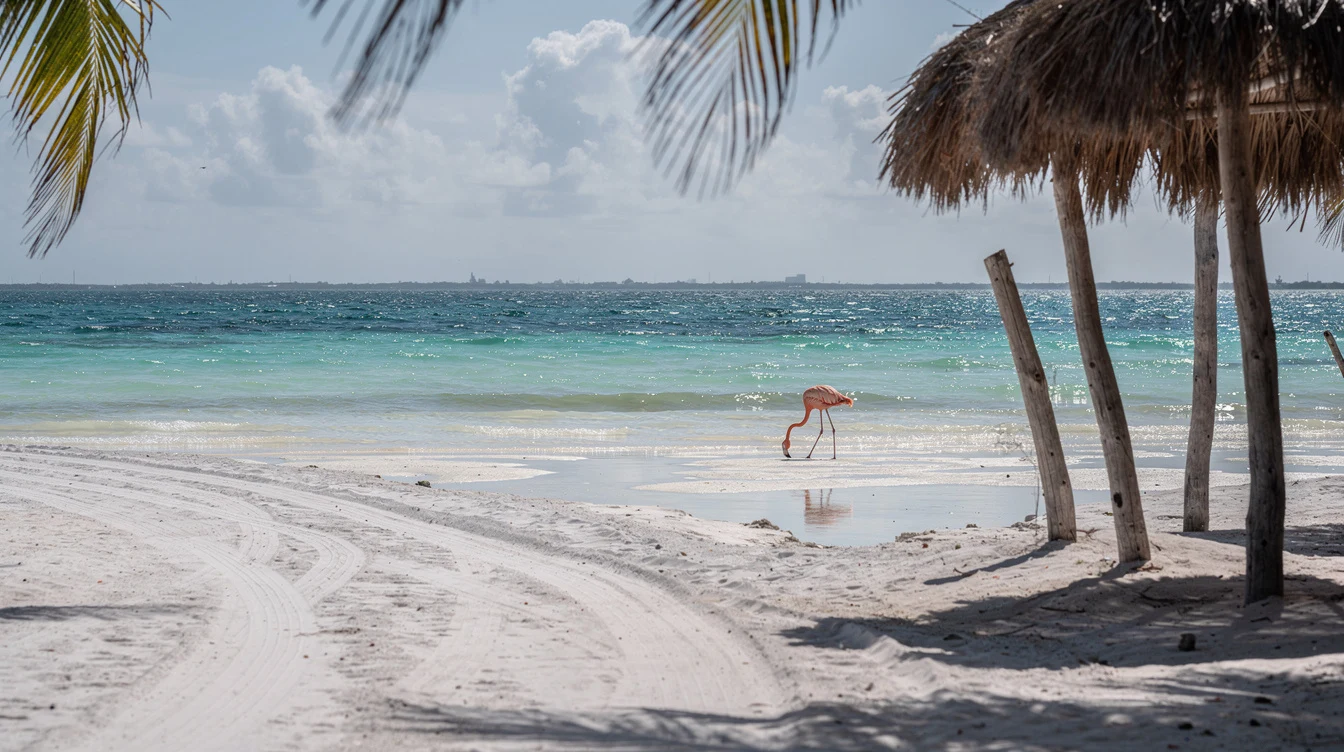
The bus from Cancún takes 1.5 hours to Chiquilá. The ferry adds 45 minutes. That’s three hours total to reach an island where 1,841 people live and no cars are allowed. The streets are sand, not pavement. And that is exactly the point of Isla Holbox.
What zero cars actually feels like
There are no engines idling at intersections. No horns. The sound you hear is golf cart tires on loose sand, or bicycle chains in the morning. The island is 26 miles long but barely 0.9 miles wide, so everything stays within reach. You walk, or you rent a golf cart, or you pedal. Those are the options.
Vehicle entry is banned to protect the environment and to keep sand from piling up on streets. It is one of the rare places where this rule is enforced for ecological reasons, not just atmosphere. The result is a town that moves at the speed of a person walking to the beach with a cooler.
How do you get there without a car?
From Cancún, take an ADO bus to Chiquilá. Two ferry companies run the crossing, one on the hour and one on the half hour. The 300 MXN one-way ticket buys a 45-minute ride across a shallow lagoon where flamingos and pelicans work the flats. Total travel time from Cancún is three hours. Private transfers to Chiquilá exist but cost around $135 for up to four people.
When the water turns into a calendar
June through September brings whale sharks. The peak is July and August, when the animals gather in numbers that draw snorkelers from Cozumel and Cabo Pulmo. But this is also hurricane season, and the island evacuates when storms track close. The trade is real: more sharks, less predictable seas.
November through April delivers drier air and lighter winds. Underwater visibility steadies out. This is the better window for general snorkeling, though Holbox is not a reef destination. The coral is thin here. What you get instead is seasonal megafauna, and the chance to float near something larger than a boat.
From April through December, flamingos feed in the lagoons. The birds are a constant presence, but their numbers swell in these months. At Punta Cocos, on the western tip, bioluminescence shows on dark nights when the water is still enough.
What 75% wild actually looks like
Most of Isla Holbox is not built. Mangroves and empty beaches take up three-quarters of the island. The developed slice is concentrated in the town center, where buildings are capped at 40 feet and the streets refuse to appear correctly on Google Maps. The island sits within the Yum Balam Biosphere Reserve, a status it gained in 1994. In 2020, El País reported 20 active legal challenges seeking to dismantle that protection.
There are no banks. No postal service. Around 50 restaurants and 75 hotels served the island as of 2020, though the real estate boom that started in the 2000s continues to shift the economy away from its fishing base. Lobster still dominates the local plates, and the catch is fresh because the main industry remains the water.
Kiteboarding and the wind window
Winter months bring reliable wind to the wide, shallow beach. Beginners learn here because the water stays knee-deep for a long way out, and there are few obstacles to drag into. Advanced riders wait for north or south winds to hit 25 knots. The climate is subhumid warm, which means temperature stays steady year-round. The variation is in the breeze, not the thermometer.
The honest limits of small and sandy
Electricity arrived in 1987. The island was destroyed by hurricanes in 1886 and rebuilt. The airstrip handles five-seater and 13-seater Cessna aircraft from Cancún and Playa del Carmen, but most people arrive the slow way. That slowness is the product. It is also the constraint.
You will not find extensive shopping. You will not find fast transport at night. You will find sand in your shoes permanently, and restaurants that close when they feel like it. The island is lively in season, quiet in the heat of summer afternoon. It is remote, but not hard to reach. It is touristy when the whale sharks peak, and almost yours in the weeks before.
By the time the last ferry pulls out for Chiquilá, the golf carts are parked and the sand streets go dark. That is when the island feels most like the refuge it was built to be.