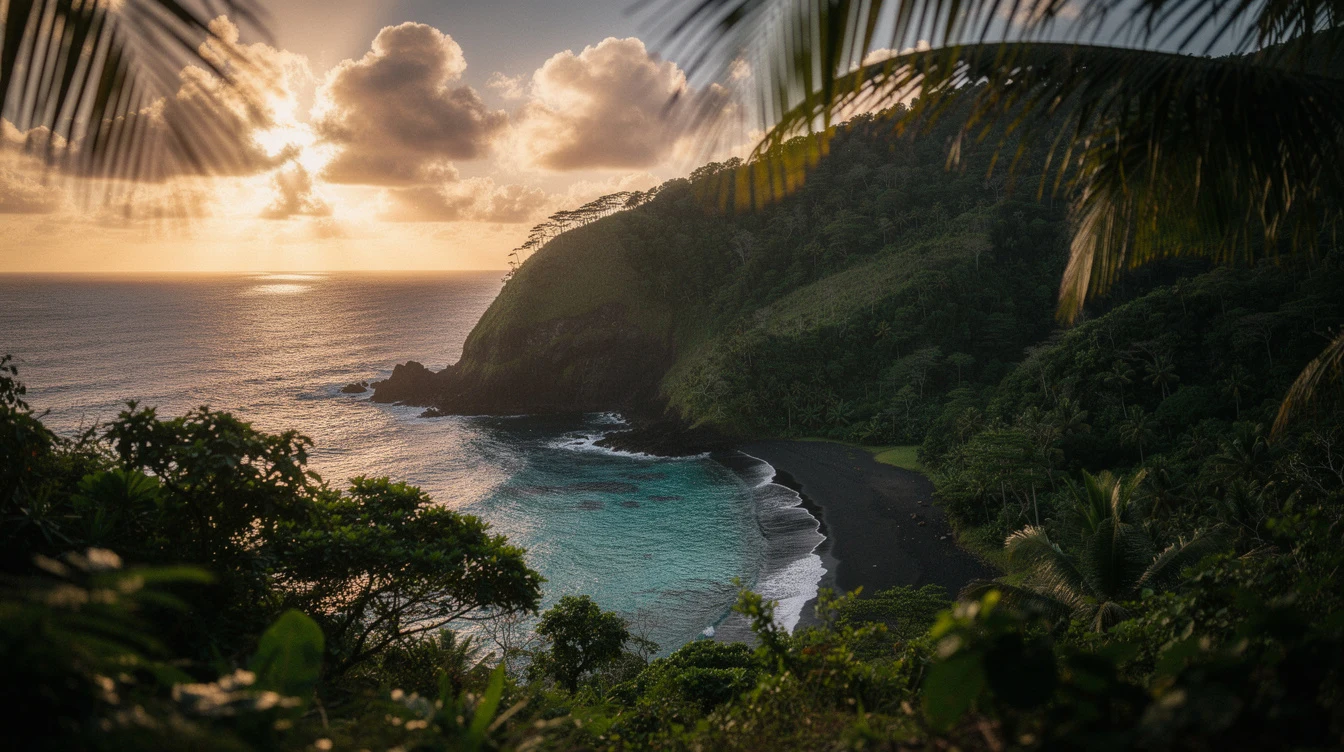
São Tomé gets the airport code and the cruise ship chatter. But the smaller island, Príncipe, is where Einstein’s theory of relativity was proven in 1919. That’s the reason to reroute your flight.
The island is 142 km² and holds just 8,420 people. It’s a volcano that has been eroding for over 3 million years, rising to 947 m at Pico do Príncipe. And it’s the place where Arthur Eddington photographed a total solar eclipse and showed that starlight bends around the sun.
The eclipse that changed physics happened here, not in a lab
On May 29, 1919, Eddington and his team set up on Príncipe and captured images of the eclipse. The photographs revealed the bending of starlight, exactly as Einstein had predicted. That confirmation turned relativity from theory into accepted science.
The island itself is the evidence. You don’t need a museum plaque to feel the weight of it. The same equatorial light that Eddington used still hits the cocoa forests every morning. And the same remoteness that made the observation difficult is what keeps Príncipe quiet now.
How do you actually reach an island this small?
Príncipe sits in the Gulf of Guinea. The airport code is PCP, and flights connect through São Tomé. That’s the only practical route. The island has one town, Santo António, founded in 1502, plus smaller settlements at Sundy and Porto Real.
From there, you walk or ride. Roads are limited, and the southern half of the island is mountainous forest without permanent settlement. The Parque Natural Obô do Príncipe, established in 2006, covers that uninhabited southern zone. That is where the endemic birds live. The Príncipe scops owl, the Príncipe kingfisher, and the Príncipe sunbird are found nowhere else on earth.
What remains from 1695, and what the French destroyed
The Portuguese built Fortaleza de Santo António da Ponta da Mina in 1695, inside Santo António Bay. The French destroyed both the city and the fortress in 1706. From 1753 until 1852, Santo António served as the colonial capital of Portuguese São Tomé and Príncipe.
But the island’s real monument is harder to label. The old plantations, first sugar and later cocoa, have largely reverted to forest since independence. That regrowth is visible. You can smell the wet soil and hear the frogs, including the palm forest tree frog and the Príncipe puddle frog, both endemic. The sound at night is dense, not silent.
Is the whole island really a UNESCO reserve?
Yes. UNESCO established the Island of Príncipe Biosphere Reserve in 2012 under the Man and the Biosphere Programme. It covers the entire emerged area of Príncipe, plus islets including Bom Bom, Boné do Jóquei, Mosteiros, Santana, Pedra da Galei, and the Tinhosas islands.
In 2025, the biosphere was extended to include São Tomé. That made São Tomé and Príncipe the first country to be designated in its entirety as a UNESCO biosphere reserve. The distinction matters because it means the entire archipelago is managed under a single conservation framework, not just the parks.
And the cocoa history is real. After 1822, Príncipe became the world’s largest cocoa producer. The labor was forced, and the population collapsed from 5,850 in 1771 to just 1,946 in 1875, the year slavery was officially abolished. That history is part of the forest now. The trees grew over it.
When to go, and what the climate does
Príncipe has an equatorial climate with no true dry season. That means humidity is constant, and rain can come in any month. The upside is temperature stability. There is no bad season, only wetter and slightly less wet periods. And the altitude at Pico do Príncipe keeps the upper slopes cooler than the coast.
The island gained political autonomy in 1995 as the Autonomous Region of Príncipe, matching the existing Pagué District. That status gives local administration more control over development, which has slowed large-scale construction. The result is that Príncipe still has no high-rise hotels and no cruise terminal.
Why Príncipe works for travelers over 50
The scale is human. You can walk across Santo António in ten minutes. The language is Portuguese, with local creoles including Principense or Lunguyê. And the pace is set by ferry schedules and forest sounds, not by tour buses.
But the trade-off is real. Medical facilities are basic. Banking is limited. And the connectivity that makes São Tomé easier also makes it busier. Príncipe requires more planning and more patience.
The reward is presence in a place that hasn’t changed its rhythm since 1919. When the afternoon light slants through the cocoa canopy, you understand why Eddington chose this island. The sky is open, the horizon is clear, and the world feels small enough to measure.
By the time the evening insects start, the harbor is still, and the town has already slowed to its natural speed. That is the point. Príncipe does not offer convenience. It offers the conditions that made scientific history possible, unchanged enough that you can still stand in them.