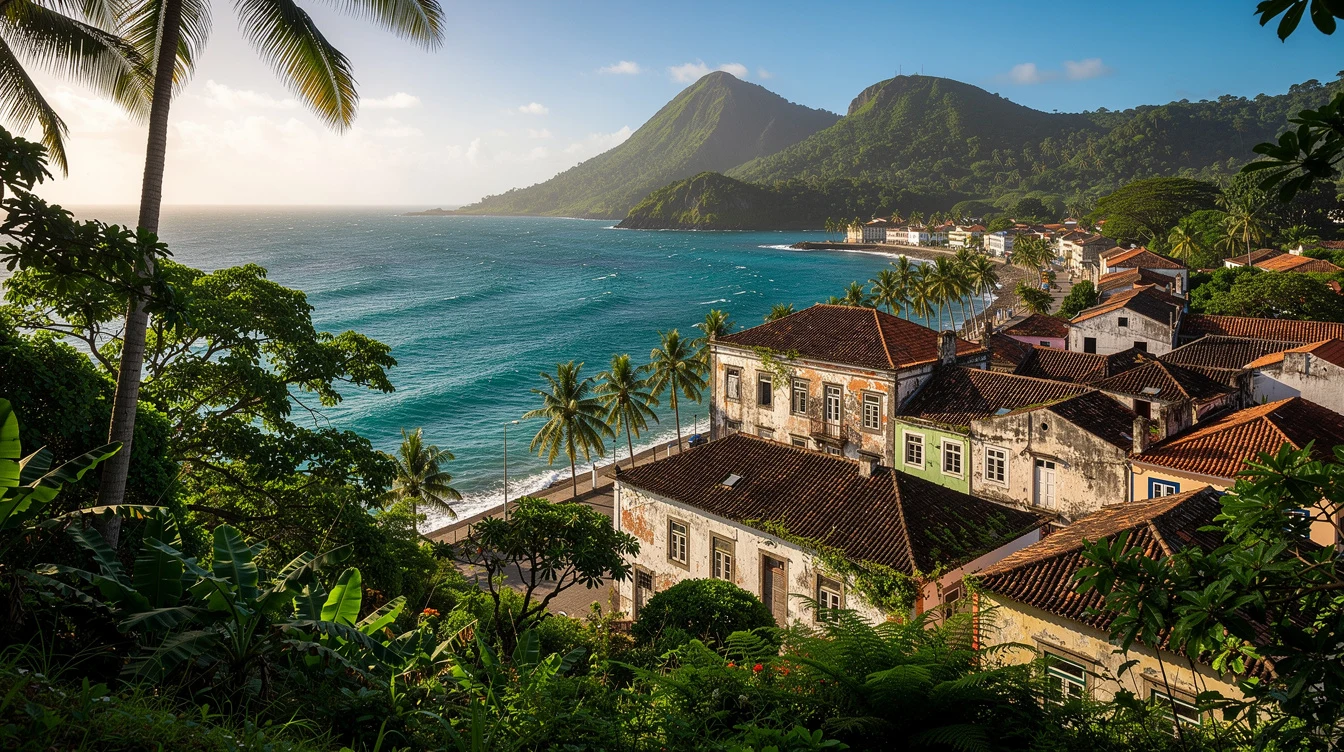
Álvaro Caminha landed here in 1493 with a plan. The island was empty, the rain was reliable, and the soil grew sugarcane almost without encouragement. São Tomé sits 40 km from the equator in the Gulf of Guinea, and that proximity still governs the place. Days start at 30 °C, nights barely cool to 22 °C, and the Benguela Current keeps everything foggy even when the rain stops. The city is small, 17 km², with 56,166 people above Ana Chaves Bay. But the scale is misleading. This was the first great sugar factory of the Atlantic world, and the architecture of that boom still paces the town.
1493 and the sugar that built the Atlantic
The Portuguese needed labor fast. In 1497, they took 2,000 Jewish children, eight and under, from the Iberian peninsula. The children were forcefully converted and shipped here for Catholic education. The Kingdom of Kongo became the next source. By the 1500s, São Tomé was the main center of sugar production on earth. The wealth was violent and brief. Brazil overtook it by 1600.
That is the timeline to keep in mind when you walk the streets. The sixteenth-century cathedral anchors the old center, though it was rebuilt heavily in the 1800s. Fort São Sebastião, built in 1566, now houses the National Museum. The walls are not decorative. They were meant to hold a product and the people forced to produce it. On 9 July 1595, Rei Amador led a slave revolt that seized the capital. The Portuguese regained control in 1596. The Dutch took the city for two days in 1599, then again for a year in 1641. The colony survived, but the sugar glory did not.
Plantation time is still the only time
Here is what “plantation time” means in practice. The short dry season runs, but the Benguela Current keeps the city cloudy and foggy even then. Annual rainfall is just under 900 mm. The wet season stretches October to May. Planters worked around these limits, and the modern city still does. Meetings drift. Ferries wait for weather. Buses leave when full, not when scheduled. The airport has direct flights to Angola, Gabon, Ghana, and Portugal, but the fog delays them without apology.
And the town is not quiet. Three radio stations, a public television station, and the tchiloli theater tradition keep the center lively. But it is not loud. The Presidential Palace, the cathedral, and the old cinema sit close together, and the scale is human. Two markets handle daily trade. The polytechnic and the University of São Tomé and Príncipe, formed in 2016, mean students mix with older residents in the praças. The highway circles almost the entire island, linking São Tomé to Trindade, Guadalupe, and Santana. You can drive it, but you will not rush.
How wet is the dry season?
Expect mist, not sun. The Benguela Current is cold water rising from the south, and it smothers the city in low cloud even in July. Pack for humidity, not heat relief. The temperature barely moves year-round, so the difference between seasons is water in the air, not degrees on a thermometer.
What remains from 1975
Independence came in 1975, and the capital kept its role. The main hospital, Hospital Ayres de Menezes, serves the country. The national stadium, Estádio Nacional 12 de Julho, hosts the city’s football clubs, Sporting Praia Cruz and Vitória FC in Riboque. The churches still dominate worship, from the Roman Catholic diocese to newer Pentecostal arrivals. The colonial street plan is intact. The harbor still matters. And the fog still rolls in by mid-morning, most days, most months.
São Tomé is old, but it is not preserved. It is simply still working. The buildings have been repainted, patched, and repurposed since 1493. The sugar is gone. The labor system that built the place is gone. What remains is the rhythm of waiting for weather, of trading when the boat arrives, of living at a latitude where the difference between wet and dry is more idea than relief. That is plantation time. It does not hurry, and it does not apologize.
By the time the afternoon fog settles over Ana Chaves Bay, the Ilhéu das Cabras offshore has vanished, and the last planes for Luanda are either gone or grounded. The city feels most like itself then, half-visible, still running on a clock set in 1493.