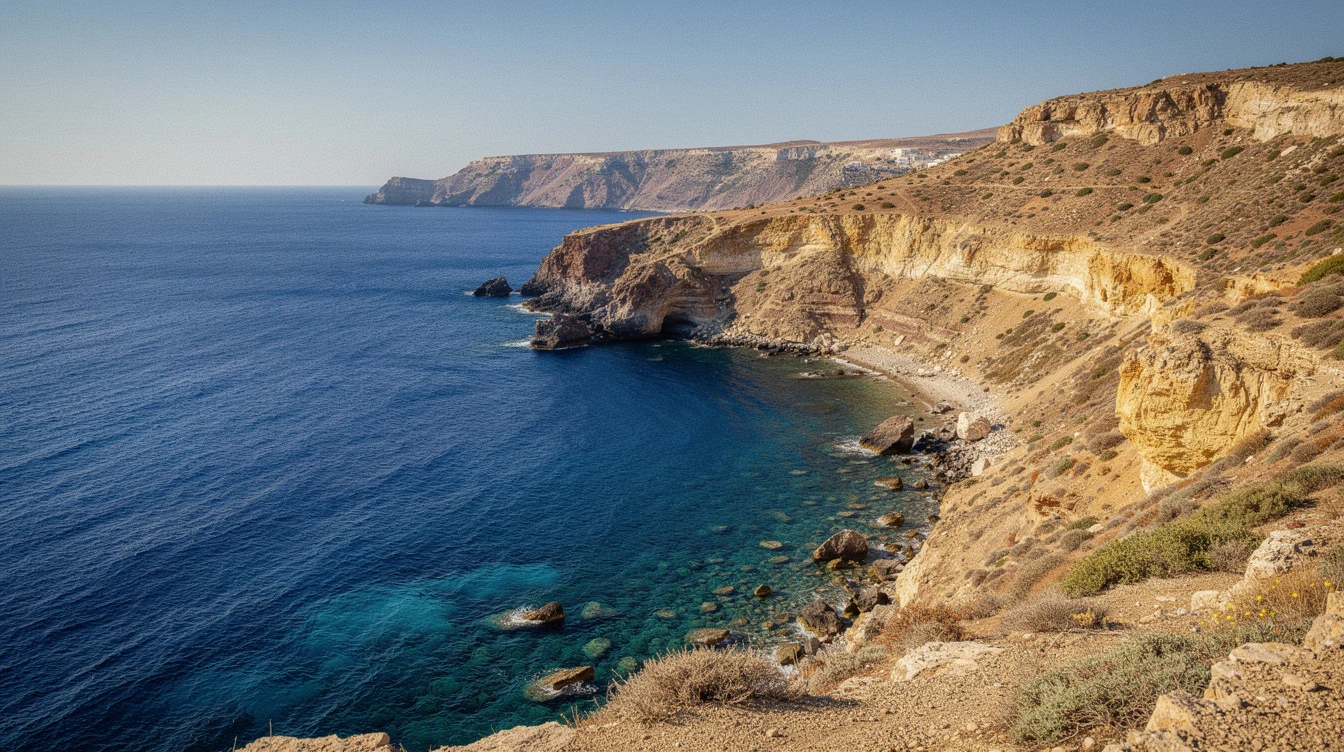
Ios sits halfway between Naxos and Santorini, and that’s exactly the problem. Travelers speed past it on the ferry, bound for blue domes and sunset crowds. But the island they skip has 723 m peaks and a harbor that empties out by late afternoon. The meltemi wind blows steady from the north all summer, so the heat never quite lands the way it does on the bigger islands.
The island where Homer supposedly died, and why that matters
The legend is specific. Homer visited the Delphic oracle, who warned him about a riddle from young children. He broke the prophecy and sailed to Ios anyway. On the coast, he saw children fishing and asked what they caught. Their answer, “Whatever we get we leave, whatever we don’t get we take,” referred to lice. He failed the riddle, slipped on muddy ground, and died from the fall.
In 1771, Count Pasch van Krienen arrived to find the grave. A local priest at the Agia Aikaterini Chapel pointed him toward marble fragments with inscriptions. With help from a scholar named Spyridon Valetas, he uncovered three graves. The last bore a verse claiming to hold “the sacred head of heroic Homer.” But the grammar was wrong. Van Krienen doubted, spent more time and money, then gave up. Theodore and Mabel Bent visited the same site in 1884. The tomb remains unproven, and that ambiguity is the point. Ios carries the weight without the crowds of better-known sacred sites.
Chora’s stairs keep the cars out, and the character in
The port at Ormos is functional. A footpath climbs from the harbor to Chora, the main village, and the climb is steep enough that you’ll feel it in July. The alleys are narrow, the stairways are steep, and cars largely don’t fit. That limitation preserves something. Since the 1990s, under Mayor Pousseos, the island has pushed to diversify beyond the young party crowd that arrived in the 1970s. European Community funds paved new roads and built a scenic amphitheatre at the top of the village hill, designed by German architect Peter Haupt.
And Chora still works. The central path holds restaurants, bars, and boutiques, but the volume is lower than Mykonos. The island is only 18 km long and 10 km wide, so nowhere is far. But the roads wind, and the hills are real.
Can you escape the party scene?
Yes, and it’s not difficult. Mylopotas beach was the 1970s sleeping-bag capital for European youth after all-night dancing. Today it’s developed into a package resort comparable to Platys Gialos or Paradise Beach on Mykonos. But the island has 86 km of total coastline. The southern beaches at Manganari stay quieter.
The interior is where Ios separates from its reputation. The highest point, also called Pyrgos, rises to 723 m in the center. The next three highest points, Xylodema, Kostiza, and Prophetis Elias, ring around it. The terrain is hilly, cliffs drop to the sea on most sides, and the geology is almost entirely metamorphic rock. There is no soft landing here. The landscape demands effort, and the effort keeps some visitors away.
What the food actually tastes like
The municipal creamery makes cheese from goat and sheep milk. Skotíri is the one to find. It’s sour, dense, and smells of summer savory. The island also produces tsimediá, pumpkin flowers stuffed with rice, and mermitzéli, handmade barley. These are not restaurant inventions for tourists. They are specific to this island, made with limited ingredients, and they taste like that limitation.
How to get there, and when the timing works
Ferries run from Athens and connect through Naxos and Santorini. The port at Ormos is on the north end, so arrivals face the climb to Chora immediately. That said, the island is not remote. It’s central to the Cyclades, which is precisely why it was a stop on ancient sea roads to Crete. The early Cycladic settlement at Skarkos hill proves the point. People have been landing here for millennia.
Go in June or September. The meltemi still blows, and the population of 2,299 residents can breathe again. August is functional but crowded. The narrow paths of Chora become exactly what they were designed to avoid.
The real reason to choose Ios over Santorini
Santorini sells certainty. The caldera, the sunset, the cruise ships. Ios sells the opposite. The Homer tomb might be real, or it might be a 1771 mistake. The cliffs are steep, but the beaches are sandy. The village is lively, but the stairs keep it human-scale. The island pursued mass tourism in the 1970s, then deliberately stepped back in the 1990s to find other audiences.
That choice is rare in the Greek islands. Most places double down on what works. Ios tried something else, and the result is an island that feels unfinished in the right way. By the time the last ferry leaves Ormos, the harbor goes quiet, and the wind keeps blowing from the north. That is when the island feels most like itself.