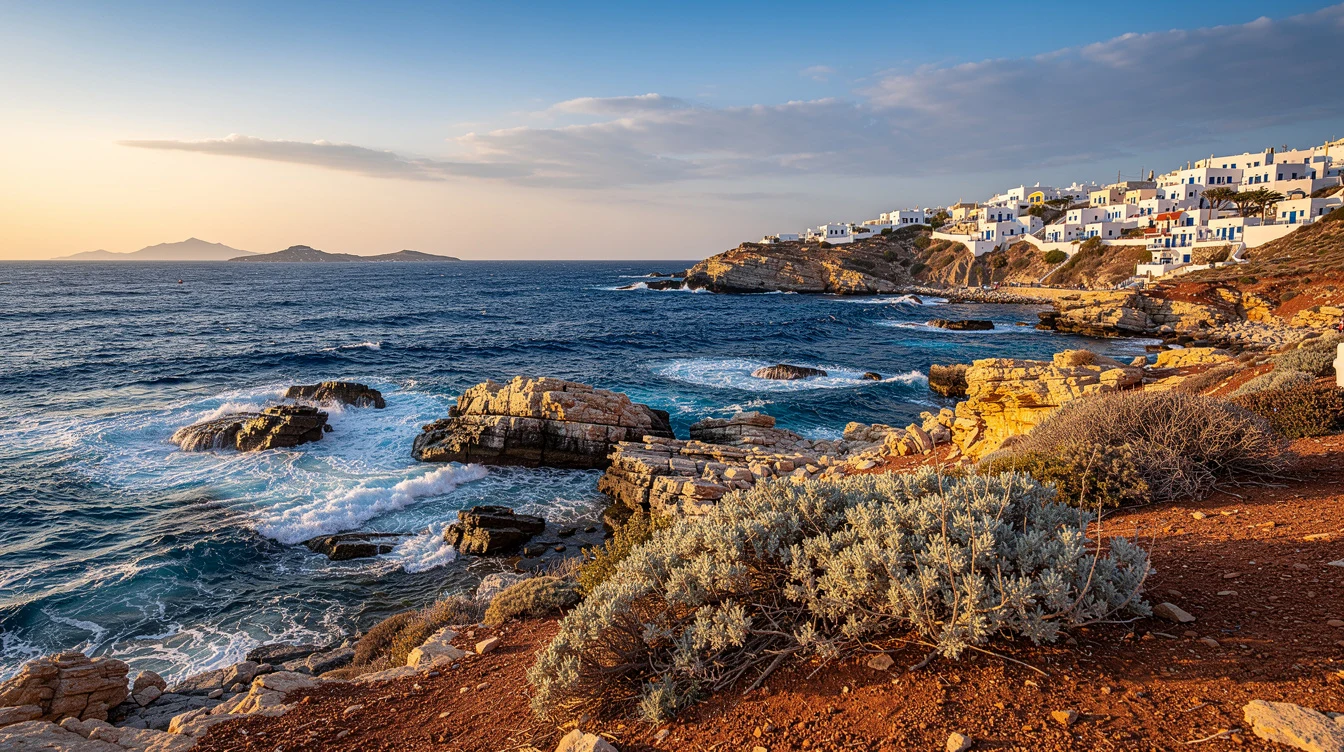
Mykonos sits 2 km from Delos, the sacred island where no one has been born or buried for millennia. That short stretch of Aegean water is what you’re really paying for. The rest, the beach clubs and the windmills, is the bill that comes with the view.
What 2 km buys you in the Cyclades
The crossing takes 20 minutes on a small boat from the old harbor in Chora. And because Delos is uninhabited, the last ferry back leaves at 3 p.m. most days. That narrow window means the ruins stay quiet even in July. The island itself, 85.5 km² of granite and scrub, rises to only modest heights. But the meltemi winds keep summer days at 27°C feeling cooler than Athens by a noticeable margin.
The proximity to Delos shaped everything here. In ancient times, Mykonos was the supply depot for the religious capital next door. Herodotus noted the Carians as original inhabitants, then Ionians from Athens in the 11th century BC. The island was poor, rocky, strategically useful. That history still shows in the terrain: no rivers, seasonal streams only, two converted to reservoirs. The 4,500 cubic metres of daily desalinated water keeps the taps running for visitors now.
How did a poor island become this expensive?
The French School of Archaeology began excavating Delos in 1873. That drew the first curious travelers. By the 1960s, international visitors arrived in numbers. The 1970s brought American nude beach culture, real or imagined. The 1980s shifted the island toward gay tourism. And by the 2000s, prices had climbed to among the highest in Greece. The transformation is complete: 10,704 residents at the 2021 census, swollen to perhaps 12,500 in the municipal count, hosting multiples of that in July.
The windmills still turn in name only
The 16th-century Venetian windmills at Kato Mili stand in a row above Chora, their wood and straw caps restored but motionless. They milled flour until the early 20th century. Now they are homes and document vaults. The northern winds that powered them, the same meltemi that moderates summer heat, still blow hard enough that the island’s nickname, “The Island of the Winds,” is not romantic exaggeration.
Little Venice, the waterfront houses with balconies over the water, was built in the mid-18th century for merchants and captains. The basement doors opening directly to the sea fed rumors of piracy. Some of those same rooms are bars now. The sunset crowds gather thick here. But the light is better at the Armenistis Lighthouse, 6.5 km north in Fanari, where the beam still turns for actual ships.
The Tria Pigadia, three identical wells dug in 1722 in Chora, sit in a row in Chora. They were practical infrastructure once. Now they are a photo stop between cafes. The Archaeological Museum, built in 1905, holds finds from Rheneia, including the famous vase showing the fall of Troy. It is one of Greece’s oldest museums, and it feels like one: the Neoclassical building expanded in the 1930s, 1960s, and 1972, each layer visible.
Petros the pelican outlasted his own legend
A storm in 1954 brought the first Petros to the waterfront. He stayed for decades, became official mascot, and after his death, a successor was elected. The current pelican is not the original, but the tradition continues. That is the kind of story Mykonos tells about itself: eccentric, maritime, slightly performative. The Aegean Maritime Museum, founded in 1983, collects the real history of ships and fishing, but the pelican draws more selfies.
The town’s population clusters in Chora on the west coast. The rest of the island’s ten villages spread thin. There is no single dramatic landscape, no mountain to climb for revelation. The highest point is barely over a thousand feet. The appeal is horizontal: the light on white walls, the wind flattening the sea by afternoon, the short boat ride to where gods were born.
Is it worth the mortgage payment?
That depends on what you value against the cost. The beaches are good, the nightlife is famous, the restaurants in Little Venice and Ano Mera serve competent versions of Cycladic cooking. But you can find comparable sand and food on Paros or Naxos, both nearby, both cheaper. The Delos connection is the specific asset. Standing on the Sacred Way, with Mykonos visible across the water, is the experience that justifies the ferry ticket. Whether it justifies the hotel bill is a separate calculation.
The season runs June through September, dry and sunny. October to March brings mild wet winters, many sunny days, and most tourist infrastructure closed. The meltemi winds make August tolerable when other islands swelter. But they also cancel ferries and whip sand against bare legs. It is never entirely comfortable, which is part of the character.
By the time the last Delos ferry returns at 3 p.m., the harbor cafes are filling for the afternoon shift. The windmills are silent. The pelican, whichever generation he is now, has likely retreated to some shaded corner of the waterfront. And the 2 km of water between here and the sacred island stay flat and blue until evening, when the light turns them silver, and the price of being here seems, for a moment, almost reasonable.