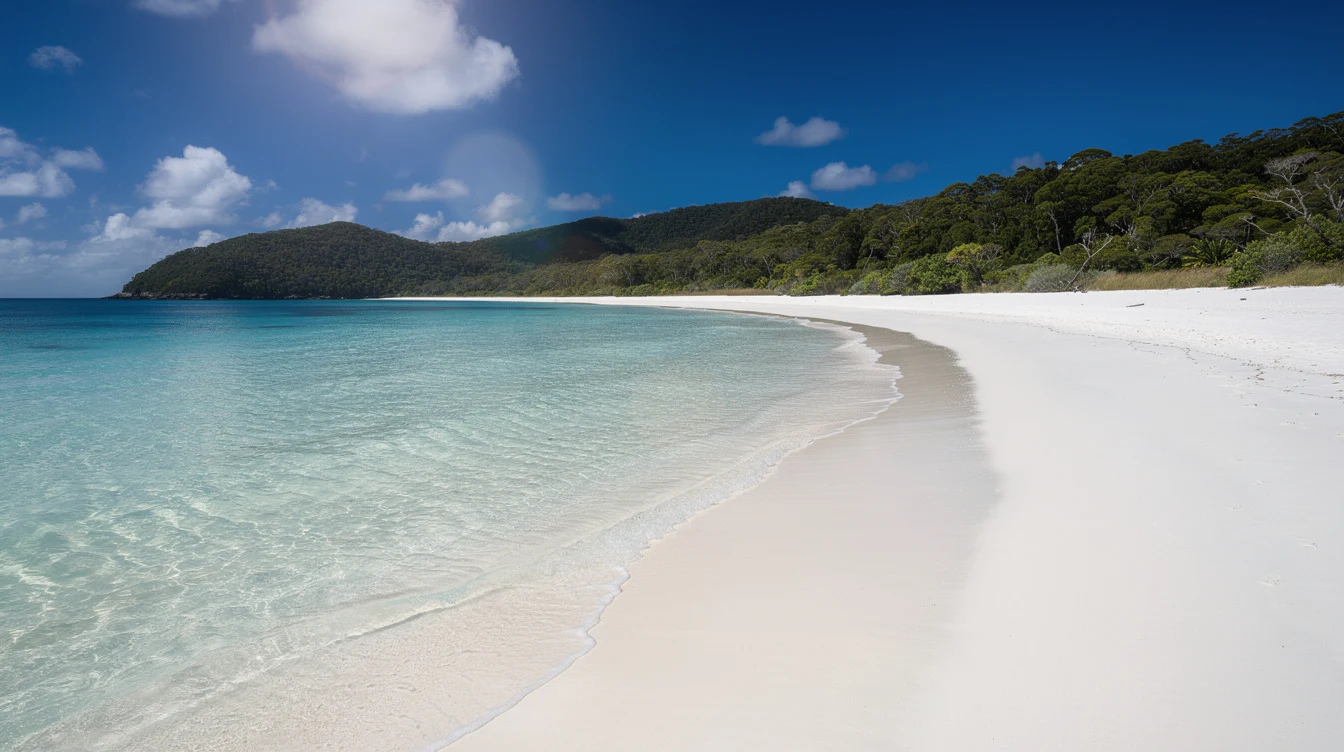
The sand on Whitehaven Beach is 98% pure silica, and that number matters more than you think. Silica does not absorb heat the way ordinary sand does. So when the Queensland sun is pushing 90°F and every other beach in the state is cooking the soles of your feet, this 4.3-mile stretch stays cool enough to walk barefoot at noon.
Locals know this. They have been calling it the one beach that never scorches bare feet for generations. And they are not exaggerating. The stuff is so fine it squeaks when you drag your heel through it, like fresh snow.
The sand is the reason you come, but the water is what keeps you
The beach runs along the eastern shore of Whitsunday Island, the largest island in the Whitsundays archipelago. It faces Hill Inlet at its northern end, where tidal shifts drag silica through shallow channels and turn the water into ribbons of white and turquoise. The effect changes by the hour. A boat captain who has run the route for decades told me the inlet looks different at 10 a.m. than it does at 2 p.m., and that is not marketing. It is tide math.
The water clarity runs to 30 feet or more on calm days. You can see stingrays from the deck without getting wet. But the beach itself has almost no shade, so the smart move is to bring a hat and plan your swimming for the morning. The afternoon sun here is direct and unforgiving, cool sand or not.
How do you actually get to Whitehaven Beach?
You do not drive. The island has no roads, no cars, no bridge. Every visitor arrives by boat, seaplane, or helicopter from either Airlie Beach on the mainland or Hamilton Island 10 miles southeast. The ferry from Airlie Beach takes about two hours each way. Seaplanes cut that to 30 minutes of flight time plus a water landing that is worth the price by itself.
Most day-trippers book through operators out of Shute Harbour or Hamilton Island. Prices run roughly $150-250 USD for a standard boat tour, and $300-500 for a seaplane or helicopter. The seaplanes usually include a stop at Hill Inlet lookout, which is the view you have seen in photographs. From there, it is a 10-minute walk down to the beach.
That said, the cheapest option is not always the best value. The faster boats get you more time on the sand. Some operators pack 40 people onto a vessel. Others run 12-passenger ribs. The difference in the experience is significant.
What about staying overnight?
There is no hotel on Whitehaven Beach itself. No restaurant, no bar, no cabana service. The island is national park, which is why the sand has stayed this clean. Campers can book sites at South Whitehaven and Nara Inlet, but you haul everything in and out by boat. Most visitors do not bother. They day-trip from Hamilton Island or Airlie Beach, where the beds and the cold beer are.
Hamilton Island has the infrastructure. Airlie Beach has the backpacker energy and more tour competition, which keeps prices down. I would pick Hamilton Island if I were traveling with someone who does not do well on small boats. The ferry to Hamilton is larger and steadier, and from there you connect to Whitehaven on a day boat.
When should you go?
The Whitsundays sit in the tropics, so the question is less about temperature and more about wet season. May through October is the dry window, with lower humidity and calmer seas for the crossing. November to April brings rain, higher winds, and the occasional cyclone that cancels boats for days. The water stays warm year-round, roughly 75-80°F, so swimming is never the problem. Getting there is.
Stinger season runs November to May, when box jellyfish and irukandji drift through northern Queensland waters. Most operators provide stinger suits on tours during these months. The suits are thin, full-body lycra. They work. Wear one.
The beach across the channel is quieter
Directly opposite Whitehaven, on Haslewood Island, sits Chalkie’s Beach. Locals also call it Stockyard Beach. It has the same silica sand, the same clear water, and a fraction of the boats. The trade-off is no Hill Inlet and no famous view. But on a busy July afternoon, when six tour vessels are anchored off Whitehaven, Chalkie’s feels like a different planet. Some operators include it as a second stop. Ask before you book.
The snorkeling is better there too. Hard coral starts closer to shore, and the fish are less accustomed to being fed by tourists.
Is Whitehaven worth the cost and the effort?
It is touristy by definition. You cannot get there without paying someone to take you. The beach has no secret corner that the boats miss. But the sand really is that white, the water really is that color, and the physics of silica really do keep it cool underfoot when everything around you is radiating heat. That is not a gimmick. It is geology.
My advice: book the earliest boat you can stand. The light on Hill Inlet is better before 9 a.m., and you get two hours before the midday crowd arrives. Bring reef-safe sunscreen. The regular kind is banned in Queensland waters, and operators check.
By the time the last boats pull away at 4 p.m., the beach empties out fast. The sand cools further. The water flattens. And for about an hour, before the light drops, you can hear the squeak of your own footsteps.