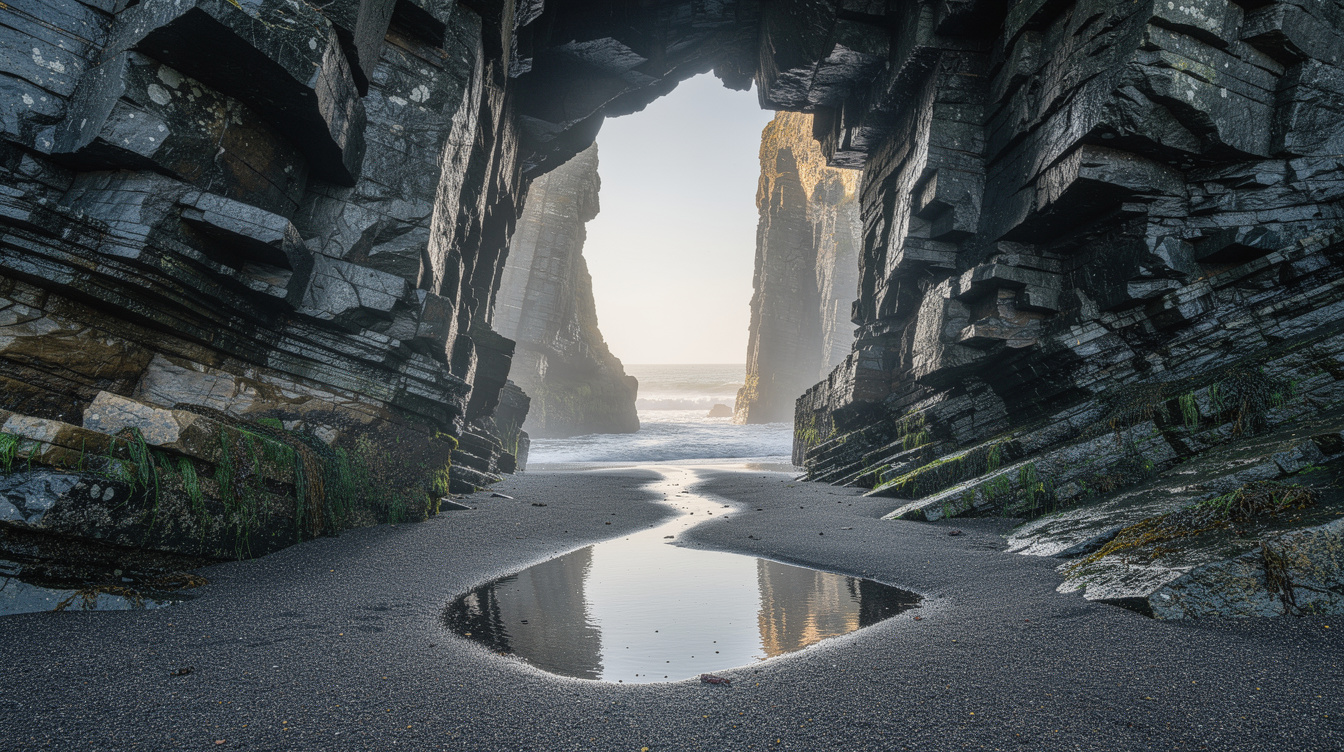
The arches at Playa de Las Catedrales are underwater for most of the day. The photographs never mention that. Every image you’ve seen, the soaring rock vaults, the dark sand corridors, the Gothic nave the Atlantic carved from schist over millennia, exists only during a tidal window of roughly two to four hours around low tide. Miss that window and you’re looking at open sea.
That is the single fact that separates a good visit from a wasted one. And it’s the fact the permit confirmation email won’t tell you.
The tide comes in and the beach stops existing
The cliffs here are carved from dark schist and slate, shaped by Atlantic wave action into arched corridors and cave chambers tall enough to stand inside. At low tide, roughly 500 meters of walkable sand opens beneath those arches. The rock smells of sea salt and cold mineral. Water drips from the arch ceilings even on clear days.
As the tide rises, the sea fills the corridors from the seaward side first. Within two hours of high tide, the arches are gone. The sand corridor narrows, then disappears. What the photos show is real, but it runs on the Atlantic’s schedule, not yours.
The geological material matters here. Schist fractures in layered sheets, and the Cantabrian waves exploit every seam. That’s how the buttress formations developed. Aerial photography erases this kind of ground-level reality at famous beaches everywhere, and Las Catedrales is no exception.
The reservation system and why the slot you book matters more than the date
From roughly June 15 through September 15, Galicia’s regional government requires a free timed entry permit for beach access. The permit is booked through the official Galician reservation portal. It assigns you an entry window. But the tidal window is assigned by the Atlantic, and those two schedules don’t automatically align.
A permit for 2pm on a day when low tide peaked at 8am means you arrive to find the arches already half-submerged. This is the mistake local guides say they see constantly, and the booking confirmation won’t flag it. Check Meteogalicia tide tables for your specific dates before you select a slot. Book the window within one hour of predicted low tide.
And bring layers. Atlantic Galicia in July sits around 64-68°F at the coast, and the cave interiors are noticeably colder than the open beach. The cold is the schist holding the sea’s temperature, not the air. Permit systems like this one exist at other protected European beaches for similar reasons, but the tidal timing element here is unusual.
What you actually find when you get the timing right
At ground level the scale surprises you. The main arch is tall enough that a two-story building fits inside. The sand beneath it is dark and coarse, nothing like the fine pale sand of a Mediterranean beach. This is Atlantic material: heavy, gray-brown, cold underfoot even in August. The sound inside the cave chambers amplifies everything. Even a calm Atlantic produces a low resonant pressure against the rock walls that you feel before you hear it.
But the honest trade-offs are real. The cliffs have a documented rockfall history, and the regional authority has closed sections of the clifftop path at various points because of it. Signage marks restricted zones. The main beach is not a swimming beach: currents around the arch bases are unpredictable, and the tidal reversal happens faster than it looks. The clifftop walk itself is flat, roughly 0.6 miles round-trip from the parking area to the main viewpoint, and fully accessible.
September is when Las Catedrales becomes a different beach entirely
After September 15, the permit system ends and access is unrestricted. Atlantic water temperature along this stretch of Cantabrian coast actually peaks in September, typically around 64-66°F, warmer than June because the ocean retains heat through summer. Autumn light hits the schist at a low angle that summer’s overhead sun doesn’t produce, and the rock shifts from dark gray to something closer to amber in late afternoon.
Tourist volume drops sharply after Spanish schools restart. Spain’s protected coastal sites tend to be almost yours once the summer system ends, and Las Catedrales follows that pattern. The trade-off is Galicia’s Atlantic weather: genuinely unpredictable by October, with rain arriving regularly.
Your questions about Playa de Las Catedrales answered
How do you get there from the nearest airport?
Santiago de Compostela Airport (SCQ) is the main Galician hub, roughly 100 miles southwest of Ribadeo. The drive via the A-8 motorway takes about 1.5 to 2 hours. The beach sits less than 1 mile from Ribadeo’s town center, with a marked access road to the official parking lot. Public transit options from Ribadeo are limited, so a rental car is the practical choice.
What’s the best month to visit?
Late May and early June give you the best combination: no permit required yet, lower crowds, and mild temperatures of around 60-65°F. Shoulder-season timing is the consistent advantage at European beaches where summer access is controlled. September works well too. July and August are busy regardless of your permit slot.
Does it cost anything?
The beach and the summer permit are both free. Parking at the official lot charges a seasonal fee, roughly $3-6 based on recent years, though this should be confirmed before you go. There are no entry fees outside the permit season. The permit itself must be reserved in advance through the official portal during the June to September window.
By the time you walk back out through the arch, the water is already moving differently. The pools you stepped over are connecting. The sand corridor is narrowing at the seaward end. You have maybe twenty minutes before the Atlantic closes the corridor again and the cathedral goes back under.