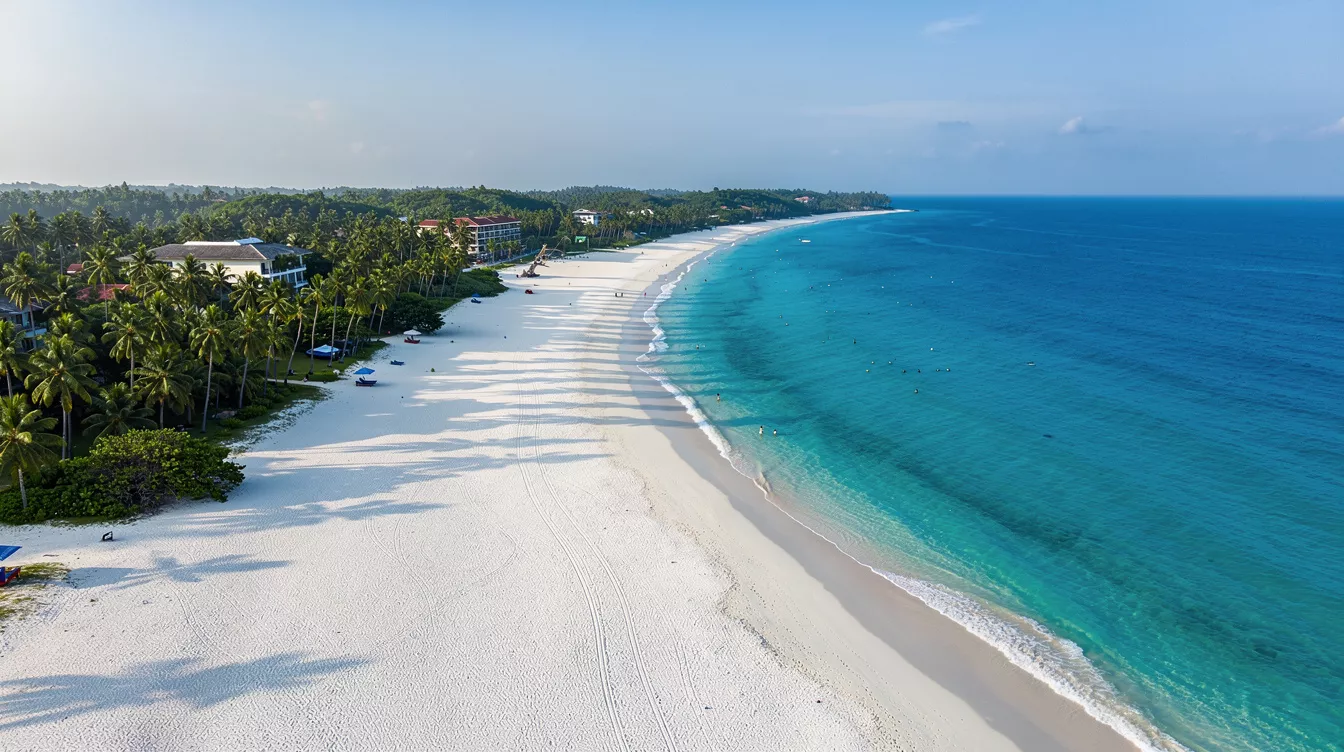
The bangka from Caticlan Jetty takes about 15 minutes across a narrow, choppy channel. You step onto White Beach near the center of the island, someone hands you a resort map, and every arrow points the same direction: toward D’Mall, toward the hotels that figured out international booking platforms first. Most Americans who visit Boracay spend their entire stay within 400 yards of that landing point. That default booking pattern costs visitors across the Philippines, and on a 2.5-mile beach divided into three distinct zones, it costs you more than you’d think.
The station system the booking sites don’t explain
White Beach runs along Boracay’s western coast and splits into three stations with meaningfully different characters. Station 1 anchors the quiet northern end, where wide sand and legacy resorts keep the morning crowd thin. Station 2 is the commercial center: D’Mall sits one block inland, fire dancers perform nightly on the sand, and the beach path at noon carries the density of a city sidewalk.
Station 3 begins south of D’Mall and runs to Cagban Jetty at the island’s southern tip. Locally-run restaurants serve grilled fish and rice for under $5. Comparable rooms run roughly 30 percent less than Station 2. And because tricycle drivers from the main boat station treat Station 3 as the far end of a fare, fewer tourists bother making the trip.
But the sand down there at low tide is wide and quiet, and that’s the whole point. In the Philippines, the zone you book decides the trip, not the destination name on your itinerary.
What the 2018 closure actually changed on the ground
On April 26, 2018, Boracay closed entirely by government order. The closure lasted six months, ending October 26, and removed more than 600 establishments operating in violation of environmental codes. Illegal structures that had been built directly onto the sand came down. Sewage systems feeding into the coastal zone were rerouted.
The beachfront pedestrian path that now runs the full 2.5 miles without obstruction exists because those structures were cleared. Locals who worked the beach before 2018 describe the water clarity at Station 3 in the years since as noticeably different, sharper, with less foam at the tideline in the mornings.
The commercial density at Station 2 returned quickly after reopening. Legal restaurants rebuilt behind the proper setback line, the fire dancers came back, and the crowd followed. The sewage didn’t return. For visitors, that distinction matters most at Station 1, where wider resort setbacks keep the beach path lighter even during the December peak.
Reading the sand from Station 1 to Station 3
Station 1’s sand is noticeably wider at low tide, sometimes 30 to 40 meters of dry ground between the tree line and the water. The offshore reef line sits closer to the surface here, which flattens the wave approach and keeps the water calmer through mid-morning. Beachfront rooms run $150 to $350 per night in high season. At 7am, this section is close to empty.
White Beach’s sand is pulverized coral and shell, fine-grained enough to stay cooler underfoot than darker beaches at the same latitude. The island’s geography shapes every physical condition on this beach, including that sand temperature. And that coolness at 10am is one of those small details that separates a good beach morning from a punishing one.
June on White Beach: the honest picture
White Beach faces west, which means the habagat (southwest monsoon, roughly June through October) pushes swell directly onto the sand. Sailing, paddleboarding, and most snorkeling operations are restricted or suspended. The beach path stays open. The restaurants stay open. Prices drop 20 to 40 percent compared to peak amihan months (November through April).
If you’re reading this in summer and wondering whether to go: the beach works, the water doesn’t. Seasonal windows define every beach in the Philippines, and Boracay’s western coast is no exception. That said, a half-empty Station 3 in July, with rain coming off the channel at dusk and the smell of charcoal from the grill stalls, has its own case to make.
Your questions about White Beach, Boracay answered
How do you get to White Beach from the US?
There’s no direct US flight to Boracay. Standard routing connects through Manila (MNL) or Cebu (CEB) to Caticlan (MPH), then a bangka crossing to Cagban Jetty (roughly 15 minutes). Kalibo (KLO) is the alternate airport, about 1.5 to 2 hours by shuttle to the jetty. Budget $3.50 to $5.50 in combined terminal and environmental fees at the port, beyond the boat fare itself.
When is the right time to visit?
November through April is the amihan season: dry, calm, and clear on the western coast. December through February is peak high season with the highest prices and largest crowds. Late April and May offer good weather with slightly lower rates. June through October brings rough seas and rain but cuts accommodation costs sharply.
How much does a Boracay trip cost?
Station 3 guesthouses run $25 to $60 per night in shoulder season. Mid-range Station 2 beachfront rooms hit $80 to $180 in high season. Station 1 resorts start around $150 and climb past $400 in peak weeks. A one-week trip from the US West Coast, connecting through Manila, typically lands between $1,800 and $3,500 depending on season and accommodation tier.
At low tide on a January morning, Station 1’s sand stretches far enough that the nearest lounge chair is 25 meters behind you. The water is 84 degrees and the color of old glass. A bangka cuts toward Caticlan across the channel, trailing a white line that closes behind it before you finish watching.