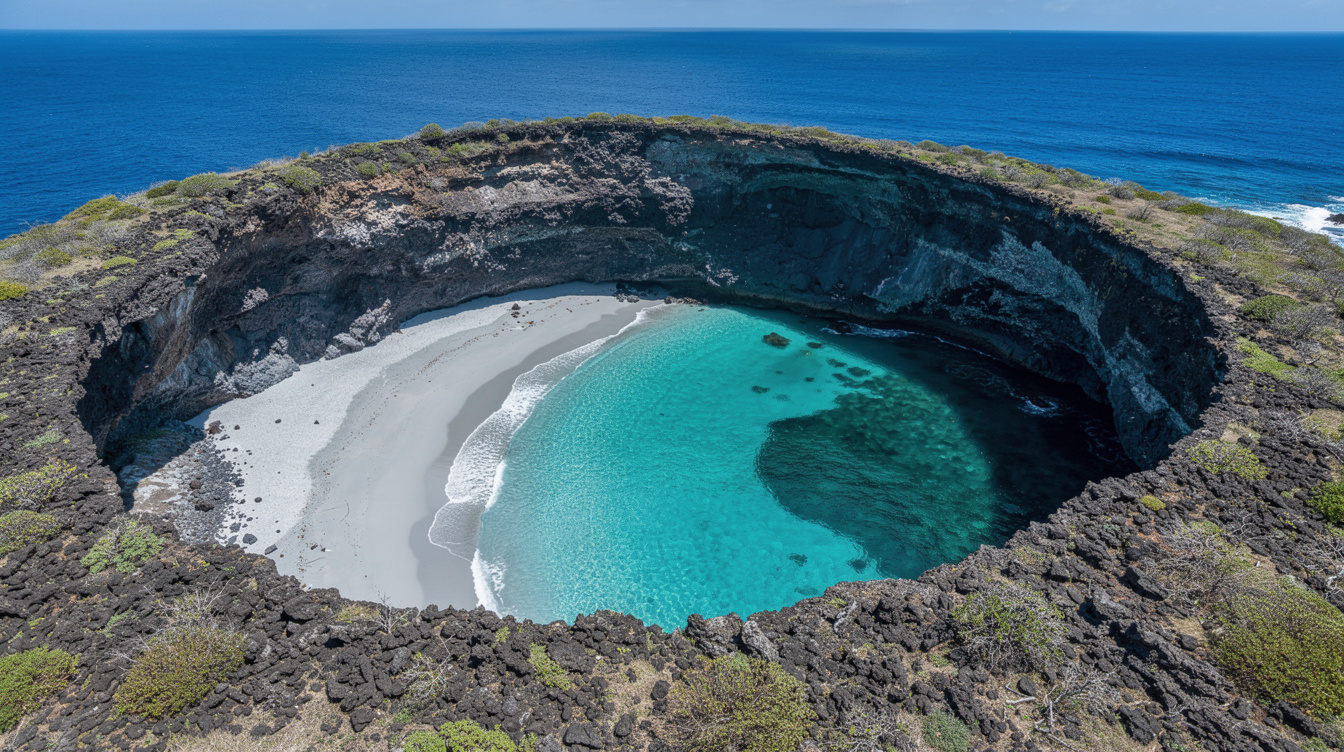
Every travel photo of Playa del Amor shows the same thing: pale sand inside a circular rock opening, turquoise water, blue sky above. What the photograph doesn’t show is the 100-foot tunnel you swim through to get there, the federal permit system that decides whether you’re allowed in, or the fact that the beach exists because the Mexican Navy blew a hole in a volcanic island and then walked away.
That sequence is the whole story. The tunnel isn’t the price of admission. It’s the reason the place is still intact.
A bombing range made this beach
The Marieta Islands sit roughly 22 miles off the coast of Punta de Mita in Nayarit, on Mexico’s Pacific coast. Through much of the early and mid-20th century, the Mexican military used them as a live artillery and bombing testing range. The repeated detonations destabilized the volcanic rock on Isla del Amor until a section of ceiling collapsed, opening the circular dome that now frames the beach.
When testing stopped, a boat captain who has run the crossing for decades will tell you the islands felt abandoned for years. Then conservation advocates, including international ocean researchers, pushed for protection. Mexico designated the Marietas a federally protected biosphere reserve, and the beach that military activity accidentally created became one of the most controlled access points in the country.
Because the dome is enclosed on three sides by basalt walls, the sun only reaches the sand directly for a few hours around midday. The walls stay cool and damp above the tide line, covered in small crabs that don’t move when you get close. Thailand used a similar conservation logic when it closed Maya Bay, and the visitor cap model that followed looks a lot like what Mexico built here first.
How the tunnel works, and when it doesn’t
The tunnel entrance sits at water level on the ocean-facing side of the island. At low tide, there’s enough clearance between the water surface and the rock ceiling to swim through face-up. The swim takes roughly 30 to 45 seconds of active effort in salt water with a mild current running through. But at high tide, the ceiling drops to the water line and the tunnel closes entirely.
And when the Pacific swell is up, the tunnel entrance surges unpredictably. Licensed guides read the swell interval before allowing anyone in. On days when the swell exceeds their threshold, operators cancel the tunnel entry and offer exterior snorkeling instead. Most operators don’t offer refunds for weather cancellations. That’s the trade-off that no booking photo explains. Brazil’s most isolated beach works on the same logic, where the entry mechanism is the experience itself, not the obstacle before it.
The permit system and what it costs
SEMARNAT, Mexico’s federal environmental agency, controls access to the biosphere reserve. Tours must run through licensed operators, and the daily visitor count for Playa del Amor is strictly capped. The permit fee is typically bundled into tour pricing rather than purchased separately by individual visitors.
Tours depart from Punta de Mita, roughly 45 minutes by panga, or from Sayulita, about 90 minutes out. Licensed day tours from Punta de Mita run approximately $80 to $120 USD per person. Tours from Sayulita run closer to $100 to $150 USD because of the longer crossing. Price includes the boat, guide, snorkel gear, and federal permit. It doesn’t include food, transport to the dock, or travel insurance. Marseille’s government-controlled calanque system runs on the same principle: licensed access, capped daily entry, no walk-ins.
But June offers a specific advantage. The December-to-March crowd is gone, and permit slots that were fully booked weeks out in February are available 3 to 7 days ahead. Water temperature sits around 77 to 80°F. The swell risk is higher than in January, which means occasional cancellations. That’s the trade-off, and local guides will tell you it plainly before you book.
Your questions about Playa del Amor answered
How do you get there from the US?
Puerto Vallarta International Airport (PVR) receives direct flights from Los Angeles, Dallas, Houston, and Chicago. From PVR, Punta de Mita is roughly 45 miles north by road, about 60 to 75 minutes depending on traffic through Bucerias. There’s no public ferry to the Marietas. You book through a licensed operator and they handle the rest.
What’s the best month to visit?
January through March brings the calmest swells, the driest skies on the Nayarit coast, and the lowest tunnel cancellation rate. And it’s also when permit slots disappear fastest. The sargassum that punishes Mexico’s Caribbean coast in summer isn’t a factor here. The Pacific side has different trade-offs. April and November are workable if January feels too crowded.
What does a full tour cost in 2025?
Budget $80 to $150 USD per person depending on your departure point. Punta de Mita tours sit at the lower end; Sayulita tours run higher because of the longer crossing time. The federal biosphere permit is included. Food, drinks, and the drive to the dock are not.
What you find when the tunnel opens
The interior is smaller than every photograph suggests. The dome opening spans roughly 200 feet at its widest point, and the sand is a pale gray-white, finer than it photographs. The sound changes the moment you clear the tunnel: the Pacific is still pressing against the outer rock, and you can feel the low compression of it through your feet on the wet sand.
There’s no vendor, no shade structure, no bathroom. You carry in whatever water you brought through the tunnel. When the guide signals, you swim back out into open water and the panga is waiting. The beach stays exactly as you found it.