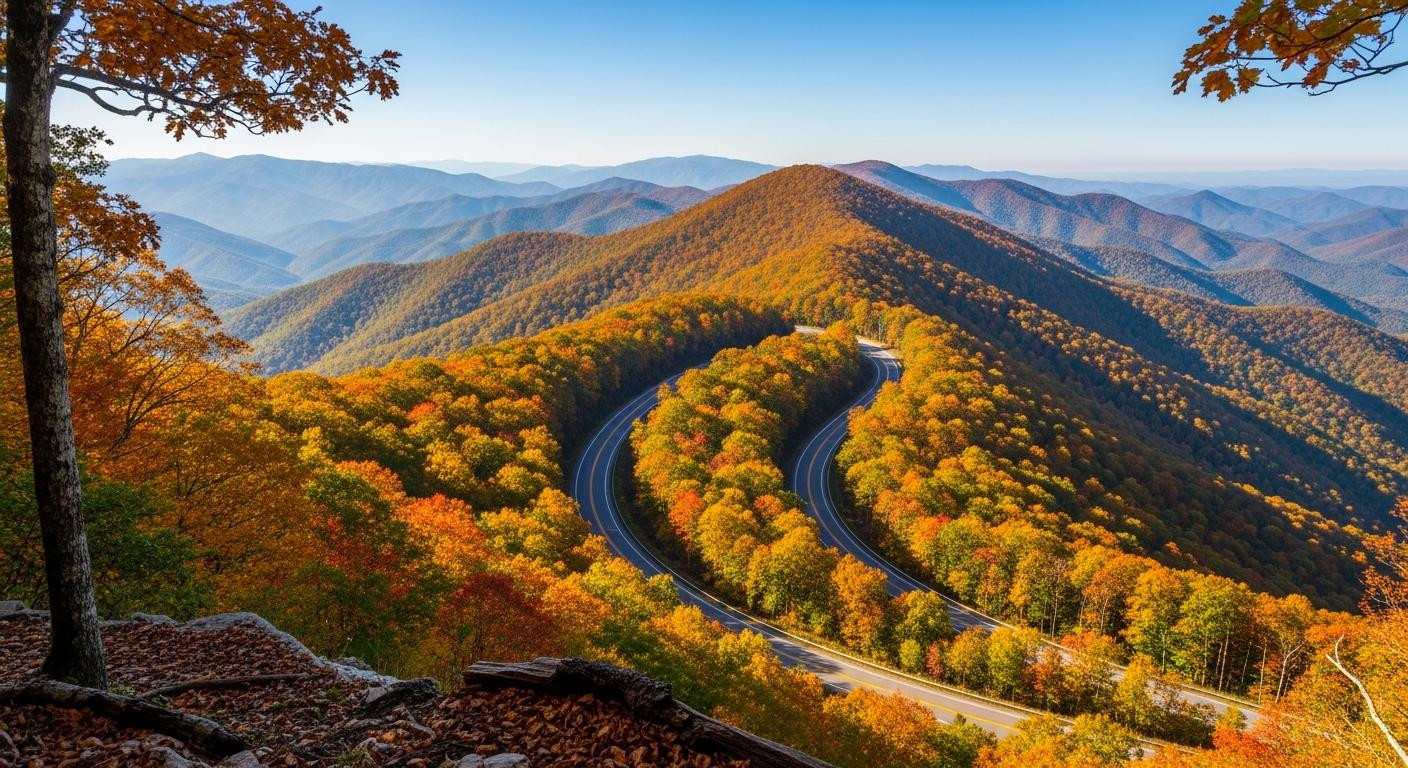
About 45 minutes into any family road trip, someone in the back seat asks if you’re almost there. The honest answer is that the best drives make that question disappear. Not because the destination is close, but because the road itself gives everyone enough to watch, argue about, and remember. Fall is the best time to test this theory, because the light drops lower, the crowds thin out, and you can actually open the windows. Here are 8 routes that hold up.
Blue Ridge Parkway, Virginia to North Carolina
The Blue Ridge Parkway runs 469 miles with no stoplights and no commercial trucks. Because the road traces ridge crests between 2,000 and 6,000 feet, you drive through four distinct color stages in a single October afternoon. Earlier foliage at lower elevations, deeper gold and red near the peaks.
Mabry Mill at milepost 176.1 is the most photographed stop on the route, and it still earns a pause. But the honest trade-off: the speed limit is 45 mph the entire length. Fill up in Floyd or Blowing Rock because gas stations disappear for long stretches. And if your kids don’t manage slow drives well, you’ll know before Roanoke. The quieter Smokies entrance at Cosby connects naturally at the southern end.
US Route 1, coastal Maine
Drive US Route 1 from Portland to the Schoodic Peninsula in September, not July. The lobster shacks stay open after Labor Day but the summer crowds leave, so you get shorter lines and parking that doesn’t require a strategy. Red’s Eats in Wiscasset serves a whole-lobster roll and closes by mid-October.
The stretch through Bath carries the smell of low tide and pine brine through the vents if you crack the windows. And the Schoodic Peninsula loop adds 40 miles and cuts roughly 80% of the Acadia crowds. It’s 160 miles total. Kids old enough to walk a mile on uneven granite will get the most from it.
Highway 89 and AZ-67, Kanab to the Grand Canyon North Rim
The North Rim closes November 15. Families who drive this corridor in October catch aspen groves near Jacob Lake at full gold above 8,000 feet, then drop 4,000 feet into the desert on AZ-67 in under an hour. Because the North Rim sits 1,000 feet higher than the South Rim, it’s cooler in summer and empties faster in fall.
AZ-67 from Jacob Lake to the rim is 44 miles with no services and no cell signal for the last 30 miles. The lodge serves dinner in one seating at 6pm. Book it at least three months out. But the moment the canyon appears through the fir trees at the rim, the drive earns everything it asked of you.
Vermont Route 100, Brattleboro to Stowe
Vermont Route 100 runs 100 miles through the spine of the Green Mountains. Peak foliage hits between the second and third weeks of October depending on elevation. Because the road stays in valley bottoms most of the way, the color frames you from both sides rather than appearing below.
The Mad River Valley around Waitsfield is where a local guide once described the drive as the stretch “where the whole state makes sense at once.” And it does, in late afternoon light when the maples go copper. One caution: Route 100 through ski towns gets congested on fall foliage weekends. Overnight options in smaller anchor towns stretch your budget and clear the traffic problem at once.
Natchez Trace Parkway, Nashville to Natchez
The Natchez Trace Parkway covers 444 miles with no commercial vehicles and no billboards, which means the windows stay worth looking out of. October foliage along the Tennessee and Alabama segments runs mild compared to New England, but the sweetgum and tulip poplar turn a deep red-gold that holds for three weeks.
But the Trace is genuinely quiet, not just “less busy.” A family that ran a small roadside farm near milepost 390 told a travel writer it gets about a third of the traffic of the Blue Ridge. Services are sparse. Fill up in Tupelo or Port Gibson.
Hocking Hills loop, Columbus to Logan
This 60-mile loop through Hocking Hills State Park works as a weekend drive or a long day. Because the sandstone gorges hold moisture, the ferns stay green into November while the canopy above goes orange. Ash Cave, the largest recess cave in Ohio, sits at the end of a flat half-mile trail that works for younger kids.
And the route from Columbus on US-33 takes under two hours to reach the park entrance. It’s free to enter. One local guide who leads weekend hikes in the gorge said October weekdays are the moment when “you can hear the waterfall before you see it.” That’s the visit.
Texas Hill Country loop, San Antonio to Fredericksburg
The Hill Country loop, roughly 250 miles from San Antonio through Fredericksburg, Kerrville, and Bandera, doesn’t rely on fall foliage. Because the elevation stays below 2,400 feet and the climate runs mild, this route works from September through December. The cypress trees along the Guadalupe River go rust-gold in late October.
Fredericksburg has a Saturday farmers market that runs year-round and smells like warm peaches and cedar smoke on fall mornings. The drive on US-290 west of Austin has little shade and a lot of sun, so start early. Pairing a western route with water-based stops keeps younger kids engaged across longer drives.
Your questions about family fall road trips
How far ahead should I book lodging on these routes?
Peak foliage weekends on the Blue Ridge and in Vermont book out 6 to 8 weeks in advance, especially Friday and Saturday nights. Midweek travel cuts both rates and competition. The North Rim requires advance booking regardless of day.
Which routes work best for kids under 8?
The Hocking Hills loop and the Hill Country circuit are the most forgiving. Both have shorter driving segments, regular services, and stops that don’t require long hikes. The full Blue Ridge Parkway is harder with very young children because of the pace and service gaps.
What does a fall family road trip cost per day?
Gas, one restaurant meal, one packed lunch, and mid-range lodging runs $250 to $380 per day for a family of four. The Northeast runs higher. Texas and Ohio run lower. The Natchez Trace and Hocking Hills have no entrance fees.
Somewhere near milepost 200 on the Blue Ridge, the light goes sideways and the valley below fills with haze the color of a spent fire. The kids stop asking questions. One of them has a face pressed against the glass.