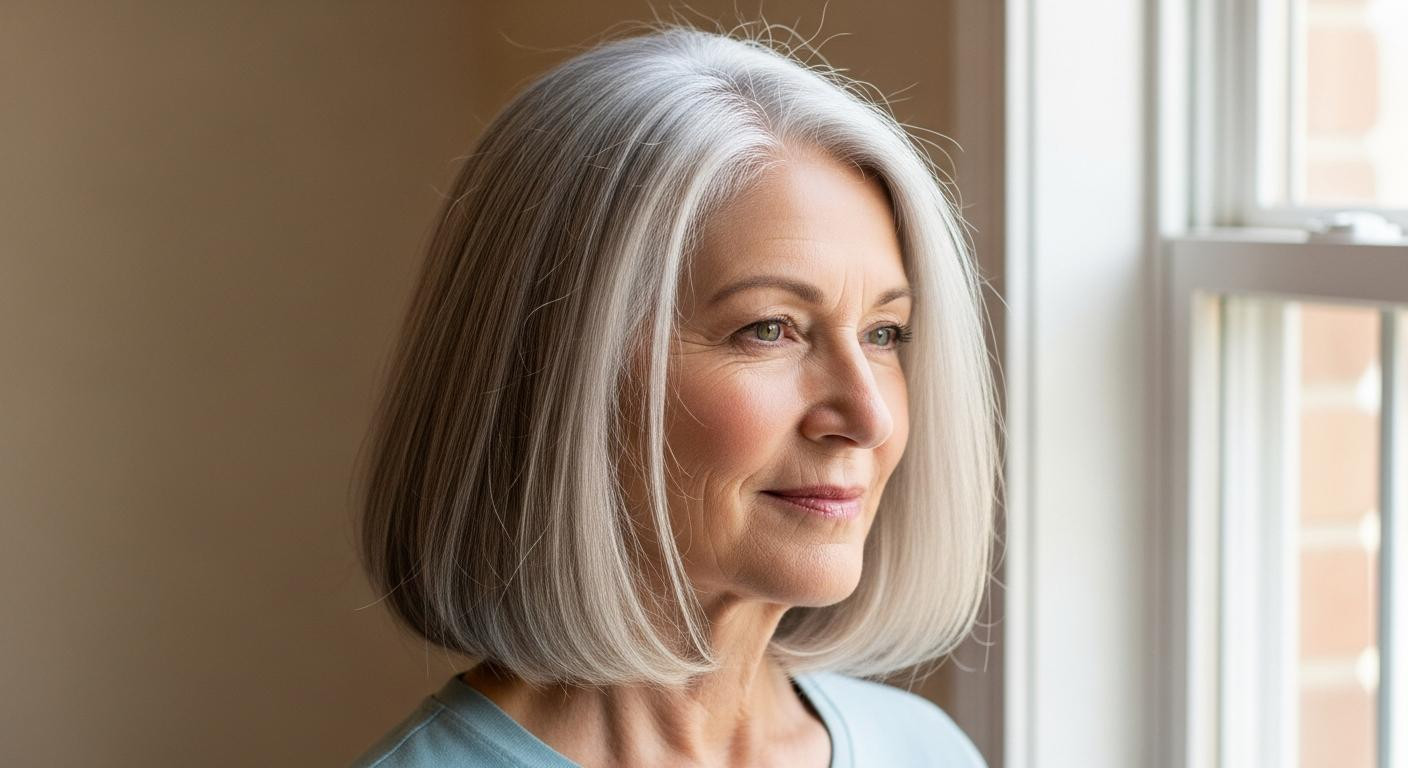
Most women walk into the salon at 57 or 62 and say the same thing: “I need more volume.” The stylist nods. What she does not always say is that volume means two entirely different things depending on what your hair is actually doing. Cut for the wrong kind, and you leave flatter than when you walked in.
Why volume and length pull against each other after 50
After menopause, each hair strand loses structural integrity as follicles narrow, so a length that felt fine at 40 now creates dead weight at the crown. Four inches of fine hair pulling straight down compresses the root faster than any root spray can lift against it. And that compression is why so many women over 50 feel like their hair “just sits there” no matter what they do.
But here is the other half of the problem. Hair that has lost overall density needs some length to create the illusion of fullness, because very short fine hair shows scalp. And visible scalp reads as less volume, not more. The length question genuinely cannot be answered until you answer the density question first.
The two hair types that need opposite solutions
Type 1: Fine strands, reasonable density
This is the woman who has enough hairs per square centimeter, but each strand is thin. Her crown flattens because length past the collarbone creates a weight load that lifts cannot fight. Hairstylists who specialize in mature hair consistently recommend removing two to three inches and asking for disconnected layers starting at the jaw, not graduated layers, which blend weight back in.
The shorter layer sits above the weight load, so when the hair dries, it springs back from the scalp by a half inch to a full inch. That mechanical lift is what you see in the layered cut that lifts flat hair at 58 by a full inch. Comfortable change, but not a drastic one. Most women are surprised how small the actual trim is.
Type 2: Density loss, fewer hairs overall
This woman has lost hairs, not just strand thickness. Her scalp shows at the part and temples. Going shorter makes this worse because below a certain length, roughly chin level, there is not enough hair to fold over and create a visible surface. The surface is doing all the optical work here.
Keeping length between the collarbone and the shoulder, with a blunt perimeter rather than layers, gives each strand a neighbor to lean against. The combined mass creates a density that shorter hair on this head simply cannot replicate. Blunt, not feathered. That one detail changes everything.
The length zones that create problems versus the ones that solve them
The ear-to-chin range is the most common trouble zone for women over 50. It is too short to fold, too long to spring, and it sits against the jaw in a way that adds visual width at the cheek instead of height at the crown. Women who leave the salon feeling “puffier” than expected have usually landed here.
Mid-back length on fine hair is the other problem zone. It sits past the point where any layer technique can counteract the gravitational pull on the root. And it requires 25 minutes of hot-tool work daily to look intentional, which is a real trade-off at any age. The same visual-weight logic that applies to outfit proportion, as explored in this piece on how print cancels silhouette, applies directly to how hair length interacts with face shape and neckline.
The two reliable zones: collarbone length, one to two inches below the jaw, works for most women over 50. And just below the occipital bone, roughly two inches below the ear, works well for fine strands because it eliminates root compression while covering the nape without requiring daily precision styling.
How color affects how volume reads
Single-process color applied close to your natural tone flattens visual texture because the light hits every strand at the same angle and bounces back uniformly. Colorists who work primarily with women over 60 describe this effect consistently: the hair looks “painted on” rather than dimensional. And dimensional hair, even with subtle two-tone variation within two shades, creates light and shadow that reads as thickness.
This connects to the same warm-versus-cool logic discussed in how cool tones flatten a room and warm ones add depth. Warm-toned highlights in silver or gray hair make the face read fuller without adding a single strand. The principle is identical: tone creates perceived dimension. A few soft pieces around the face, not a full balayage, is enough to shift the read entirely.
Your questions about volume and length after 50, answered
Does going shorter always add volume?
No. For women with density loss, going shorter reduces the surface area of hair, so thinning becomes more visible, not less. Shorter adds volume only when the problem is strand weight compressing the root, not follicle count reducing overall mass. These are different problems and they need different cuts.
Should I use layers if my hair is already thin?
It depends entirely on placement. Layers starting below the jaw and graduating downward remove weight from the ends without touching the surface layer, so visible density stays intact. Layers starting at the crown remove the very surface hair that is doing the coverage work. Image consultants who focus on women over 50 make this distinction the first thing they explain to new clients.
What is the one question to ask before any cut?
Pull a single strand from your crown and hold it up to natural light. If it tapers visibly from root to tip, you have a fine-strand, weight-suppression situation. And if the strand looks uniform but you simply have fewer of them than you did at 40, you have a density problem. Bring a photo of your part in natural light to your next appointment. That photograph tells your stylist in 10 seconds what a consultation rarely surfaces in 20 minutes.
She is standing sideways in a well-lit mirror, her hair landing one inch below the collarbone, blunt at the perimeter, with a half-inch of visible lift at the crown. Her part shows no scalp. The length is doing exactly what length is supposed to do.