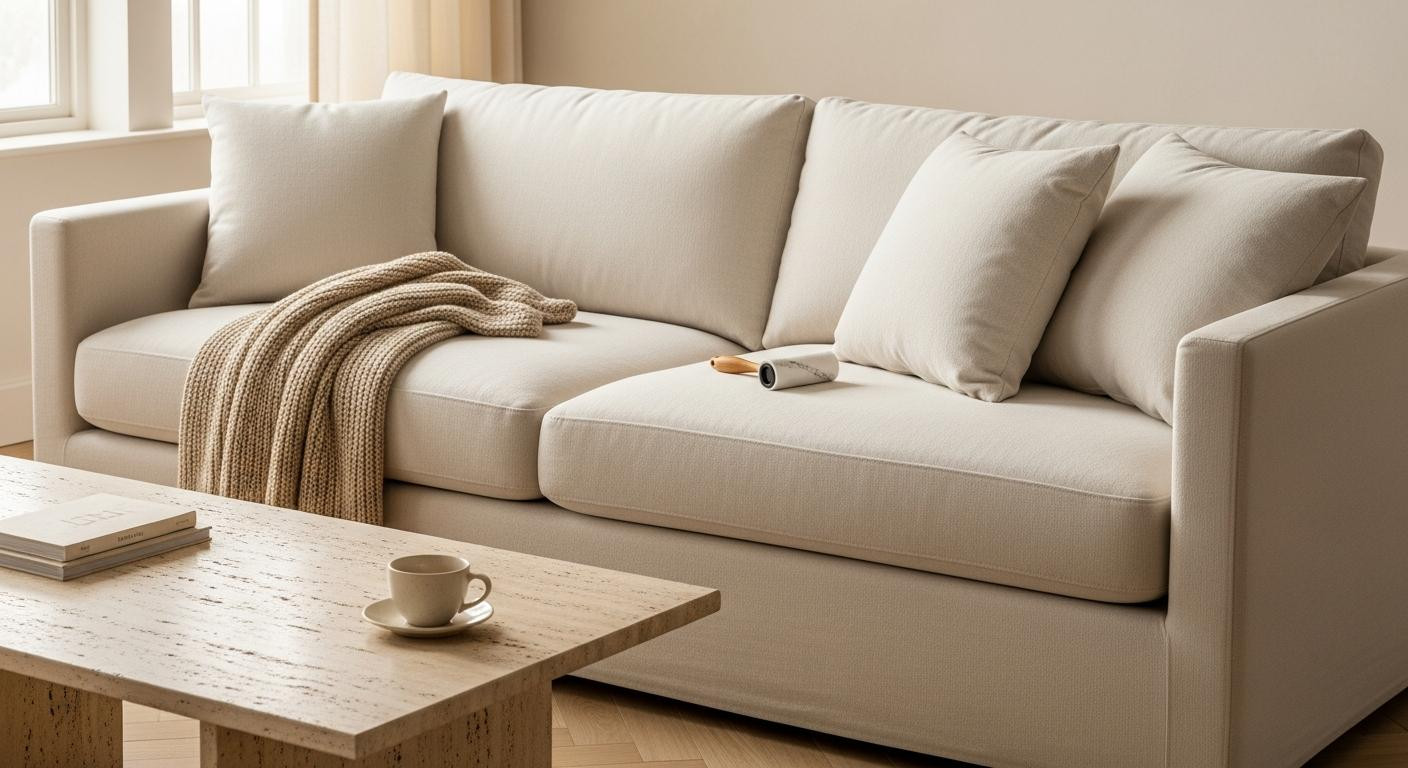
Your living room on a Tuesday in May when the travertine table finally arrives: the $340 stone catches afternoon light in a way your old IKEA piece never did. The $980 linen sofa photographs like a Domino editorial. Your sister asks if you hired a designer. But when your nephew visits with a juice box, you realize the room no longer allows children with beverages. The sofa can’t handle pet hair without a lint roller. The coffee table shows every water ring within six hours. Quiet luxury costs money. It also costs spontaneity, mess tolerance, and the ability to eat takeout on the couch without anxiety.
Here’s the full accounting of what the style actually demands, and what you gain in exchange.
The dollar breakdown works in three tiers
A mid-tier quiet luxury living room runs $2,400 to $3,500 for renters or homeowners starting fresh. That breaks down to 60% on a linen or performance-fabric sofa, 25% on one stone or oak anchor piece, and 15% on textiles and lighting. An Article Sven sofa at $1,899 plus a Wayfair travertine side table at $340 covers your hero pieces. Add $287 in warm-toned lamps with 2700K bulbs, plus $340 worth of oat and sand throw pillows.
The budget play sits at $800 to $1,200. That’s an IKEA Dyvlinge chair at $249, Target Casaluna linen bedding around $120, and $45 worth of LED bulbs that shift the room from builder-grade to intentional. You won’t finish the space, but you’ll shift the feeling from chaotic to grounded.
Designer standard starts at $6,000 and climbs past $10,000 fast. Restoration Hardware linen sectionals begin around $4,500. Custom plaster walls add another $2,000 to $4,000 depending on square footage. Concentrating dollars on fewer, better pieces is the core quiet luxury strategy, which means your room looks expensive because the bones match designer standards, not because you bought more stuff.
What the style won’t let you do anymore
No eating on the furniture
Linen stains. Stone shows rings. The $1,899 sofa doesn’t come with washable slipcovers at that price point, those start at $1,800 and up from Pottery Barn. Quiet luxury assumes you eat at tables, drink from coasters, and never bring coffee into the living room without a tray. If you currently eat dinner on the couch three nights a week, this style costs you that habit. Professional upholstery cleaning for a linen sectional runs $190 to $260 per service in major metros, according to residential cleaning specialists.
No visible storage clutter
Floating shelves hold three objects maximum. Coffee tables stay nearly empty. The aesthetic requires hiding mail, remotes, charging cables, and kids’ toys in closed storage, which adds $400 to $900 for minimalist credenzas from West Elm or CB2. Your room looks curated because you’ve edited out 70% of what you use daily. That editing takes 15 minutes of cleanup every evening, or permanent discipline about what enters the room.
What you actually gain in exchange
A nervous system that unclenches
ASID-certified interior designers note that warm neutrals lower cortisol and soft textures signal safety to the body. The room genuinely feels less stressful after work because your eyes aren’t processing six competing patterns and fourteen accent colors. This isn’t aesthetic preference, it’s measurable nervous system relief. Getting lighting right with 1,500 to 2,500 lumens at warm color temperatures amplifies that effect.
Rooms that photograph as status without logos
A $2,680 living room looks like $6,000 because the bones work. Sofa scale, material quality, and lighting color match what designers specify for high-end projects. You’re buying the visual language of wealth without needing actual wealth. That perception shift changes how guests and you interpret the space. For remote workers on Zoom, the backdrop reads professional and polished without trying too hard.
The maintenance tax nobody mentions
Linen wrinkles. Stone etches from acidic drinks. Boucle collects pet hair like Velcro. Budget 90 minutes monthly for steaming linen cushion covers with a $45 handheld steamer from Amazon, sealing stone surfaces every six months with $18 stone sealer, and lint-rolling upholstery weekly if you own pets. Design experts featured in staging publications confirm that clients consistently underestimate ongoing labor.
IKEA’s $249 Dyvlinge chair costs the same to maintain as a $1,200 West Elm version because both use similar textiles. The style’s simplicity hides that work. If you don’t naturally enjoy puttering with household maintenance, quiet luxury will feel like a second job. And stone-look alternatives from Wayfair show water rings just as fast as real travertine, they just cost $180 instead of $580.
Your questions about quiet luxury at home answered
Can I do quiet luxury with kids under 5?
Yes, but swap linen for performance fabrics. West Elm’s performance velvet sofas start at $1,899 and handle spills better than untreated linen. Choose sealed stone or wood over porous travertine. Accept that the room will photograph less pure because you’ll need washable slipcovers and closed toy storage. Budget an extra $500 for kid-proof versions of hero pieces.
Does this style work in rentals?
Completely, because it’s furniture-driven. You can’t add plaster walls or change lighting fixtures permanently, but a $980 linen sofa and $340 in warm LED bulbs transform a rental living room without permanent changes. Warm neutrals compensate for bad builder-grade light in north-facing apartments. Stick to the mid-tier budget and ignore finishes you can’t control.
What’s the minimum budget to start?
Eight hundred dollars gets you one room’s soft goods. Target linen bedding at $120, warm bulbs at $45, three neutral throw pillows at $87, and a stone-look side table from Wayfair at $180. It won’t finish the room, but it shifts the feeling from chaos to calm. The difference is immediate enough that most people add the sofa within three months.
Your hands at 9:14pm on a Wednesday, straightening the linen cushions for the third time that day because the room only feels expensive when every fold sits intentionally. The maintenance never ends. But when you walk in tomorrow morning and the light hits that travertine just right, your shoulders drop two inches without you noticing.