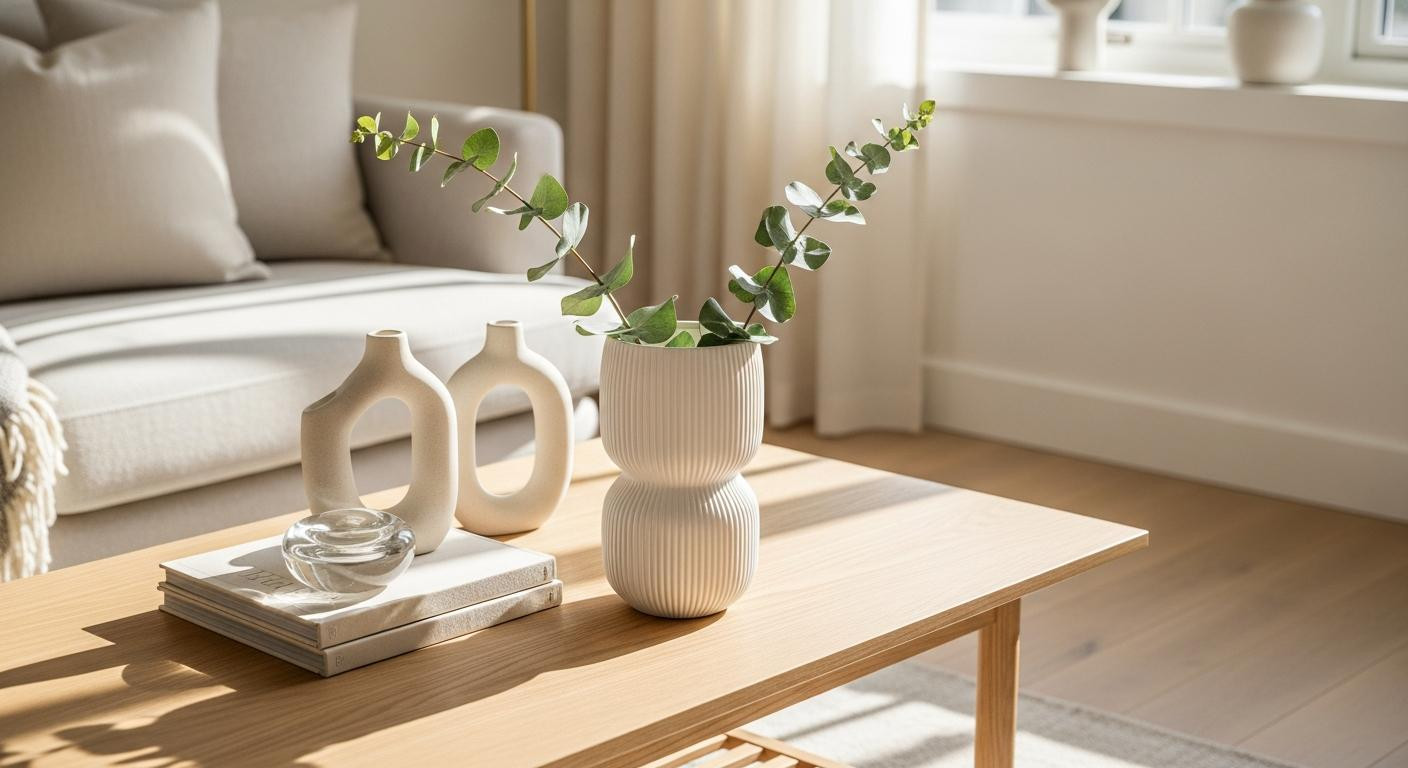
Your living room at 2:47pm on a Saturday when your sister-in-law picks up the ribbed glass vase from your coffee table and asks where you found “this gorgeous piece.” You paid $25 at IKEA three weeks ago. She’s holding it like it cost $180 from CB2. The weight feels right in her palm, the matte white glaze catches window light without glaring, and the sculptural profile reads expensive because nothing about it signals budget. This happens with seven specific IKEA pieces under $50 that fool guests, designers, and your own perception every time you walk past them.
The $2.49 glassware that reads like $38 artisan pieces
The POKAL colored glasses sit on your open shelving at eye level, and every single guest asks if they’re vintage European finds. They cost $2.49 each. The secret sits in the tinted glass thickness and the way colored glass always photographs richer than clear. A set of four runs $9.96 total, but arranged with two amber, two smoke gray, the collection reads curated rather than bulk-bought.
The weight matters here. Each glass measures 11 ounces and the walls are thick enough that when you set one down, it lands with the thud of handblown glass. West Elm’s colored tumblers run $38 for a set of four. The visual difference in a styled kitchen? Nearly invisible. The POKAL glasses hold the same light, the same water, the same perceived value.
Why the $29 oak mirror reads like $180 custom framing
The shelf detail stops it from looking mass-produced
The DVÄRGSYREN mirror costs $29 and includes a narrow oak shelf attached below the glass. That shelf changes everything. Mirrors without architectural detail read like bathroom basics. Mirrors with integrated shelving read intentional, like someone designed this specifically for an entryway or bedroom corner.
The oak veneer measures thin, probably 2mm, but the grain runs consistently and the finish stays matte. Glossy wood screams particle board. Matte wood suggests solid construction even when it’s veneer over MDF. You can set a small vase on that shelf, a candle, or just leave it empty. The point is the shadow it casts, the dimension it adds, the way it makes a $29 mirror feel built-in.
The 15×23 inch size fits where statement mirrors fail
Most statement mirrors measure 30+ inches and require wall anchors in rentals. The DVÄRGSYREN measures 15.75×23.63 inches, small enough for Command strips but large enough to anchor a narrow wall. That size sweet spot makes it feel custom-scaled rather than compromise-sized. And the 3.25-inch depth gives it enough profile to cast real shadow without jutting awkwardly from the wall.
The $49 lamp that makes corner lighting feel expensive
The RÖDFLIK floor lamp costs less than three months of takeout coffee
The RÖDFLIK floor lamp runs $49 and solves the corner darkness problem every renter faces. The clean steel arc keeps it from reading like a college dorm essential. The shade sits high enough (57 inches) that light pools exactly where reading happens, and the weighted base prevents the tip-over anxiety cheaper arc lamps trigger.
Floor lamps under $80 usually fail at the joint where the arc meets the base. That joint either wobbles or looks plasticky. The RÖDFLIK’s connection point uses a thick metal collar that reads solid when you adjust the angle. According to interior designers featured in House Beautiful, structural pieces like sofas deserve 80% of your budget, but accent lighting like the RÖDFLIK can sit in the remaining 20% without looking cheap. West Elm’s arc lamps start at $199. The difference sits mostly in brand perception and maybe 15% sturdier engineering.
Sculptural lighting adds $300 of perceived room value per piece
Lighting changes room perception faster than furniture because it alters how you see everything else. A single sculptural floor lamp makes a sofa look more expensive, makes wall color read richer, makes the whole corner feel designed. The RÖDFLIK’s minimal silhouette works in cozy modern, Japandi, and warm minimal spaces without fighting other styles. Design experts with residential portfolios note that IKEA pieces work best as “supporting characters” in higher-end rooms, meaning one $49 lamp surrounded by better textiles and furniture reads elevated rather than budget.
The textural vase that photographs like studio pottery
The KONSTFULL vase costs $25 and the unglazed ceramic exterior feels exactly like the $180 versions CB2 sells as “artisan collaborations.” Texture beats finish when it comes to expensive-looking ceramics. A glossy vase reflects light and shows every fingerprint. A matte textured vase absorbs light and hides handling marks.
The KONSTFULL measures 8.25 inches tall, wide enough for grocery store flowers without looking like a bud vase. The irregular surface texture comes from the molding process, not hand-carving, but guests can’t tell the difference from three feet away. It styles exactly like West Elm’s Pure Foundations collection at one-seventh the cost. And the sculptural silhouette works with nothing in it, which makes it functional decor rather than just a flower holder.
The linen throw that reads like $180 European bedding
The DYTÅG throw runs $49 and delivers the same rumpled luxury you’d get from Pottery Barn’s Belgian Flax line at $139. The secret sits in the linen-blend composition and the fact that it softens with every wash cycle, not stiffens. Cheap throws feel scratchy forever. Quality linen blends relax into something you actually want to touch.
The throw measures 51×67 inches, large enough to drape over a sofa arm or layer at the foot of a bed. The weight feels substantial without being heavy, and the loose weave catches light in a way that photographs beautifully. But the real trick is the color palette. The DYTÅG comes in warm oatmeal and soft gray, both of which read expensive because they’re not trying too hard. No bright whites, no saturated colors, just the kind of muted neutrals that cost $200 elsewhere.
Your questions about IKEA under $50 finds that look three times the price answered
Do these pieces actually last or do they look cheap after six months?
The glassware and ceramic pieces hold up indefinitely because glass and glazed ceramic don’t degrade from normal use. The RÖDFLIK lamp’s metal construction means no plastic yellowing. The DVÄRGSYREN mirror’s oak veneer can chip at edges if you’re rough during moving, but mounted on a wall it stays pristine. The DYTÅG linen throw softens with washing, which actually improves the expensive look. Professional organizers with certification confirm that avoiding IKEA’s plastic-heavy storage and sticking to natural materials, metal, and glass delivers longevity at budget prices.
Which IKEA pieces still look obviously cheap no matter how you style them?
Anything with visible particle board edges, glossy synthetic finishes, or lightweight hollow construction. The LACK side table reads cheap because the hollow core makes it sound empty when you set something down. The FEJKA fake plants look plasticky in natural light. Stick to solid materials, matte finishes, and pieces with enough weight to feel substantial. According to the 80-20 budget rule, spend big on structural pieces and use IKEA for the accents that sit on top of better foundations.
Can I mix IKEA budget pieces with actual designer furniture without it looking obvious?
Yes, if you follow the 80-20 budget rule. Spend 80% of your budget on the sofa, rug, or dining table, then use IKEA for the 20% accent pieces: vases, mirrors, throws, lamps, baskets. The KONSTFULL vase sits on a $1,800 credenza without looking out of place because vases don’t carry structural weight. The POKAL glasses work on a $400 dining table because glassware is an accent, not a foundation. Lighting designers with residential portfolios emphasize that matte ceramic finishes and textured glass create perception gaps where price becomes invisible and only the styling matters.
The ribbed glass catches afternoon light at 4:17pm on a Tuesday, casting soft shadows across the oak shelf below. Your coffee table holds $87 worth of IKEA styling that reads like $400 of collected ceramics. The room feels expensive because the textures are right, the finishes stay matte, and nothing announces its price.