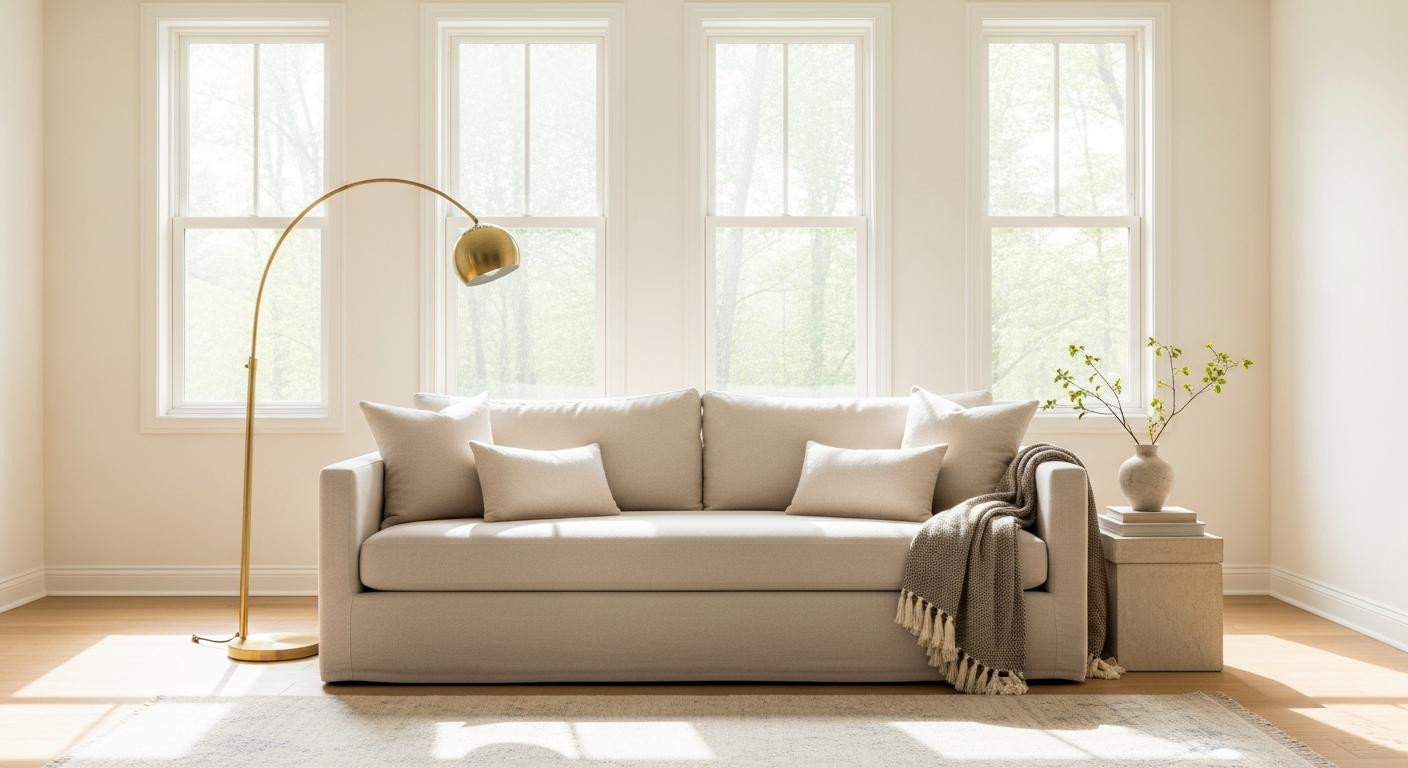
Your living room holds $1,847 worth of furniture and decor you bought over eight months, but it still reads like a waiting room. The West Elm sofa cost $1,299. The three throw pillows ran $147. The rug was another $289 from Article. But when your sister visits and says “it’s nice” in that polite voice that means something’s off, you realize the problem isn’t the budget. It’s where you spent it. The 80-20 rule says spend 80% on the room’s visual base and 20% on pieces that add personality. Get the proportions wrong and a $2,000 room feels unfinished. Get them right and a $600 room looks collected.
The base is whatever your eye registers first from the doorway: sofa scale in living rooms, bed size in bedrooms, cabinet fronts in kitchens. In a 12×14 foot living room, that means a properly scaled sofa ($800-$1,400) creates visual weight that budget accent chairs cannot replicate. The formula fails when reversed. Three $400 chairs around a $200 futon makes the room feel temporary.
This applies across categories. In bedrooms, invest in the bed frame and mattress, not the nightstands. In kitchens, prioritize cabinet paint or replacement fronts over decorative canisters. The base establishes credibility. Everything else decorates it.
Where the 20% accent budget actually shows up in photos
Your base sofa anchors the room, but the $89 arched floor lamp from Target and one $68 textured throw create the personality that gets saved to Pinterest. The 20% lives in pieces that add shape, texture, or finish contrast, not more furniture. Rooms fail when this 20% becomes six small purchases instead of two intentional ones.
In a 200-square-foot living room, that means one statement lamp plus one layered textile. Not four mediocre accessories. The difference is tactile. Linen drapes over the arm of the sofa. Brass catches afternoon light from the west-facing window. Those textures register as expensive in a way that matching candle holders never will.
Design experts featured in Architectural Digest recommend concentrating accent spending on items that change the room’s silhouette or add finish contrast. That’s lighting, one large-scale art piece, or a single sculptural object. Not a collection of small decorative bowls.
Bedrooms: art and one nightstand moment
The bed is 80%. The remaining 20% creates the styled feeling through one large art piece above the headboard ($120-$200) and one sculptural nightstand element. A ceramic lamp, a brass alarm clock, a single stem vase. Not all three. The error is buying matching everything in the accent budget, which reads formulaic rather than collected.
And here’s where renters gain an advantage. Choosing the right wall color becomes your 80% base investment when you can’t replace furniture. One gallon of warm beige paint costs $45 and transforms a 10×12 foot bedroom more than $200 in throw pillows ever could.
The budget math that prevents random room syndrome
A $600 total budget for a living room doesn’t mean $480 on base and $120 on accents when base needs outweigh available funds. It means identifying the single largest visual mass and allocating 60-70% there first. Then filling remaining base needs before touching accents. In practice: $400 sofa, $120 rug, $50 curtains, $30 on one lamp.
The room feels complete because proportions match human sight lines, not because every category got funded. That’s the discipline that separates expensive-looking rooms from expensive rooms. Professional organizers with certification confirm that visual weight matters more than dollar equality across categories.
But rentals with existing furniture flip the formula. Your 80% base is provided. The entire budget becomes strategic 20%: slipcovers that change sofa texture ($89-$150), one large-scale art piece, one quality rug to define zones. The mistake is spending the full budget on small decorative objects because the big stuff is covered.
Track by visual weight, not dollar equality
Those small objects fight the existing base instead of elevating it. They create the “why does this room feel cluttered when I only added a few things” problem. The answer is you added six things at eye level when the room needed one floor-level anchor. Scale and placement create impact. Quantity creates noise.
What cheap rooms buy first and expensive rooms skip
Expensive-looking rooms skip matchy-matchy sets, decorator pillows in sets of six, and pre-styled shelf vignettes. They buy the one sofa that fits the room’s proportions, paint walls in one cohesive neutral, then add exactly two accent pieces with intention. A vintage brass lamp from an estate sale and a single oversized art print.
The 80-20 rule exposes why buying a little of everything creates visual clutter. Investing in three neutral pillow inserts at $25 each, then rotating affordable covers through the seasons, delivers more visual variety than twelve permanent pillows crowding the sofa. Your room doesn’t need more stuff. It needs the right base and the discipline to stop at two great accent pieces.
Lighting designers with residential portfolios note that one $150 statement floor lamp transforms a room faster than five $30 table lamps scattered across surfaces. The single piece creates a focal point. The five create decision fatigue every time you walk in.
Your questions about the 80-20 budget rule for decorating every room answered
Does the 80-20 split work in kitchens where I can’t replace cabinets?
Yes, but your 80% becomes paint or peel-and-stick cabinet film ($120-$180 for a 10×10 foot kitchen), not the cabinets themselves. The 20% goes to hardware upgrades or one sculptural lighting fixture. The rule adapts to what you can control. In rentals, treat existing cabinets as your inherited base and spend 80% on the largest changeable surface.
That’s walls, window treatments, or rugs. Swapping cabinet hardware for $40 becomes your 20% detail that makes the whole 80% base feel intentional.
What if I already bought six small accent pieces, do I start over?
No. Consolidate them. Remove four, keep the two with the most texture or shape interest. Use the others in different rooms or storage. The rule isn’t about throwing money away. It’s about editing what’s visible so the room’s base gets proper visual weight. Return what you can within store windows. Archive the rest.
Can I spend 80% at IKEA and 20% at vintage shops?
Absolutely. The rule is about proportion and visual hierarchy, not retail prestige. An $800 IKEA sectional in the right scale with a $120 vintage brass lamp reads more expensive than a $600 Article sofa surrounded by $300 in Target accessories. Source doesn’t matter. Scale, proportion, and restraint do.
Your bedroom on Thursday evening when the $1,099 bed frame sits against the wall and the $87 vintage oak lamp from the estate sale casts warm light across white linen. Two purchases. The rest of the budget stayed in your account. The room feels complete because the proportions finally match what your eye wanted all along.