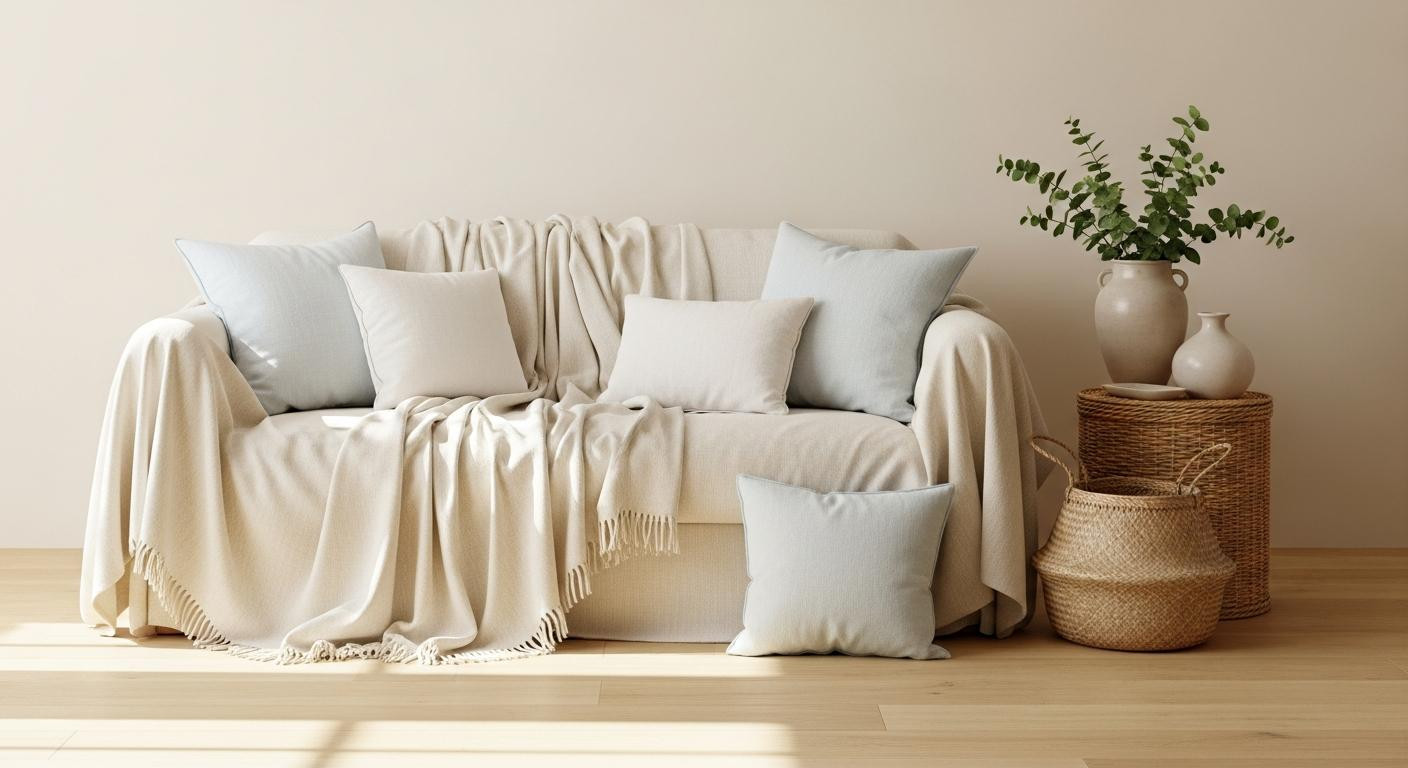
Your living room hits 72 degrees on the thermostat but feels eight degrees warmer where your forearm touches the velvet throw at 3pm on a Tuesday in May. The chunky knit pillows that looked cozy in January now trap body heat like wool blankets. Nothing broke, the furniture still works, but the room holds winter in its textures and your body registers the mismatch before your brain names the problem. Three changes fix the sensory lag without replacing a single piece of furniture.
Winter textures trap thermal energy spring rooms need to release
Dense pile fabrics absorb and hold heat through increased surface area and reduced air circulation. In February, velvet and chenille created cozy microclimates around seating. In May, when ambient temps rise but you haven’t swapped textiles, those same materials function like insulation in reverse, keeping warmth in instead of letting the room breathe.
A velvet throw pillow can measure 6 to 8 degrees warmer than a linen one in the same 72-degree room because of trapped air pockets in the pile. According to textile engineers who study thermal comfort, tightly woven fabrics with deep pile structure reduce evaporative cooling by up to 40 percent compared to flat-weave alternatives. The room doesn’t need cooling, it needs materials that stop fighting the season.
Dense weaves block airflow even when windows are open
Heavy curtains and layered throw blankets create physical barriers to cross-ventilation. A closed velvet drape can reduce air movement by 50 to 60 percent in a room with open windows. This isn’t about temperature on the thermostat, it’s about perceived stuffiness and stagnant air that makes 72 degrees feel like 78.
Dark colors absorb spring light instead of reflecting it
May sunlight carries different intensity than February sun, with longer days, higher angle, and more UV. Deep burgundy and charcoal textiles that felt grounding in winter now absorb that increased light energy and convert it to heat. A dark throw pillow in direct afternoon sun can measure 12 to 15 degrees hotter than a cream one, making the room feel darker and heavier because materials are literally eating the brightness.
The three-change formula that resets sensory temperature in 90 minutes
Change one: swap pile fabrics for flat weaves
Replace velvet, chenille, or cable-knit throws and pillows with linen, cotton sateen, or lightweight canvas. Target Threshold linen pillow covers run $16 each, IKEA VITMOSSA cotton throws cost $29, and H&M Home washed linen cushion covers sit at $12. Flat-weave textiles allow air to pass through fiber structure, creating cooling through evaporative surface area.
A linen throw pillow at 72 degrees ambient feels 5 to 7 degrees cooler to touch than velvet because moisture wicks and evaporates instead of being trapped. Lighter weaves reflect rather than absorb spring sun, making the room register as brighter without adding lamps. Rooms under 250 square feet need only two to three textile swaps to feel completely different. Budget math: three pillow covers plus one throw equals $77 to $90 total investment.
Change two: pull furniture 8 to 12 inches from walls
Move your sofa, chairs, and media console away from perimeter walls to create circulation channels. In rooms under 200 square feet, 8 inches works. Over 250 square feet, push to 12 inches. Winter arrangements tuck furniture tight to walls to create enclosed, protected seating areas. That same layout in May blocks airflow paths and traps heat along baseboards.
Moving pieces creates convection corridors that let warm air rise and circulate instead of pooling. And counterintuitively, pulling furniture inward makes small rooms feel larger because defined pathways replace pressed-against-wall tension. The 18-inch furniture pull interior designers use follows similar spatial logic. Time cost: 20 to 30 minutes for an average living room, zero dollar cost.
Change three: replace one heavy layer with three light ones
Remove the single chunky throw blanket or oversized floor pillow. Add three smaller elements: a lightweight cotton throw, a woven basket, a ceramic vase with stems. Winter styling relies on single-impact pieces, one big sculptural thing that reads cozy. Spring styling works through multiplicity and negative space, several small things with air between them.
A room with one 60-inch floor pillow feels 30 percent more crowded than the same room with three 18-inch accent pieces arranged with 10-inch gaps. The square footage is identical but the perceived density drops. West Elm woven baskets run $34, Target ceramic stem vases cost $18, IKEA cotton throws sit at $15. Total: $67 for three items that replace one $80 floor pillow.
Why this works when single swaps fail
Each change addresses a different sensory input: thermal touch, air movement, visual weight. Swapping just textiles leaves furniture blocking airflow. Moving furniture without changing fabrics still traps heat in materials. But the textile swap that dropped my living room 6 degrees only worked because it was paired with spatial changes.
The three changes function as a system. Flat-weave fabrics allow air to move, pulled furniture creates circulation paths, distributed accessories give that air somewhere to flow. Together they reset the room’s relationship to May conditions. Interior designers who specialize in seasonal staging confirm that layered interventions produce exponentially stronger results than isolated fixes.
Admittedly, this only works if your baseline furniture is functional. If your sofa sags or your curtain rod is broken, you need repairs first, not styling theory. But for rooms that are structurally sound and just feel off, the method attacks the seasonal mismatch from three angles simultaneously.
Your questions about the quick refresh method answered
Do I need to store winter textiles or can I rotate them back?
Yes, rotate them back in October when overnight temps drop below 55 degrees consistently. Store velvet and chunky knits in vacuum bags or plastic bins with cedar blocks. Budget-conscious version: keep one winter throw in the linen closet for unexpected cold snaps, store the rest. The seasonal swap is part of the system, textiles should work with ambient conditions, not fight them.
What if my room faces north and never gets direct sun?
North-facing rooms still benefit from furniture pull and lighter textiles, but you can keep slightly richer colors because you’re not fighting heat absorption. Soft charcoal instead of cream works fine. Focus changes two and three more heavily than change one. Why linen curtains work in west-facing rooms proves directional light matters, but air circulation fixes benefit all orientations.
Can this work in rentals where I can’t change wall color?
Absolutely, none of these three changes involve permanent alterations. The method was designed for renters. Textiles, furniture placement, and accessory swaps reverse in minutes. If anything, this works better in rentals because you’re working within existing constraints rather than fighting them. And the five-texture rule that stops flat rooms applies regardless of lease terms.
Your living room at 6:30pm when evening light slants across the new linen throw and you realize you haven’t thought about opening another window in three hours. The room holds 71 degrees but your shoulders dropped two inches when you sat down. The sofa is the same sofa, the air moves differently.