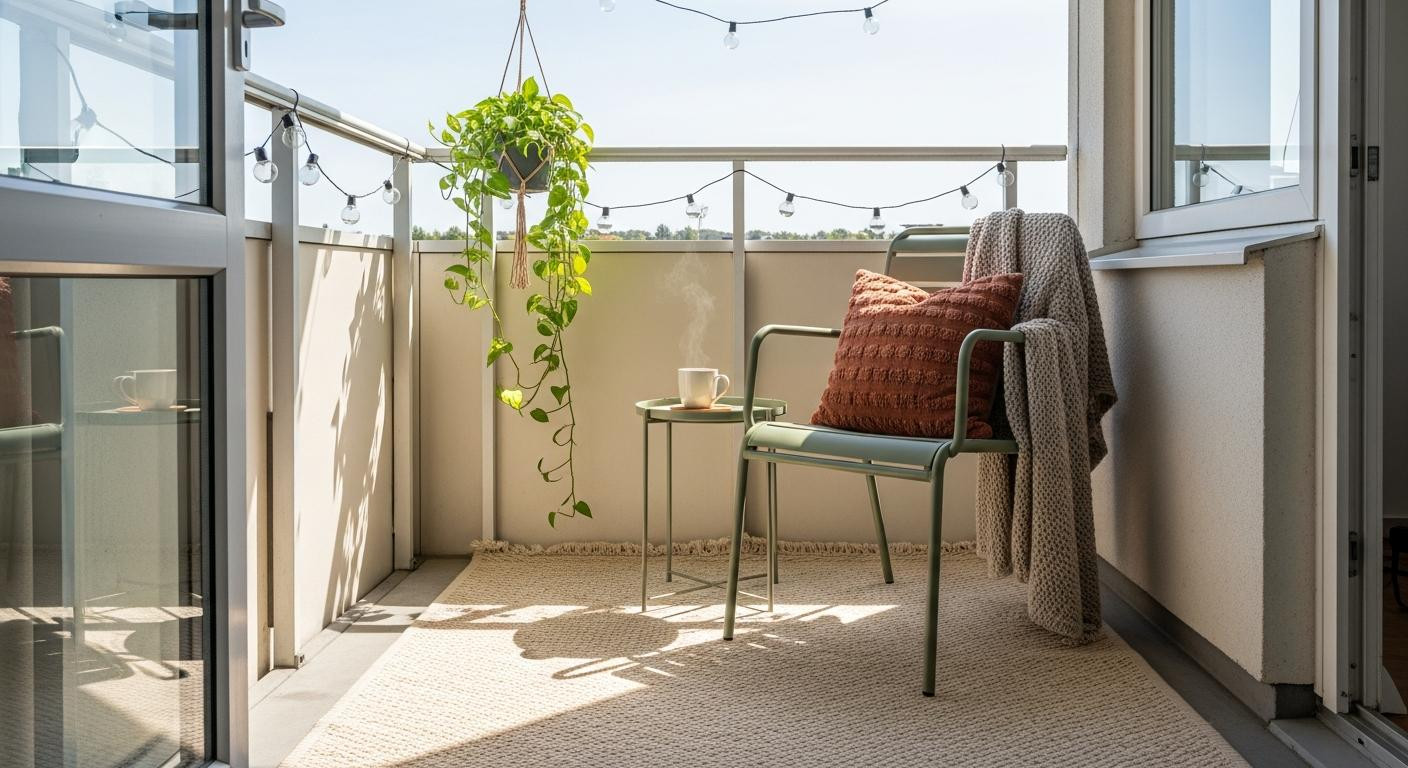
Your balcony at 8:47pm on a Tuesday holds a folding chair you haven’t sat in since October and three dying succulents you water when guilt strikes. The concrete slab measures roughly 6×8 feet, just large enough to make you feel worse about not using it. Renters who transform these spaces for $200 don’t buy different furniture. They divide their budget into five zones with specific percentages that compound visual impact instead of isolating it in a single bistro set that leaves $81 for everything else.
Your flooring decision eats 35% because it defines every other choice
Spend $70 on an outdoor rug first, not last. Design experts featured in Architectural Digest confirm that floor coverage creates the perceptual boundary between concrete slab and outdoor room, which makes undersized rugs the most common budget mistake renters make. A 5×7 foot rug on an 8×10 foot balcony makes the space feel more cramped, not less, because it highlights how much concrete remains visible around the edges.
IKEA’s synthetic outdoor rugs start at $19.99 for smaller balconies under 50 square feet. Wayfair’s polypropylene options in the 6×9 foot range cost $34.99 and handle the UV exposure that kills jute rugs within eighteen months. The texture underfoot when you step outside barefoot Sunday morning separates temporary from intentional, which justifies spending more than a third of your budget before you’ve added a single chair.
But this only works if you pick polypropylene over natural fibers. Polypropylene outdoor rugs resist four years of sun fading on exposed balconies, while jute needs covered porches to survive a full season without bleaching to gray.
Zone two takes 25% for seating that actually fits your floor plan
Allocate $50 to furniture, not $119. The cause-effect relationship matters here because overspending on a complete bistro set leaves insufficient budget for the lighting and textiles that make furniture feel placed rather than parked on concrete. Target’s folding bistro sets cost $89.99 for three pieces but consume 18 square feet when chairs are pulled out, which overwhelms balconies under 60 square feet.
A single Threshold chair at $40 plus a $25 side table uses 8 square feet and creates the asymmetrical visual interest professional organizers with certification prefer over matchy-matchy symmetry. And here’s where placement outweighs price. Pulling balcony chairs 24 inches from the railing makes the space feel like a room instead of a ledge, regardless of whether you spent $40 or $140 on seating.
This formula only works if you host one person at a time. Dinner parties need the bistro set, which means sacrificing your lighting budget entirely.
Lighting gets 20% because it extends usability past 6pm
Reserve $40 for string lights or solar lanterns. Renters who skip this zone use their balconies only during daylight hours from May through August, wasting 70% of potential outdoor time when temperatures actually make sitting outside comfortable. Amazon’s solar string lights with 20 LED bulbs cost $18.99 and deliver 8-hour runtime without requiring outlet access most renters lack.
But installation determines longevity more than price. The support wire trick stops string lights from sagging after three weeks of wind exposure, which prevents the droopy appearance that makes budget installations look cheap instead of intentional. The moment warm white light hits terracotta pots at 8:14pm, the balcony stops being the place you store bikes and becomes the place you’d rather eat dinner than inside.
Lighting designers with residential portfolios note that 2700K warm white bulbs create the cozy retreat aesthetic renters describe in transformation posts, while cooler 5000K daylight temperatures feel institutional against concrete and metal railings.
Solar lanterns work better than plug-in strands for balconies without outlets
Metal solar lanterns at $14.99 each provide 6-8 hours of ambient light after a full day of sun exposure. Two lanterns placed on opposite corners cost $29.98 total and eliminate the extension cord problem that prevents most renters from adding lighting at all.
Softness holds 15% because concrete needs texture to feel finished
Spend $30 on throw pillows and one blanket. Hard surfaces dominate small balconies in the form of metal chairs, concrete floors, and glass railings, creating visual and tactile coldness that contradicts the warm retreat you’re trying to build. Kohl’s pillow covers start at $12.58, and one $18 neutral throw blanket from Target softens seating without permanent modification.
Bring pillows inside before rain to prevent mildew. That’s a 30-second task that protects your investment instead of replacing moldy cushions every spring. And here’s the budget hack designers won’t tell you: $6.99 spray paint refreshes three worn planters, adding texture for under $7 instead of buying new ceramic pots at $15 each.
Corduroy pillow fabric against your back when you sit outside with coffee Sunday morning makes the $200 feel like $800. That sensory detail separates spaces you tolerate from spaces you actually choose.
The final 10% solves privacy with vertical green
Use your remaining $20 for hanging planters or railing boxes. ASID-certified interior designers confirm that vertical elements create privacy screens without rigid barriers that shrink perceived space, which matters more on balconies under 70 square feet where every visual trick counts. One $8 hanging planter with trailing pothos blocks sightlines within three months as vines grow past 18 inches.
The alternative costs $15 for faux trailing plants that provide instant coverage for renters who travel frequently and can’t commit to watering schedules. Green at eye level when you’re seated makes 50 square feet feel like a garden instead of a box overlooking the parking lot. Sheer curtains block 58% of light on narrow patios if you need more coverage than plants alone provide, but they consume budget better spent on foundational zones when you’re working with exactly $200.
Your questions about splitting a $200 balcony budget
Can I skip the rug and put that $70 toward nicer furniture?
Only if your balcony has wood decking instead of concrete. Concrete without a rug photographs and feels institutional regardless of furniture quality, because the rug defines the usable perimeter and makes the space feel designed rather than incidental. Spending $120 on a bistro set sitting on bare concrete delivers lower perceived value than a $50 set on a $70 rug.
What if I only have $150 instead of $200?
Cut 10% from each zone rather than eliminating one entirely. That’s $52.50 for flooring with a downsized rug, $37.50 for a single chair without a table, $30 for solar lanterns only, $22.50 for two pillows, and $7.50 for one hanging planter. The formula still compounds impact across zones instead of isolating your entire budget in furniture that sits on ugly concrete.
When should I spend more than 25% on furniture?
Only when your balcony measures under 40 square feet and you’re choosing a hammock as sole seating. Hammocks cost $50-130 and deliver higher comfort per dollar than bistro sets on tiny balconies, but they eliminate your ability to host others or set down drinks. The trade-off works for solo retreats, not social spaces.
Your balcony at 8:32pm on a Thursday in late May when the string lights glow against the cream rug, the single chair holds a terracotta pillow, and trailing pothos partially obscures the neighbor’s kitchen window. You spent $197.43 across five zones. The space finally feels like somewhere you’d choose to be.