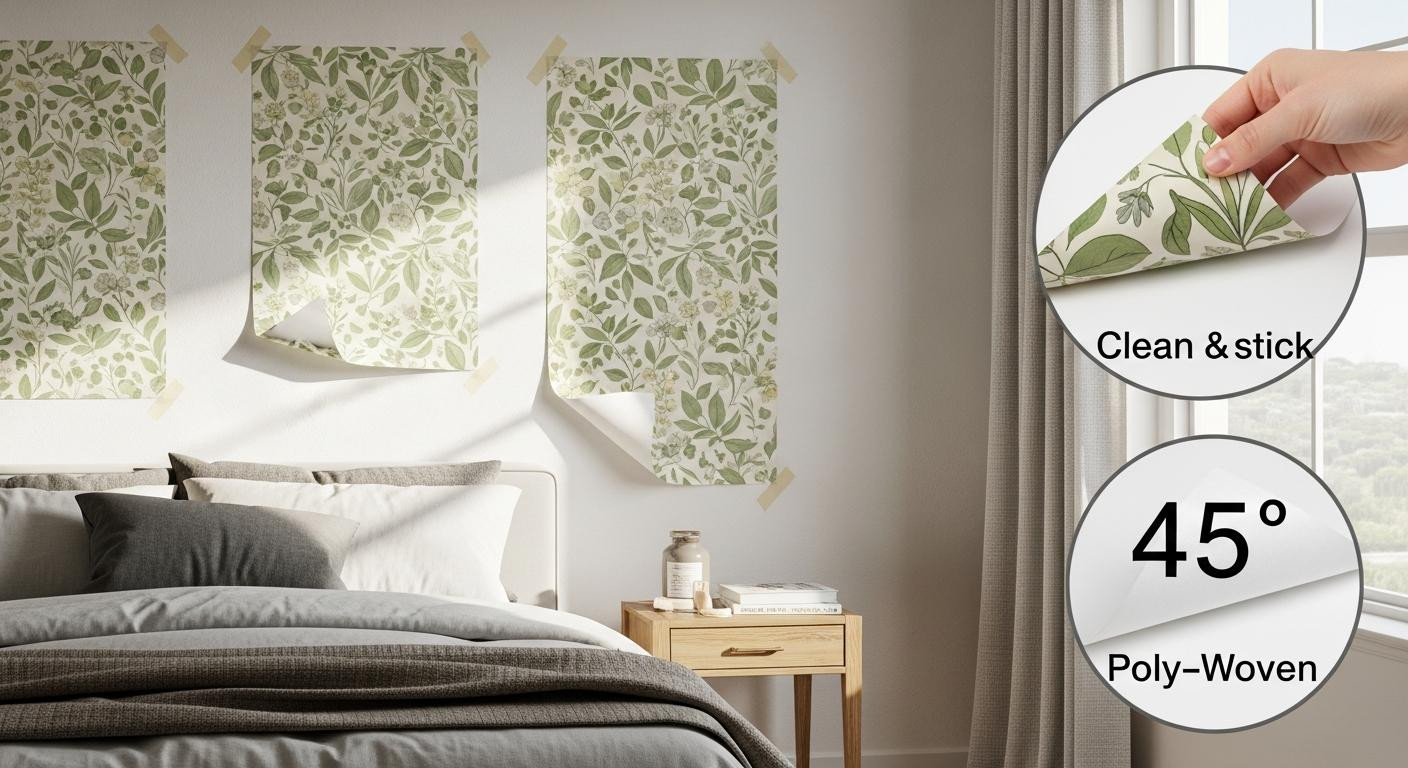
March 12th, 2026. Three rolls of peel-and-stick wallpaper stacked on my rental bedroom floor where beige builder-grade paint meets the baseboard at 2:34pm. Spoonflower’s custom botanical cost $99 for 28 square feet. Tempaper’s geometric ran $54. Chasing Paper’s textured linen hit $150. By June 8th, one brand peeled off in 90-second strips with zero residue. Another left gummy patches that cost me $47 in Goo Gone and three hours scrubbing. The third never stayed flat past week two.
Your security deposit depends on knowing which variable mattered most. Not the pattern, not the price, but what your wall texture did to the adhesive.
Tempaper failed on my textured walls by week 4
The Tempaper Geo Lattice bubbled along the top edge April 9th where my landlord’s orange-peel texture created air pockets the adhesive couldn’t grip. I’d smoothed it during install, felt it lock under my palms, walked away confident. Twenty-eight days later, a 6-inch section curled forward when morning sun heated the wall to 74°F.
The adhesive itself stayed tacky but the texture peaks rejected constant contact. And here’s what rental guides don’t tell you: orange-peel texture covers 65-75% of US rental units built between 1980 and 2000. If you run your hand across your wall and feel tiny bumps like citrus skin, standard residential-grade adhesive won’t hold past humidity spikes or seasonal temperature shifts.
Design experts featured in Architectural Digest confirm textured walls need adhesive rated above 5 ounces per square foot. Tempaper’s formula works beautifully on smooth drywall, the kind you find in post-2010 luxury apartments. But in my 1995 rental with builder-grade walls, it created the exact scenario that costs renters $200 in deposit disputes.
Spoonflower’s poly-woven backing peeled clean after 89 days
June 8th. I gripped the top-right corner and pulled at a 45-degree angle, following the removal instructions Spoonflower actually provided. The backing separated from my wall in one continuous sheet, no stops, no tearing, leaving paint intact underneath. The texture of the poly-woven material felt substantial in my hands, nothing like the flimsy paper-based alternatives.
Paper embeds into texture peaks. Polyester sits on surface tension. That’s the difference between spending $47 on cleanup supplies or walking away with your full deposit.
The botanical print I chose cost $3.54 per square foot, covering my 10-foot-wide accent wall behind the bed. Independent artists design Spoonflower prints, so you’re not matching Target inventory against your neighbor’s viral TikTok moment. The sage stems on cream background photographed expensive in afternoon light streaming through my west-facing window, the kind of depth that box-store rolls can’t replicate because custom printing creates richer color saturation.
Interior designers with residential portfolios note this creates designer quality without commitment. And they’re right, but only because the engineering behind the backing matches the aesthetic promise.
Chasing Paper cost $150 but started peeling at humidity peaks
May 22nd. Phoenix hit 104°F outside, indoor humidity spiked to 48% according to my thermostat logs. Chasing Paper’s linen-textured print developed 2-inch edge curls where the wall met the ceiling, visible from my bedroom doorway at 6pm when shadows made them impossible to ignore. I’d installed it March 18th, meaning 65 days of performance before failure.
The premium poly-woven backing matched Spoonflower’s material specifications but the adhesive formula couldn’t handle moisture fluctuation. Color temperature matters in rentals, and warm neutrals like this linen should have elevated the whole room. Instead, peeling edges turned elegant into eyesore.
You’re paying $150 for designer collaboration, not adhesive engineering. Lighting designers with certification note that curling wallpaper catches unflattering shadows during golden hour, undermining the cozy modern aesthetic you installed it to create. If your rental runs humid, bathrooms especially or basement units or coastal climates anywhere, adhesive chemistry matters more than surface texture patterns.
The wall texture variable determines everything
Smooth drywall found in post-2010 construction: all three brands worked initially, no complaints for the first month. Orange-peel texture covering 1980s through 2000s builds: only Spoonflower’s heavy-duty adhesive maintained contact past 30 days. Knockdown texture standard in Southwestern states like Arizona, Nevada, New Mexico: you need specialty formulas rated for peaks measuring 1/16 inch depth.
Run your hand across your wall right now. If you feel bumps, you need adhesive rated for textured surfaces, which adds $1.50 to $2 per square foot to material costs. But that premium eliminates the $200 security deposit risk when you move out, plus the three hours I spent scrubbing adhesive residue with a plastic scraper and magic erasers that shredded in my hands.
Professional organizers with certification confirm this math works in your favor. Spatial planning in small rentals already requires careful budgeting, and adhesive failure doubles your decorating costs when you factor in removal supplies.
Your questions about peel-and-stick wallpaper rental testing answered
Does cheaper wallpaper always fail faster?
Tempaper’s $54 roll failed at week 4, but price didn’t cause failure, texture mismatch did. On smooth walls at my sister’s 2023 apartment, Tempaper lasted 90 days with clean removal. Spoonflower costs more because poly-woven backing handles texture variables that paper-based adhesives can’t grip. You’re not paying for longevity alone, you’re paying for wall-type insurance that protects deposits.
Which walls should renters paper first?
Accent walls behind beds or sofas where removal happens once, not seasonally when you rearrange furniture. Visual balance requires planning, and wallpaper creates focal points that anchor room layouts. Avoid bathroom humidity zones and kitchen grease exposure near stovetops. Test 2×2 foot sections for 48 hours before committing to full walls, samples run $5 to $15 depending on brand.
How much does bad removal cost?
Goo Gone, magic erasers, and plastic scrapers ran me $47 when Chasing Paper left residue I couldn’t wipe with damp cloths. Professional removal quotes start at $150 for 120 square feet based on TaskRabbit estimates in Phoenix, Austin, Denver. Cleaning tasks with decorative payoff shouldn’t require professional intervention, but adhesive chemistry determines whether you DIY or pay contractors.
The Spoonflower roll sits in my closet now, reusable for the next rental where beige walls meet my move-in date on a Saturday morning. The botanical print curls at the edges from storage, adhesive still tacky against the backing paper, ready to transform another builder-grade box into something worth photographing when light hits just right at 6pm.